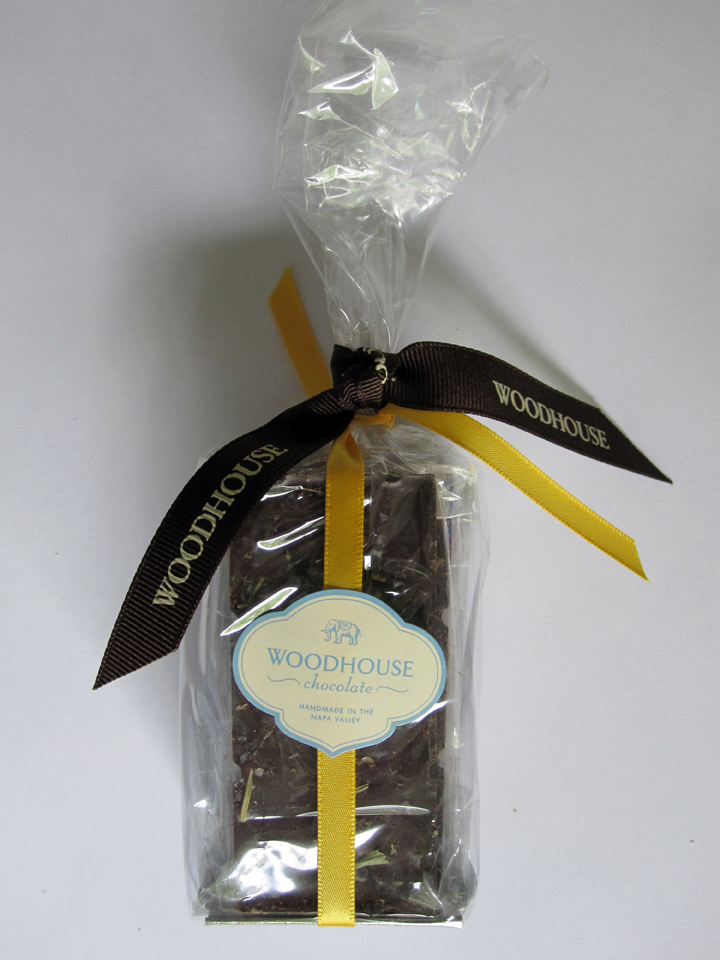
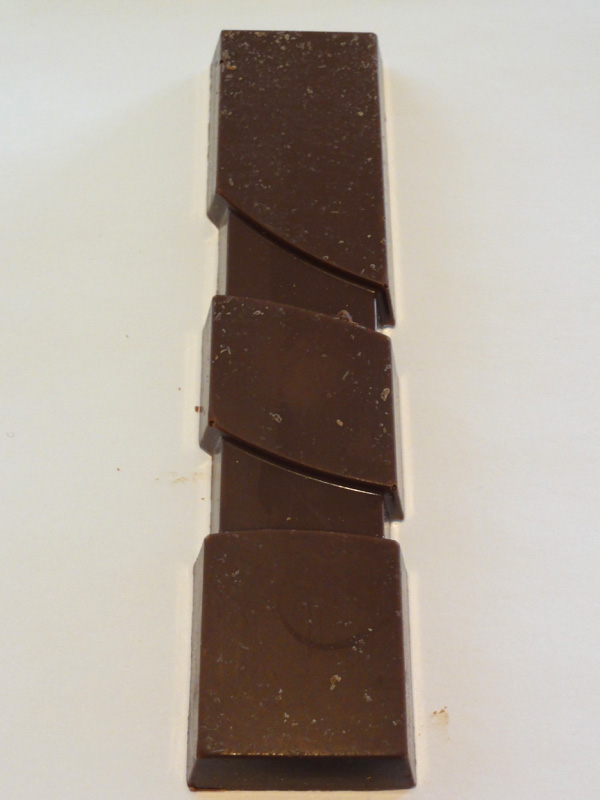
Next up from Woodhouse Chocolate are their Salty Savory Bars, a package of five small bars of chocolate which they say have been created from a culinary approach rather than a confectionary one. Or, to put it another way, each bar has some salt and some other herbs or spices added. All the bars are dark – I’d guess about 60% cocoa solids, but definitely nothing higher – and they aren’t very big either. That makes them the ideal size for sampling something new because there really isn’t enough of anything to really cause offence. Or so I thought.

Running through the five bars, we have:
Smoked Paprika with Saffron Salt – the delicate flavour saffron salt could easily be overwhelmed, but instead there is just the slightest hint of smokiness which gives it enough space to breathe. Very subtle, well-balanced, and a really interesting flavour combination.
Chinese 5-Spice & Sesame with Sea Salt – a little light on the 5-Spice, or maybe it just never stood a chance against the sesame seeds sprinkled on the back of the bar. That said, the mixture of sea salt and sesame seed is still rather tasty.

Four Pepper & Lemon with Sea Salt – probably the most successful bar in the pack. The pepper starts off slow but builds at a healthy rate as the chocolate melts, all with some sharp citrus lurking in the background. This one almost made me sneeze by the end, but if you are going to put pepper in chocolate, you shouldn’t be half-hearted.
Herbs de Provence with Fleur de Sel – this one just doesn’t work for me at all. There are too many different flavours competing and in the end, nobody wins. Everything clashes and the mix of all those herbs with chocolates just doesn’t taste right. Definitely my least favourite of the bunch.
Chile & Cumin with Pink Salt – this one had a very strong chilli aroma, yet that isn’t really reflected in the taste. There was a smouldering heat which was replaced by a rush of cumin right at the very end as the chocolate disappeared. Not as hot as I was expecting, but to be honest, I’m glad.
So a bit of a mixed bag, but Woodhouse should be applauded for trying out some more unusual combinations even if they don’t always work out. And only one – the Herbs de Provence bar – is something that I’d never want to try again. Definitely an interesting collection suitable for the more experimental chocolate lover.
Information
- Buy it online from:
- Contains dark chocolate.
- Filed under 5-spice, chilli, cumin, fleur de sel, lemon, paprika, pepper, saffron, salt, sesame, us, woodhouse.

I’m something of a fan of wafers, I must admit. My favorites are the cheaper than cheap bright pink strawberry wafers from dollar stores and Loacker’s irresistible squares of Quadratini Wafers. KitKats aren’t bad, either, though my interest in them has gone down a bit after tasting foreign-imported ones instead of the inferior Hershey’s kind we have here in the U.S.
Now, if I take wafers as a sort of guilty pleasure, the combination of them with the Reese’s formula makes sense, as Reese’s Cups have also been known as such on Chocablog. In theory, such a thing as these Reese’s Sticks would be able to combine the addicting texture of wafers with the Reese’s taste. Yet I don’t find myself drawn in by the actual product.
The recipe consists of three layers of wafer with two of peanut butter, all dipped in Hershey’s Milk Chocolate. It seems more buttery than either a Reese’s Cup of KitKat, though you would think that the added texture would only keep the flavors grounded. What I realize as I eat these is that the texture of Reese’s Cups means much: greasy and crumbly, at once, it offers something the sticks do not.

They’re also most indelicate sticks, being thicker than KitKats. That brings more to light the poor wafer quality. Having said that I love dollar store wafers, I obviously don’t care much if the wafers themselves are poor, so long as they’re put together in a way that works. The well-made Quadratini Wafers are, I believe, four or five layers of very thin wafers, which creates the most perfectly addicting texture. Not at all the case here, where the wafers are thick and bland with little else to make up for the fact.
Further, the chocolate is a small percentage of the whole, and being Hershey’s, it only adds to the buttery and sweet taste. The saltiness of the peanut butter is there, but it comes in too late to help. It just isn’t the same when it’s coming nearly as an aftertaste.
I don’t have the love for this combination I can sometimes claim for Reese’s Cups. What works there doesn’t here.

This bar is (and I’m afraid remains) something of a mystery item. Why? Well there’s a clue on the front of the box, just before the weight of the bar. Yep, this is a single origin 55% cocoa solids milk chocolate bar made from beans from Papua New Guinea. In Korea.
Here at Chocablog we’ve tasted a fair old selection of Oriental chocolates, and I think it’s fair to say that the majority of our reviews haven’t really been glowing. Of course there are exceptions, but they have tended to be ‘exclusive’ products (like the Awaji Orange sticks I was given) rather than the mass produced confectionery we usually find. We’ve had even more limited experience of Korean chocolate, and the verdicts haven’t been great.

Well I bring good news. I slit open the foil wrapper inside the box, slid out the (very unusually shaped) bar, and was immediately greeted by the waft of rich milk chocolate. Up close and personal and that rich milk chocolate smell is deeper still, hinting at a creamy sweetness and depth of flavour that comes to life as it melts on the tongue. Yes, it’s still quite sweet, but the volume and quality of the cacao used means that there’s plenty of deep, earthy cacao notes sitting alongside the milk and sugar.
I’ve become quite a fan of the higher cacao content milk chocolate bars, ever since my Hotel Chocolat St Lucia experience, and this bar made a similar impression. My only complaint would be that the thing isn’t big enough!
Unfortunately there isn’t an English version of the Cocomolli website and I don’t have a handy Korean friend around, so I can’t even tell you if these bars are available in the UK. Maybe Mr Cocomolli will enlighten us in due course.

Another day, another trip to my favourite butcher shop, and more Polish chocolate to accompany my purchase of chicken wings. Since discovering this shop, I’ve come to the conclusion that about 50% of the commercial chocolate of the whole world must be made in Poland. Is there a national sweet tooth or something?
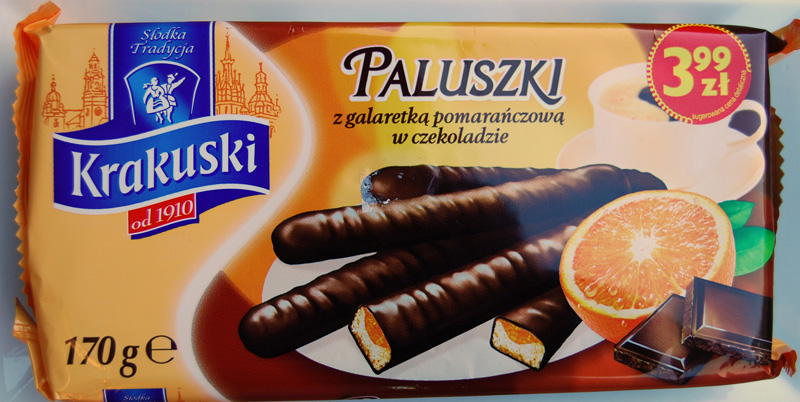
Anyhow the Paluszki claims to be “z galaretka pomarańczową w czekoladzie”, which Mr Google tells me means “with orange jelly in chocolate”. I also sort of figured that out from the picture.
As far as I can tell from the label and a quick web search, the maker is a well established Polish cake business, now owned by the German Bahlsen group – which seems to have brands and factories throughout Europe, and claims to be the largest family-run biscuit enterprise in the world.

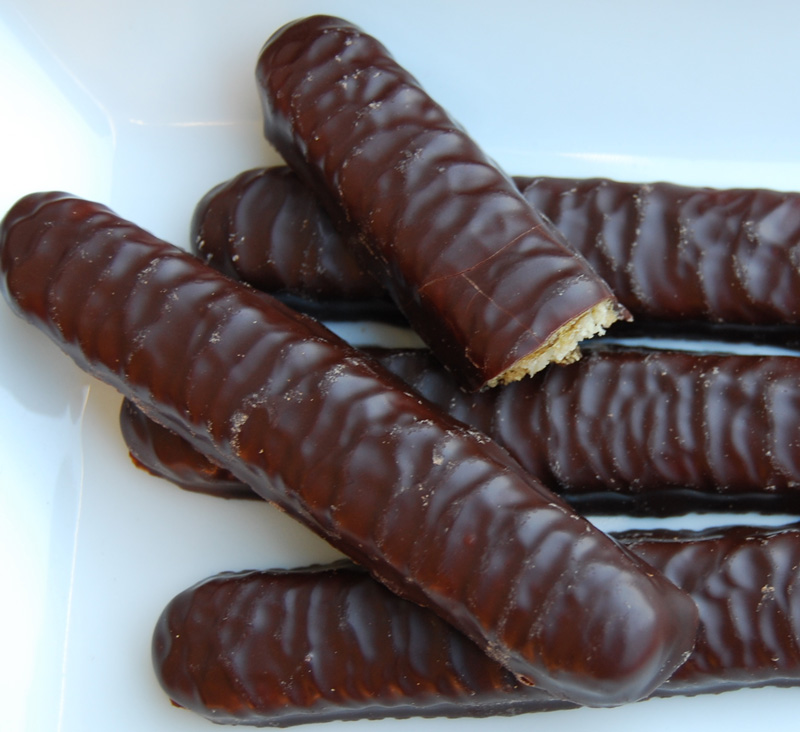
As often seems to be the way, the picture is far more flattering to the product than reality. The orange jelly is pretty thin, fairly pale, and does not have a very orangey taste. The ingredients list tells me that there is 2.7% condensed orange juice in, perhaps it needs a bit more. The biscuit is more like a cake, soft rather than crunchy. And the chocolate is… well… thin, and nothing very special.
So, this seems to be a variation on the Jaffa Cake, in yet another of its incarnations.
My feeling about this: meh. It’s nothing special. Its not bad, but neither is it good. Oldest son found the open pack sitting on the kitchen table and just walked by munching on a handful. His view: “These are OK but a bit wussie”. I think that about sums it up, really.