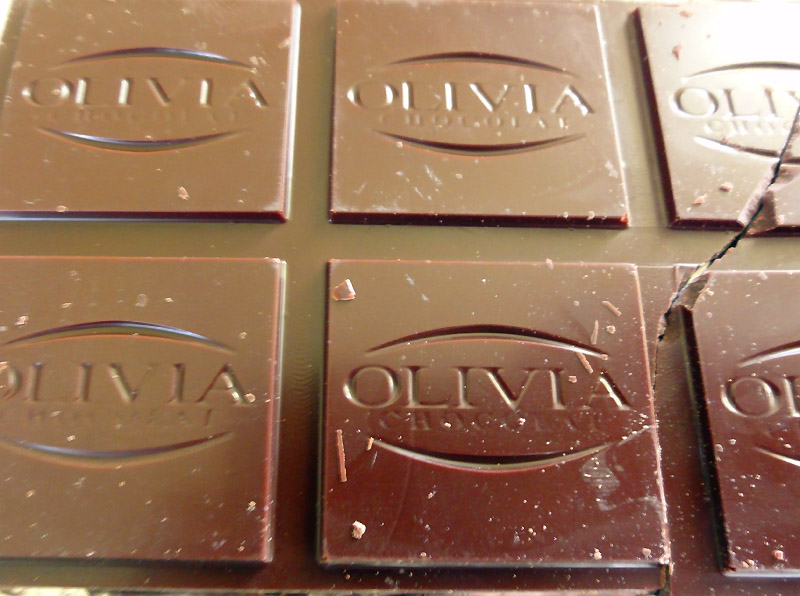
I’d like to introduce you to Olivia. She’s quite slender (2x 50g tablets of dark chocolate) but don’t let that fool you – Olivia packs a punch. She’s Canadian – a first for me – and has excellent organic credentials
This version uses raw, organic Criollo and Trinitario (another version uses the same beans but roasted) and promises a ‘uniquely rich and softer flavour’. The chocolate smells fantastic – rich, deep cacao with winey overtones. On the palate it melts quickly, delivering mild acidity and exceptional smoothness. The first wave of flavours are quite intense (mainly due to the high cacao content) but it very quickly settles down into a smooth, flowing richness with those wine and fruit notes mellowing out as the cacao flavours spread.
The organic cane sugar is apparent, adding a rich sweet undertone which compliments the chocolate well. The mouthfeel is silky smooth and the finish clean and long, making this thoroughly enjoyable. It may be a bit on the ‘dark side’ for some (that initial hit can be quite surprising) but once the chocolate starts to melt it calms down quite quickly. The manufacturers notes recommend trying it with Port or red wine. I’d add ‘and possibly a dessert wine’ – those winey notes might well blend well with a rich, sweet white.

One thing I will say about this chocolate is that it doesn’t have any remarkable flavours. The combination of Trinitario and Criollo beans is a fairly tried and tested combination, and as such there aren’t any dramatic highs or standout flavours. It’s very good quality organic chocolate made with raw beans and organic sugar, gluten free & with all the right credentials, but it’s not outstanding, just very good.
If you’re a fan of deep, dark chocolate I’d definitely give this one a go. If you’re looking for something extraordinary, then there are other (more expensive) bars out there for that. I’ve not been able to find a UK stockist, but you can order Olivia chocolate from their website and they will ship worldwide.

I enjoy meandering through candy shops painted with old-fashioned style or a spritz of vintage feel. It is both the atmospheric quality of shops like these and the chance to try some out-of-the-ordinary candies that I revel in. Whilst visiting the Old Town district of San Diego, California, I was charmed by the historical environment, in whose shops I could purchase such not-so-touristy items as a pair of handmade black lace gloves. Passing by the candy shop on the first evening but being unable to step inside, I made certain to return the next day.
After witnessing adherence to period style elsewhere in the area, I was a bit disappointed as I began browsing typical collections of rock candy and handmade taffy, interspersed with licorice and lollipops. I’ve seen more interesting shops, ones that tempt your mind back in time better. Yet I could hardly leave with nothing, selecting as my victim a plain silver-wrapped bar of chocolate by the name of U-No. It fits the basic requirement: I definitely don’t see it on a daily basis. And while U-No perhaps does not take you back in time, it does feel like a bar with a vintage background.

The company that now owns U-No, Annabelle Candy, is based out of Hayward, California – the history of the bar itself is supposed to go back to the twenties. Its description is “a smooth, rich chocolate truffle-like center with crushed almonds, covered by creamy rich milk chocolate, guaranteed to melt in your mouth.” Fluffy is the word I would use to describe the nougat/mousse center. Much fluffier than what you get inside a 3 Musketeers, it is also filled with more essence of chocolate, which does make it truthfully melt in your mouth instead of simply dissipating because of all the airy texture. What I most want to compare U-No to is a Hostess product, perhaps the tube-shaped rolls of cake and cream known as Ho Hos. The words “rich” and “creamy” do apply here, though strictly adhering to their confectionary connotations.
The suggestion to put the bar in the freezer I tried and was not impressed by. To me, the distinctive texture is what makes this bar and freezing it just gives it an awkward feel. (Carrying it in the car across the state border and then storing it in an eighty-degree room probably did nothing for it, either, but let’s just disregard that fact.) The gist of the matter: U-No is a fun bar and maybe even a tad better than some of the more widely available ones.

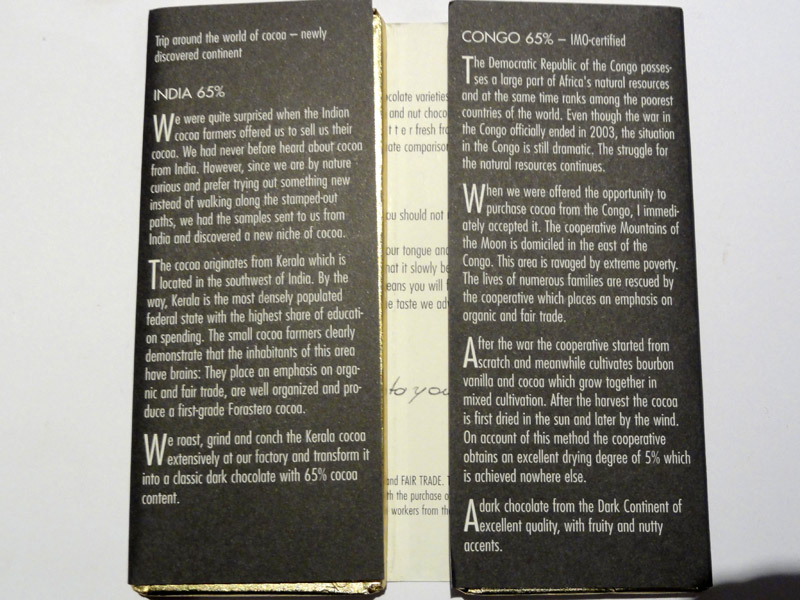
Another one of Josef Zotter’s ‘compare and contrast’ Labooko pairings, this brace of 35g bars is the first I have seen where both chocolates have identical cocoa content. Zotter have taken cacao from two co-operatives on different continents and made a pair of 65% dark chocolate bars – one from Kerala in India and one from the Mountains of The Moon Co-Op in the D.R. Congo (which is IMO certified, as well as being organic of course).

I was particularly interested in the Indian bar – the cacao comes from Kerala, and when I was over there last year I had quite a hard time finding any decent chocolate. I was looking forward to seeing what Zotter could do with Indian beans. Keralan cacao farmers are well organised, and the state spends more on education than any other. The farmers also put emphasis on producing an organic and Fairtrade Forastero cacao.

The Congolese co-op has been instrumental in changing the lives of numerous families in a war-torn, poverty stricken part of Africa which is still trying to recover from a war that ended eight years ago.
To look at them you’d be hard pressed to tell these two bars apart. Both are identically moulded of course, but they’re also the same shade of deep red-brown. On the palate it’s a different story .
The Indian bar has higher acidity and a lighter mouthfeel. The added salt (a feature of both bars) makes itself known fairly early on, mingling with the light cacao flavours. The overall taste is light, slightly woody, with fruity overtones. The finish is clean, with the fruity high notes lingering on the palate long after the chocolate has melted away.

The Congolese bar has greater depth of flavour, with less acidity and a more pronounced plummy, fruity flavour. It’s bigger, bolder and ‘fatter’ in the mouth with the salt still present but less pronounced. At the finish some of the bolder notes taper off to leave a clean, high, finishing flavour with those red berry/fruit notes persisting to the last.
Like most of Zotter’s products, this pairing offers the consumer an opportunity to sample top quality chocolate made from beans produced in two very different parts of the world. Having visited Kerala and only found one place selling anything like half decent chocolate, I have to say I think this is an excellent idea. It takes skill to produce good quality cacao, and different skills required to turn that cacao into good quality chocolate, and Zotter certainly have the know-how required to do that.

I found this block at the usual place for imported Polish chocolate, yes, the butcher shop you are all sick of hearing about. There was no special reason to choose this, apart from it was there, and I kinda liked the picture of the tree.
In doing a very quick bit of research, I thought I should check the web site for Terravita.
It’s a flash site, and it’s all in Polish – which is shame because it’s so strange and quirky that I’d love to see it in English as well. Even though I have no idea what’s being said, the graphics, crazy Heath-Robinson / Rube Goldberg cartoons and animations has had me hooked, and watching to see what some crazy machine or mouse will do next. It’s all very clever… so what will the chocolate be like?
First impression: this has the largest “Nutrition Facts” panel that I think I have ever seen on any food product, ever. So I’m thrilled to find that the 77% chocolate contains 4 servings of 40g each, and of that, 16g is fat and 17g is dietary fibre! Hey – dietary fibre is supposed to be good for you, and this has more of it than fat. The excuse I’ve been looking for is here – each chocolate, it keeps you regular!
In terms of flavour, this is what I call “closed” – it takes quite a while to develop, and is quite subtle to build up. If you compare it to say a Lindt 70%, the difference is quite noticeable. The Lindt melts quite quickly, the flavour builds quickly, and you get a nice big hit quickly. The Cocoacara, by comparison, is slow to develop the flavour; it melts slowly, and the flavour is not as strong. There are hints there probably of vanilla, and the very slight bitterness to be expected of a high cocoa chocolate
This is a curious one. I don’t dislike it, but nor do I especially like it; it’s sort of a bit challenging and if I were to offer it around the colleagues and fellow chocolate fiends I suspect some of them would reject it. By the time I’ve tried the third piece it seems to be growing on me, but I’m still not really sure what to make of it.
Competently made: yes. Exciting: not so sure.