One of the many benefits of working for Cocoa Runners is that our suppliers sometimes send us interesting samples along with our order shipments. As Cocoa Runners only deal with bars, I usually get to take things like this home for myself.
It’s a tough job.
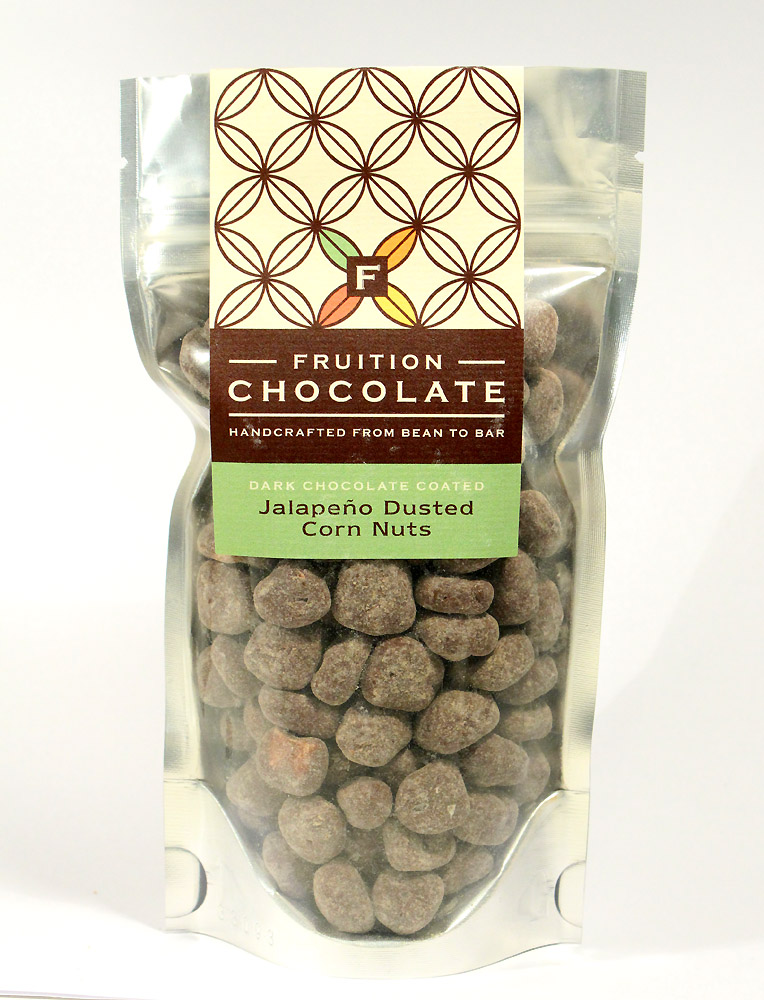
For those not aware, Fruition Chocolate are an American bean-to-bar chocolate maker, based in the Catskill Mountains of New York State, near Woodstock – home of the famous music festival.
Bryan Graham and his team make some of my all time favourite bars (their 56% Dark Milk with Fleur De Sel is to die for), but they also produce a range of confectionery products with their chocolate.

These wonderful creations are made from corn nuts – roasted corn kernels – that are salted and dusted with jalapeño chilli powder before being coated in chocolate.
They may not look like much, but they are one of the most addictive chocolate snacks I’ve ever tasted. The corn nuts are small and intensely crunchy, with the flavour popcorn. There’s a hint of salt and a gentle heat to them that builds as you munch on them. But they are never too hot and never too salty and work fantastically well with the 66% dark chocolate that they’re rolled in.
The balance of flavour, texture and heat works perfectly and results in a snack that’s almost impossible to put down. It’s a simple snack made with quality ingredients – including some of the best chocolate in the world.
Fruition do sell online, but currently only ship to the US. But if Cocoa Runners ever expand beyond bars, you can bet this will be one of the first products our list. In the mean time, these are worth visiting upstate New York for!

I’m sure you’ve all noticed that Easter is soon upon us, and as you’re reading this I’m guessing you’re keen to know what sort of thing the good people at Hotel Chocolat have on offer in 2014.
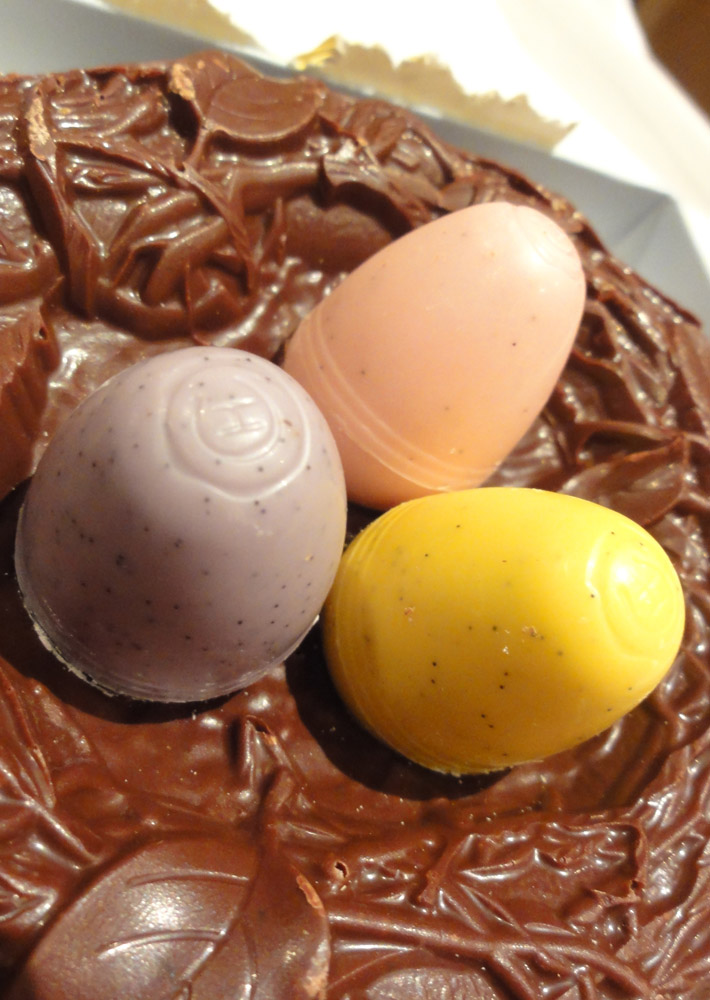
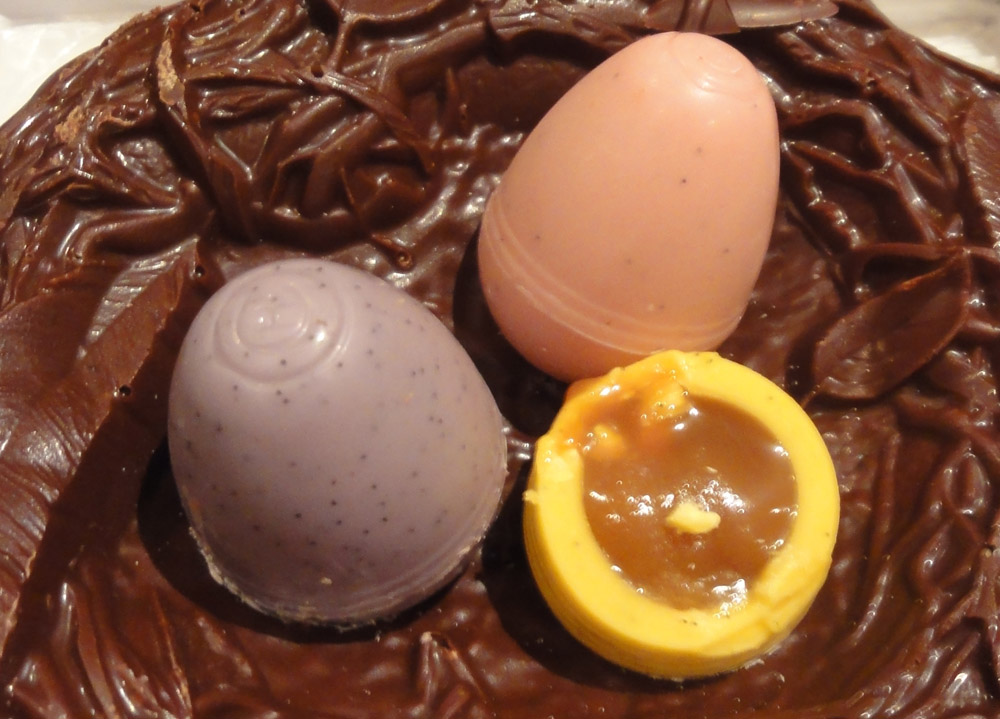
First up from my small selection of goodies is this 50% cacao milk chocolate nest with three of Hotel Chocolat’s distinctive egglets sat in the middle. Thankfully they aren’t glued in there – I had visions of wearing rather than tasting the caramel egglet!

Each of these egglets is made from 36% cacao white chocolate, and each has a different centre. There’s Caramel (yellow), Praline (blue) and Raspberry Ganache (pink), quite grown up flavours for something that has such a lighthearted look about it. The caramel is soft, unctuous and rich and the praline is a delight, and while the sweet tartness of the raspberry ganache was my least favourite, that really was a matter of personal taste.
The nest is another matter entirely. I have handled novelty ashtrays that are less solid than this little beast. It’s impossible to get into it without the aid of implements, such is it’s thickness. I ended up having at it with a very sharp knife, and it was well worth the effort.

It was a Hotel Chocolat 50% cacao milk chocolate that really changed my mind about high cacao milk chocolate, and even an ardent dark chocolate fan like myself had very little problem tucking into a second chunk.

I found myself liking the way this was put together as well. The packaging and content work well together and I almost found it nostalgic. Whichever way you look at it, it’s a well presented, well made Easter novelty from an accessible, quality chocolatier, and one I would recommend (but be aware that sharing it might be difficult – best buy one each).

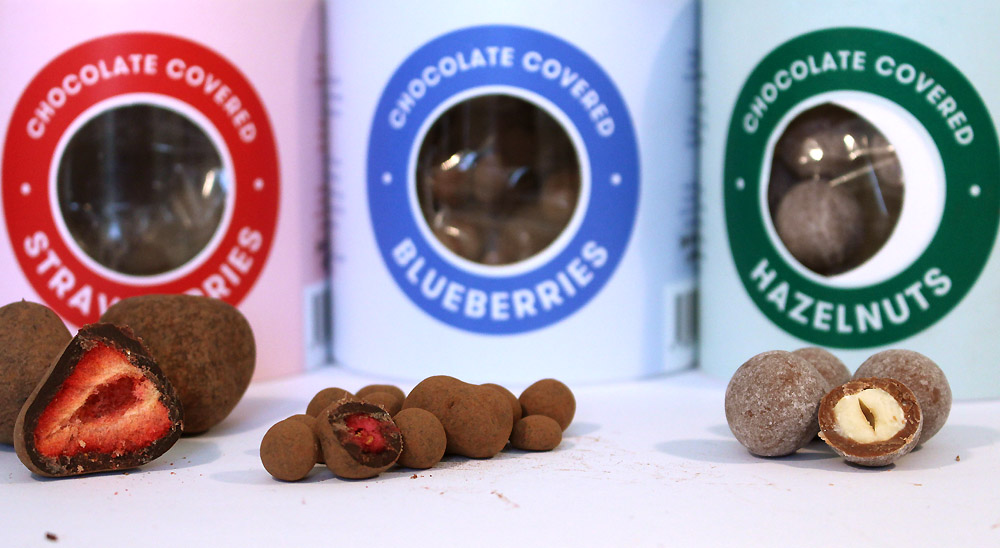
Naive Chocolate are a bean-to-bar chocolate maker based in Lithuania. We fell in love with them when we first tried their chocolate a couple of years ago, so I was incredibly excited when they offered to send these three tubs of chocolate covered fruit & nuts.
There are three varieties; blueberry, strawberry and hazelnut. The fruit varieties are both made with whole, freeze dried fruit covered in dark chocolate. The hazelnuts are caramelised whole before being covered in chocolate.
They are all absolutely amazing. I literally can’t get enough of them.
Let’s start with the blueberries. They’re small, intensely fruity, crunchy and moreish. Being small, you can’t just eat one at a time, but I found myself taking more and more with each mouthful. They’re packed with flavour and a delicious crunch.

The chocolate is listed as dark Madagascan and “41%”, but I think that might be 41% of the total weight, but that’s not entirely clear. I can say that it is perfectly matched to the fruit & nuts in all three of these products, being neither too rich or too sweet.
The strawberries are a bit mad. Whole, full-sized freeze dried strawberries. They have the same crunch as the blueberries, but obviously they’re a lot bigger, so not quite as easy to eat. They’re still delicious and still packed full of fruit flavour though.
And then there’s the hazelnuts. I’m not a big fan of hazelnuts, but these are just amazing. The nuts have been caramelised before being coated in chocolate, so they have a similar delicious crunch to the fruits. The caramelisation has given them the perfect level of sweetness to balance the chocolate, and the result is something that’s nigh on impossible to stop eating.
I love all three of these. They’re simple, yet perfectly formed. Naive’s online store seems to be offline at the moment, but if you drop them an email and tell them how desperately you need them, then maybe you’ll get lucky and they might sell you some…

Chocolatier Paul A Young is well known for his challenging and exotic creations, but could his first bean-to-bar chocolate, made from whole unwinnowed cocoa beans, change the way we make chocolate?
Paul A Young has become one of the UK’s best known chocolatiers by changing the way we think about flavours. From his famous Marmite Ganache, to his popular Port & Stilton truffle and Cigar Leaf Caramel, there’s nothing run of the mill about his chocolates.
Whether or not one of his more unusual creations works for you has always been a very individual thing. Like the Marmite in his truffles, some of his creations elicit an unashamed “love or hate” reaction. The thing they have in common is that they force you to change your perception of how chocolates should be made.
Now for the first time, Paul has moved beyond simply making truffles and bonbons from couverture and graduated to making chocolate from the bean. But his approach to chocolate making is likely to get people talking more than ever.
It’s a project that has been in development for over a year. But it was during one of his early experiments with his team that he hit on an idea that it seemed would not only save time and labour during the chocolate making process, but would also reduce wastage and potentially enhance the flavour of the chocolate.

Whole Bean Chocolate
The key was in the winnowing. The time consuming process of removing the paper-like shells from roasted cocoa beans. Most chocolate makers have machines the do this automatically, but doing it by hand in their early bean-to-bar experiments, the team started to wonder why they were doing it at all. After all, they knew the shells had flavour, as they’re often used to make “cocoa tea” infusions. So why not just leave them on?
The team made a batch roasted beans with their shells still on and were surprised and delighted with the results.
The Whole Bean Chocolate Making Process
Making chocolate from whole beans is not just simpler than using shelled beans, but it also reduces waste. Cocoa shells may be light, but when you start making chocolate in bulk, they represent a significant percentage of the bean that simply gets thrown away. By keeping the shells on, more of the bean is used and waste is reduced. “We use around 38kg of a 40kg bag of cocoa beans” he tells me.
With the shells on though, there is always the risk that contaminants could get into the chocolate, so the team are strict about quality control, examining every bean before it goes into the chocolate. This process also helps them remove any smaller, mis-shaped or damaged beans that might react differently to the roasting process.

The Beans
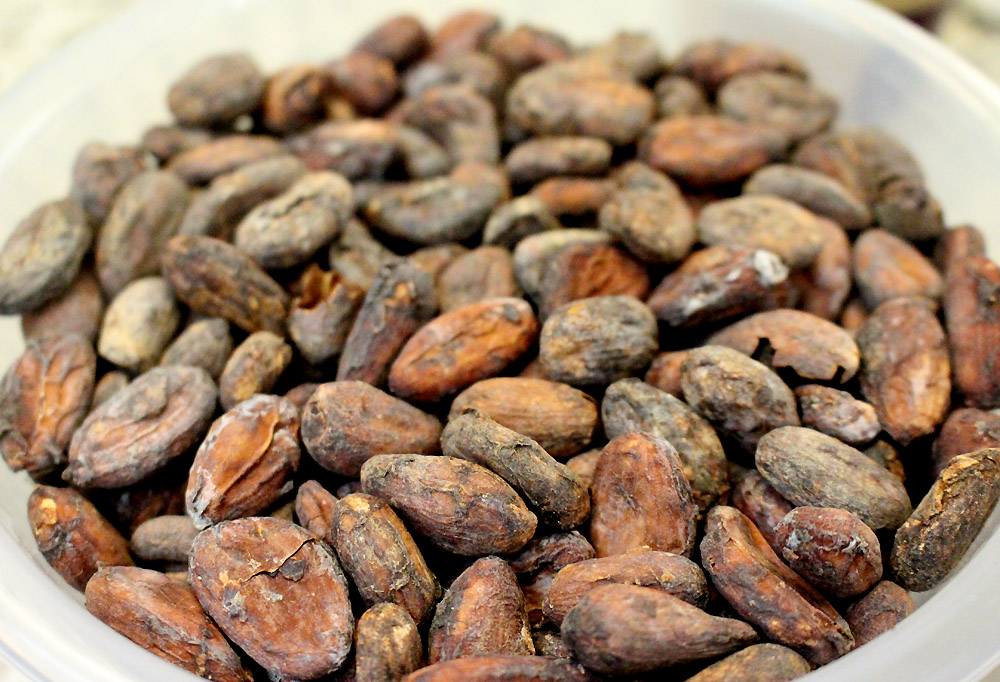
Paul is initially using beans supplied by Menakao from Madagascar, one of the country’s best known cocoa growers and chocolate makers. The beans are a varietal blend (Criollo, Trinitario, Forastero) and arrive in London fermented, dried and ready to roast.
Roasting is done in a conventional oven, but in order to get the best flavour from the beans and their shells, they undergo a ‘two phase’ roasting process. After an initial roasting at a high temperature for 20 minutes, they are then given another 5 minutes at a lower temperature. This process is designed to get the maximum flavour from the beans and their shells, while keeping the flavour of the chocolate “true” to the bean itself.

Breaking The Beans
After roasting, the next phase in the chocolate making process is to break the beans in to small pieces. Paul has found that the simplest way to do this is with a standard food processor on the “ice crystals” setting.
It only takes a few pulses to break the beans into small enough pieces to go into the melanger, and release the most amazing smell. As his team breaks the beans, the whole kitchen is filled with a vibrant, fruity, acidic aroma.

The Cocoatown Melange
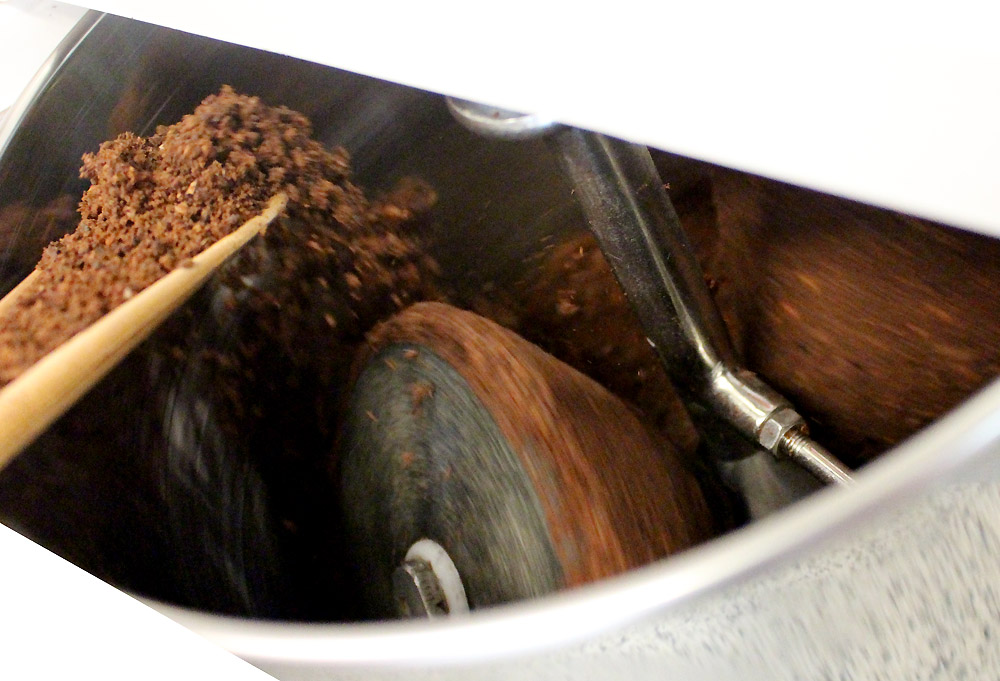
If there’s one company that has driven the explosion in bean to bar chocolate in the last five years, it’s Cocoatown. Their melanges – converted spice grinders – do the job of grinding, refining and conching in a single machine, not much bigger than a desktop food mixer. They’ve revolutionised the bean-to-bar chocolate industry by making it affordable for chocolate makers to get off the ground.
Paul has the smallest model Cocoatown offers, and it has proved more than adequate for their initial needs. The inside of the melange has a granite base and two granite rollers that revolve inside, slowly grinding, refining and mixing the chocolate.

The broken beans are added slowly to the machine and with the help of a little initial heat from a paint stripper, they soon start to form a paste. Sugar is added slowly, and eventually the heat of the friction alone is enough to transform the mixture into cocoa mass – and eventually into chocolate.
Paul has chosen to break with convention when it comes to the sugar he uses too. Rather than the cane sugar that most chocolate makers use, he uses unrefined, organic Demerara sugar. Being a pastry chef by training, Paul sees using the right sugar as just as important as using the right cocoa. Rather than being just a neutral tasting sweetener, the Demerara adds its own unique character to the flavour of the finished chocolate.
The chocolate is ‘conched’ for just 7 hours – a tenth of the time of many bean to bar chocolates. Instinctively, you might think that you would want to conch a “whole bean” chocolate for longer in order to create a perfectly smooth chocolate, but the conching process doesn’t just refine the texture.
As the chocolate is stirred for hour after hour, chemical changes take place that affect the flavour of the finished chocolate. Some of the acidity is broken down over time, resulting in a more rounded flavour, but you also lose many of the characteristic notes present in the bean.
Getting the conch time right is a balance between getting the best texture and flavour from the bean. It’s a very subjective thing, but Paul has chosen to try to remain “true” to the flavours present within the bean combined with a less refined texture.
Tempering
The final step in the chocolate making process is the tempering – the controlled heating and cooling of the chocolate that’s required in order to produce a glossy looking bar with the perfect “snap” when you break it.
As a traditional chocolatier Paul has always prided himself on being one of the few who tempers chocolate by hand on a marble table. So it shouldn’t be a surprise that he’s chosen to hand-temper his bean-to-bar chocolate too. I’m not aware of any other bean-to-bar chocolate makers tempering in this way, so this may be another first for a commercial bean-to-bar chocolate.
The Finished Product
“Everyone shells just because that’s what they’ve been told”
There are two bars in the range for launch, a 64% and a 73%. Both are dark chocolates made with Menakao cocoa beans.
As you might expect, the chocolate has some texture to it, but it also has a bold, punchy and acidic flavour. It’s difficult to tell how much of the texture is down to the shells and how much is simply because of the short conch time, but Paul tells us that with a longer conch time he is able to produce perfectly smooth chocolate. He just prefers the texture and flavour of the less refined bean.
Which begs the question: Why does anyone winnow cocoa beans in the first place?
“Everyone shells just because that’s what they’ve been told.”, he tells us. It has become the standard practice and nobody questions it. There are undoubtedly reasons why winnowing might be advantageous: the beans could be easier to roast, or the shells may cause issues with some chocolate making equipment. But having tasted the chocolate, I can’t see any reason why winnowing should have become the only option.
The thing I love best about Paul A Young is his experimental nature. He has never been afraid to question the way things are done or to take risks. It might not always work, but more often than not it results in unique and exciting products that both challenge and delight.
His bean-to-bar chocolate is no exception.
Paul A Young’s Whole Bean Madagascan Chocolate bars are available to buy now from his four London shops. To order by phone, see their website.
Photo Gallery