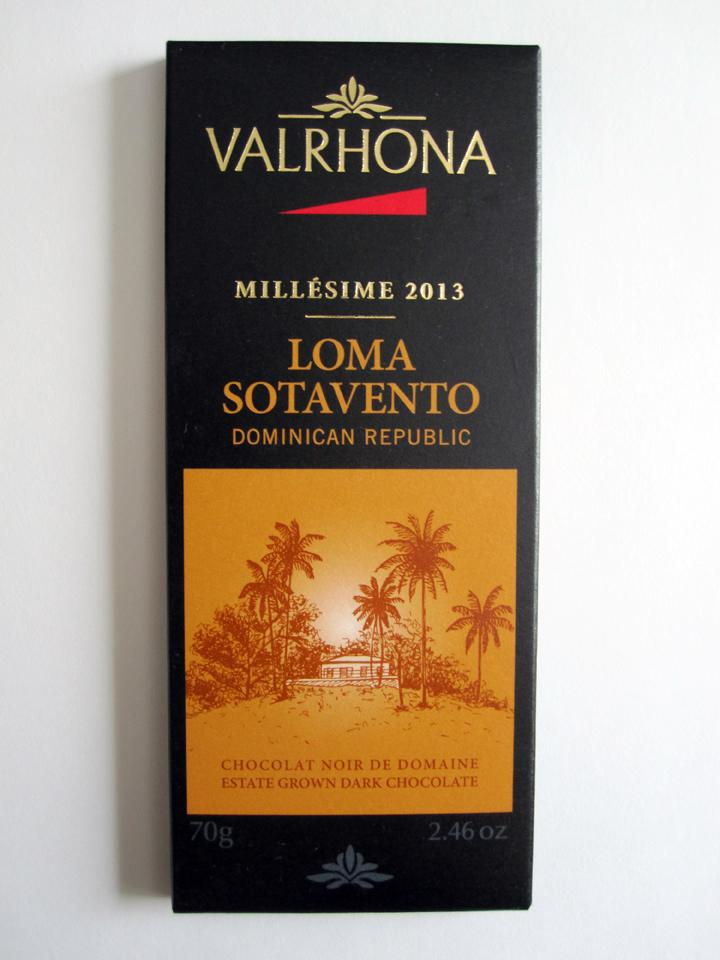
On my first trip to Paris, back when I had more of a casual relationship with chocolate, I stumbled upon a café which had an impressive window display of Valrhona Chocolate. When I went in to investigate, I was introduced to some of what is still my favourite chocolate and even now, I still look at them as being one of those reliable brands that I can depend upon. It also means that anything new from Valrhona is pretty much an automatic purchase, as was the case when I saw their Loma Sotavento bar.
Valrhona Loma Sotavento is the first batch of bars from a new Dominican Republic plantation which Valrhona started farming back in 2011. The bar weighs in at 70g, and it gets a new look box which features a sketch of the estate. When it comes to percentages, a bit of hunting around reveals it is 64% although it isn’t displayed prominently which is a little strange – you have to seek out the ingredient list to find it.

The chocolate itself looks typically pretty – nice and shiny, with an interesting series of lines that guarantees that only strangely-shaped pieces can be snapped off. When it comes to flavour though, I was a little underwhelmed. That isn’t to say that this isn’t a decent bar of chocolate, but it lacks the specialness I was hoping for.

It starts off promisingly enough with plenty of smooth, robust chocolate notes but just as it begins to build up some momentum, it stops. Some of that is down to the added vanilla which is always there without being too obvious, but there’s a distinct lack of complexity from the beans. There might be the slightest suggestion of citrus and berries as it lingers, but it just isn’t enough to elevate this from being surprisingly one-dimensional.
Maybe they are still finding their feet when it comes to this particular location but considering that this is a Valrhona bar, I was expecting more. I’m not willing to give up on Loma Sotavento yet though and I’ll be back to see what the 2014 Vintage has to offer.

After visiting bean-to-bar maker Madre Chocolate, our next stop on our Hawaiian chocolate tour was just around the corner at Manoa Chocolate.
Manoa (meaning thick or solid in the Hawaiian language) is another bean-to-bar chocolate maker, set up in 2010 by Dylan Butterbaugh and fiancé Tamara Armstrong. Butterbaugh is a Kailua local, but didn’t discover cacao until traveling in Indonesia that he discovered cacao – a tree that happens to grow quite well in Hawaii!

With Dylan away finding beans in Costa Rica, it was Tamara who met us at the Manoa factory shop, a converted real estate office. It’s a little larger than Madre’s shop, but still very small for a factory. But with a little more space to play with, Manoa have managed to be quite creative with their layout.
Around half of the building is dedicated to production, and the other half is a spacious shop and tasting area. Large windows separate the two halves of the factory, meaning visitors to the shop can have a clear view of the entire chocolate making process. This also enables Manoa to run regular events and guided tours of the space.

In 2012, Manoa launched a successful Kickstarter campaign, raising over $18,000 for new equipment. The video they produced to go with the campaign is a great little introduction into Manoa, and also shows the construction of the current factory & shop.
The factory is now full of beautiful chocolate making equipment, but there is at least one link to the past. The old “Winnowing Device” has been modified and improved over the years, but like many small chocolate makers, it’s still a homemade contraption held together with duct tape and glue with a shop vac attached to one side.

This is the machine that removes the papery shells from the cocoa beans after breaking them, and it’s often one of the biggest challenges a small chocolate maker faces. While a conventional oven or coffee roaster can be used for roasting beans, and companies like Cocoa Town produce a range of grinders for small chocolate makers, nobody really sells an affordable winnowing machine.
Many small batch chocolate makers end up having to make their own machines, and more often than not, they simply use a series of tubes and a vaccuum cleaner to blow the lighter shells away from the valuable cocaa beans.
It works, and the Manoa winnowing device is a marvel of ingenuity, but with well over 100 bean-to-bar chocolate makers in the US alone, I can’t help but think there’s a gap in the market!
For me, the most impressive piece of kit was the beautiful San Franciscan roaster. Designed for roasting coffee beans, it does a great job evenly roasting cocoa too.

After showing us around the factory, Tamara insisted we sit down and try some chocolate.
Like Madre, Manoa use locally grown Hawaiian cacao where they can, but supply is limited, so they also need to look elsewhere. Their current range includes cacao from Costa Rica, Liberia, and Papua New Guinea in a variety of flavours, with their “Breakfast Bar” – a 60% dark milk chocolate made with nibs and coffee beans their most popular offering. I also enjoyed their Dark Milk with Lavender and spicy Ghost Pepper bars.. although I have to admit, I was’t so keen on the Goat Milk Chocolate! But there really is something for everyone in the range.

I have to confess, I loved Manoa. I love that they’re telling tourists and locals alike about the exciting world of Hawaiian chocolate. I loved the chocolate, and most of all, I loved how friendly and welcoming everyone was. I can’t wait to go back.
You can find Manoa Chocolate at:
315 Uluniu Street, Suite 203
Kailua, Hawaii
96734
Photo Gallery

Jennifer Earle reports from the World’s 50 Best Restaurants Gala Ceremony
Sitting in the audience of the World’s 50 Best Restaurants gala ceremony, amongst some of the greatest chefs in the world, I listened as the announcements of various additional awards peppered the countdown: Best Sustainable Restaurant, Chef’s Choice, Best Female Chef… and, the one I was primarily there for: the inaugural Best Pastry Chef award. At first it looked a little convenient; Ramon Morató, Creative Innovation Leader of Cacao Barry, sponsor of the award, took the stage to present the trophy and then, the announcement:
“Winner of the inaugural World’s Best Pastry Chef award… Jordi Roca of El Celler de Can Roca”.
Jordi also happens to be the global ambassador for Cacao Barry, the very brand sponsoring the award. Ramon had also taken up a signed box of the limited edition new chocolate they’d launched earlier that day to give to the winner. Signed by… Jordi himself.

Aside from the fact that I am sure that there is no way Cacao Barry could have influenced the integrity of the awards and that I observed for myself the dropped jaws on the company representatives in the audience, the few hours I spent with Cacao Barry earlier in the day at the new chocolate launch had already assured me this convenient coincidence was just further proof that the new team behind the brand knew what they were doing.
The sponsorship of this new award, within what is probably the most-anticipated list of awards from any restaurant owner/investor and of foodies around the globe, is just one example of how Cacao Barry are making a stand for quality and ensuring their brand is associated with the very best in the food world. It is already the fourth year Cacao Barry have been the official chocolate sponsor of the awards. This additional sponsorship further cements their support of the event and of patisserie chefs worldwide. Of course, all of this would be fairly worthless if the quality of the chocolate was actually sub-par. Their latest efforts – all part of the master plan – are most certainly not.

For some time now Cacao Barry has been in the shadow of its parent company, Barry Callebaut. By “shadow” I do mean that the relationship causes them to bear some of the associations attributed to Callebaut and as a result have a less positive perspective than some of its peers supplying the restaurant and confectioners world. Barry Callebaut is an impressive business, but it is a behemoth and the range in quality of chocolate it offers is vast. They are set up to be all things to all people, thankfully with a minimum standard that excludes vegetable fats from being used. Cacao Barry is the premium arm of the company and acts completely independently from the rest of the group. It’s sadly carrying the stigma of that association and still in many people’s eyes has – as one foodie described to me – “the budget premium” perception firmly hooked to it.
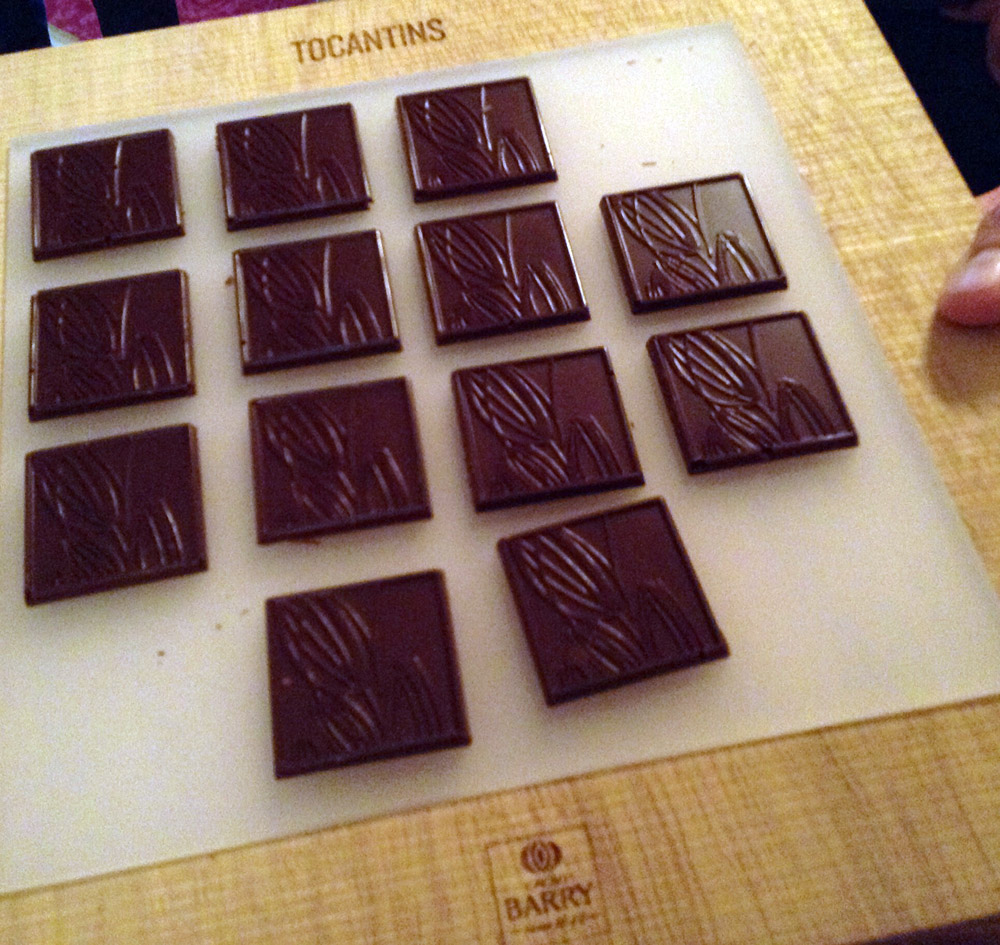
Well, the new branding team is working to shake off this reputation, much to the excitement of the internal product team and, now, me. Last Monday afternoon saw the launch of the most significant chocolate in their range yet: a limited release, Brazilian Amazon 70% chocolate called Tocantins. Sadly it will be only exclusively available to this year’s Top 50 restaurants and selected ambassadors, journalists and bloggers (including very lucky us!). Cacao Barry’s Global Brand Leader Joost Lindeman was quick to assure the select audience of partners, ambassadors and chefs that the limited release was due to actual physical restriction of the product rather than a desire to restrict it to only some chefs.

Tocantins is exactly what a single origin chocolate should be, a journey of aroma and flavours that lingers deliciously even after it’s completely melted away. It starts with an almost olive-oil like texture and pepperiness and then peaks into fruity acidity and finally finishes with a strong but well-rounded cocoa note. The peppery feeling remains on your tongue as well. I’ve been impressed by some of Cacao Barry’s range before, thinking it equalled some of its rivals for quality cooking and patisserie. This new chocolate it would be almost terrible to tamper with. At most it should be served as an unadulterated bon bon, or a pure ganache tart, maybe with a layer of caramel. I’d accept a mousse as well, but I think I’ll be eating most of my (signed and numbered!) box straight from its beautiful slab.
The presentation is also well-thought through and striking. A papier mâché box indented with the name and stamped with the brand, closed with a piece of string and secured with a branded wax seal. Inside the box are two beautiful 500g slabs, perfectly tempered and then sprayed with more chocolate to give a matt, woody appearance, harking to its Amazonian beginnings. The only flaw in this gorgeous ensemble is that each slab is wrapped in brown paper tissue (sealed closed with branded stickers), imparting a slightly papery note to the outer layer of the bars.
I was shocked to realise that it’s taken this long for the World’s 50 Best to include an award for Best Pastry Chef. It seems long overdue. I surely can’t be the only person who will trek to a restaurant based on rumours of an outrageously good final course, or looks at the dessert menu first and plans the rest of the meal around that choice? The pastry chefs really are the unsung heroes of the restaurant world. They usually arrive first to bake the bread and leave last to put the final touches on the last plate that leaves the kitchen. Their work requires precision and patience as well as a great palate and skill. It is their talent that will ensure that a great head chef can secure a position in the Top 50 at all.

El Celler de Can Roca was already high on my hit list of restaurants, even before it took number one last year, but now that it’s still in the top two and has the world’s best pastry chef there’s no doubt that if I’m making a pilgrimage to visit any of these World’s Best 50, this will be it.

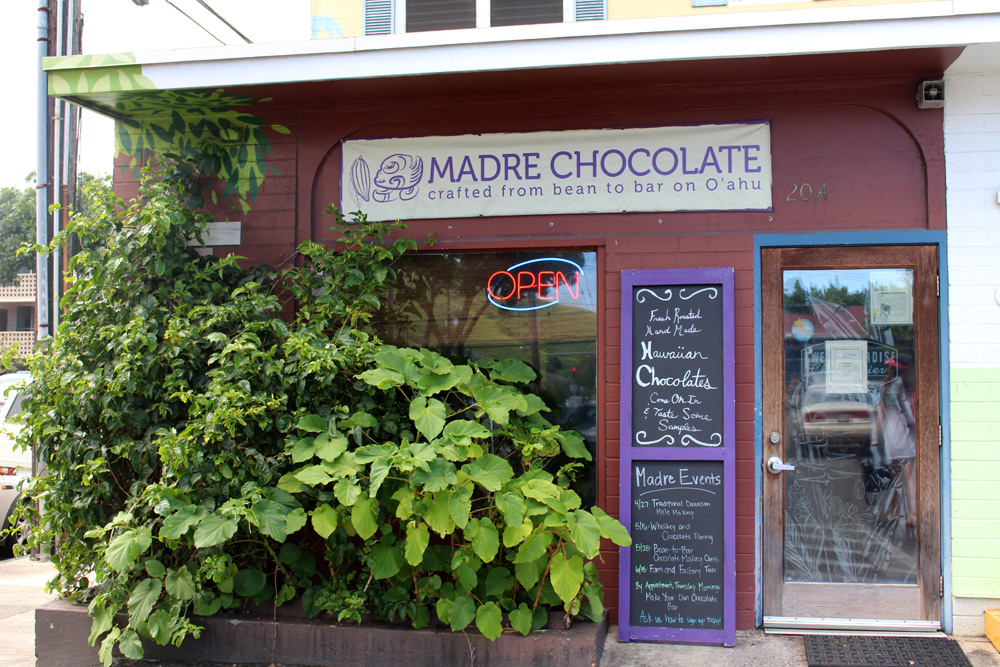
The first stop in our chocolate tour of Hawaii was probably the state’s best known bean-to-bar maker, Madre Chocolate. Based in Kailua, 25 minutes drive outside downtown Honolulu, Madre was founded in 2010 by David Elliott and Nat Bletter.
Madre describe themselves as Oauhu’s first bean-to-bar chocolate maker, and they have grown quickly. In 2011, they opened their retail store and factory, and this year they opened a second retail location and “cocoa garden” in the Chinatown district of Honolulu.
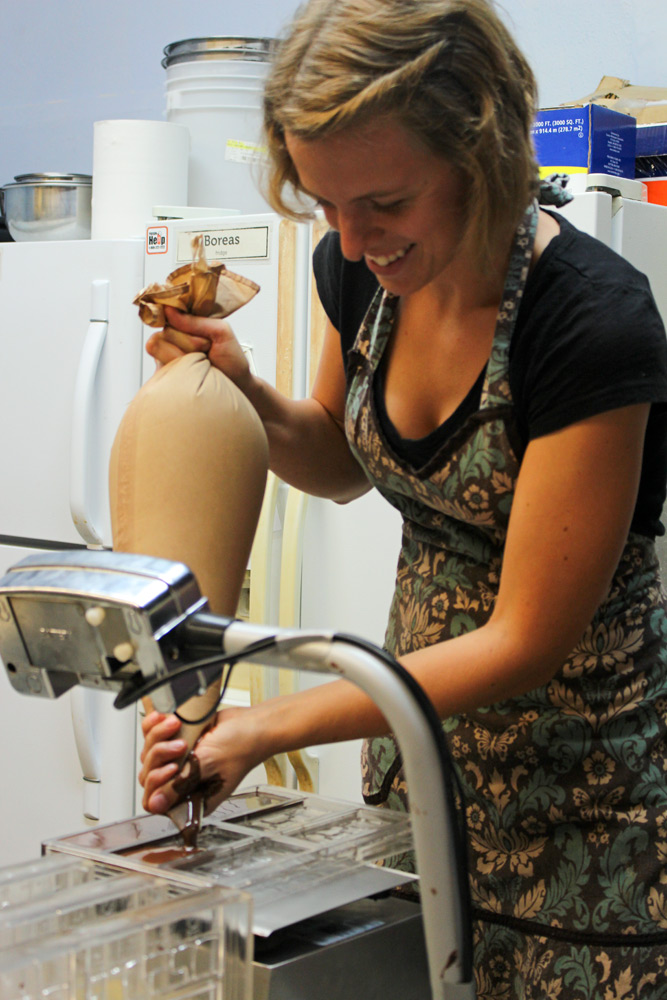
Production is still based in the original Kailua location, and when we visited, David and chocolatier Carley were preparing to mould some freshly made bars.

But there’s no fancy moulding machinery at Madre. For the small batches Madre produce, it’s simpler and more efficient to mould by hand. So the chocolate is transferred from the tempering machine into a giant piping bag and from there, the moulds are filled manually.

It may seem time consuming and labour intensive, but there’s something wonderful about knowing that every bar has been poured by hand in this way. And in actual fact, the process was quite speedy – in no time at all, Carley and David had turned out over 60 bars.

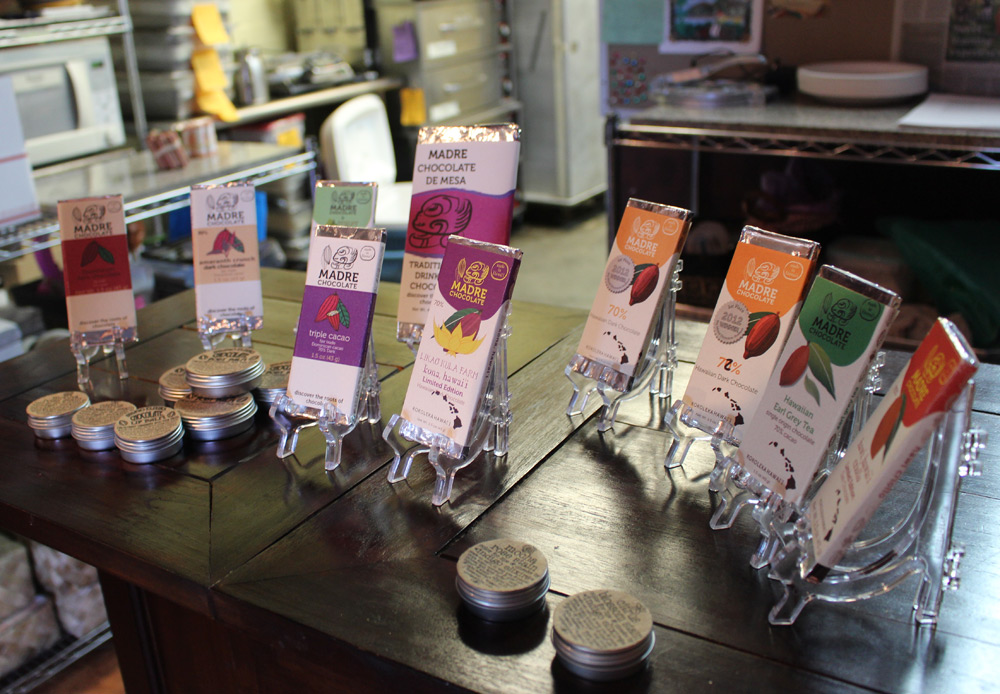
Madre use a combination of locally sourced cocoa and beans sourced from the Dominican Republic. Like most Hawaiian chocolate makers, they would love to be able to use more local ingredients, but at the moment there just isn’t enough being produced. But we tasted some fantastic chocolate, from single Hawaiian estate bars like the 70% Likao Kula Farm, to the deliciously spicy Coconut Milk & Caramelised Ginger and one of my all time favourite chocolate bars, the Triple Cacao – which is made with both cocoa nibs and pulp.
Madre have an extensive range of bars that changes regularly. This makes sense in Hawaii where small crops mean that certain ingredients may have limited availability, and it also works well with Madre’s approach of micro-batch chocolate making. While at the factory, we must have tasted 15 different bars, and it seemed that there was always something new and exciting to try!

Madre do everything from conching and tempering to moulding and wrapping in their Kailua factory store, but because of lack of space, the one thing they don’t do is the roasting. Instead, they roast all their beans down the road at Lonohana’s factory. This is a great way of sharing resources – particularly in Hawaii, which is after all, the most isolated population centre on earth. The industry in Hawaii relies on this kind of co-operation, and fostering it is one of the major reasons that events like the Big Island Chocolate Festival exist.

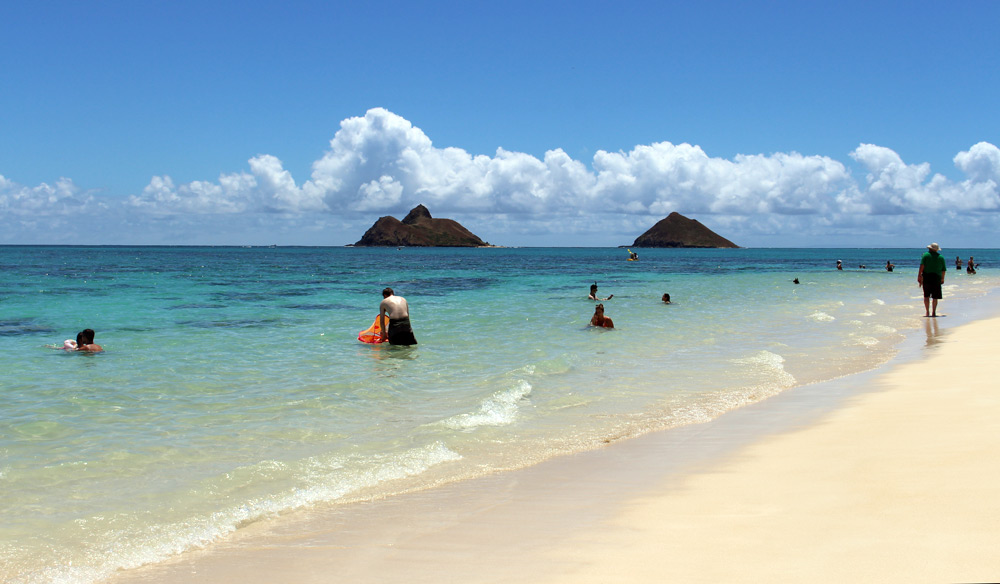
If you ever find yourself in Hawaii, a trip out of town to Madre is well worth the effort. It’s just around the corner from Manoa Chocolate’s factory, and if you need any further incentive, it’s also just a short walk from Lanikai – one of the world’s most beautiful beaches…

Photo Gallery