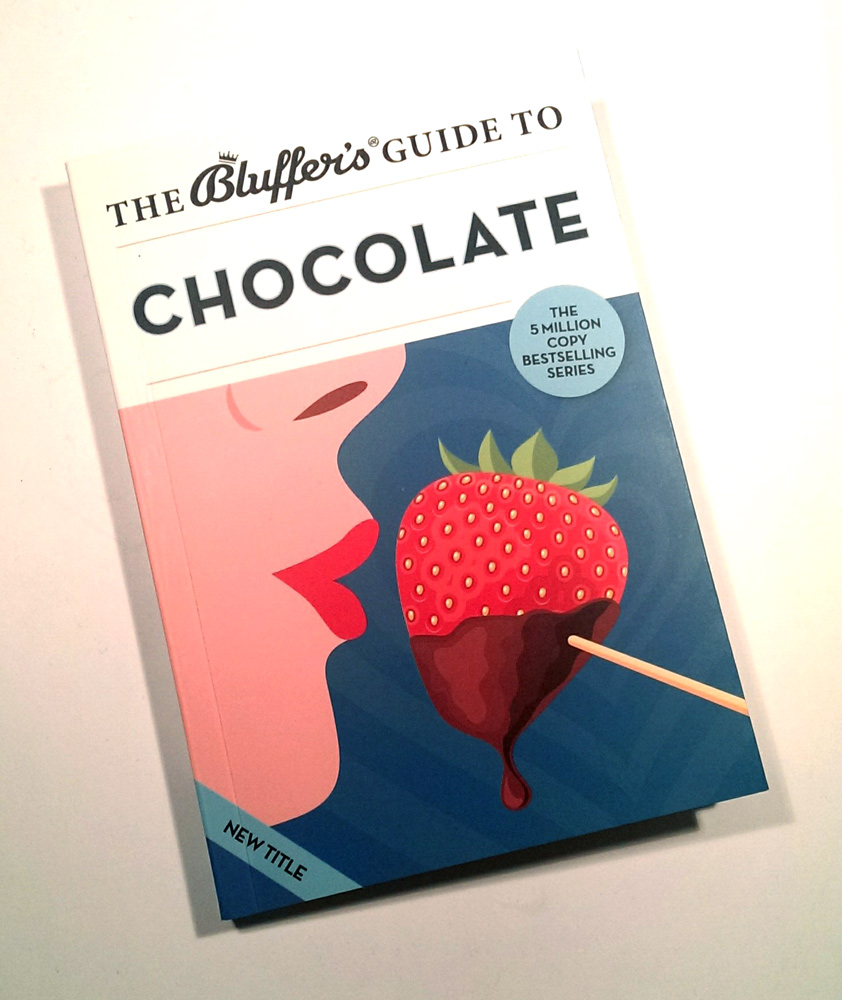
When fellow blogger Neil Davey told me he’d written a book about chocolate, obviously I had to review it. As luck (and no doubt a prompting from Neil) would have it, a day later, the publishers got in touch offering to send a copy.
The Bluffer’s Guide To Chocolate is a small 100 page paperback that’s packed with chocolate related facts. But rather than impart actual knowledge, the book is designed to give you just enough chocolate facts to get you through an evening full of hardcore chocolate lovers. People like me then.
Naturally, it’s my duty to count every single error and make a big deal about how this is completely the wrong way to learn about chocolate.
The book contains 17 factual errors.
Actually, that’s a bluff. After studiously making notes about every minute detail, I actually gave up a third of the way through when I realised I was having so much fun, despite not agreeing with every last word.
“Criollo beans from Venezuela are more floral, while Madagascan beans give more acidity. Javan Criollo beans are well rounded.”
You see, while this book might seem to be designed as a bit of silly fun to arm you with just enough knowledge to get you through an evening with Martin Christy and Alex Rast, it’s actually packed with all sorts of interesting and useful facts.
So while a mini paperback book is never going to give you a real in-depth knowledge of the world of chocolate, I think it is probably just enough to inspire the complete beginner to want to go out and find out more.
Don’t be a bluffer
If you’re actually trying to bluff their way through an evening in a room full of chocolate geeks, you shouldn’t rely on this book. A small paperback simply won’t give you the knowledge needed to hold in in-depth conversation.
But that’s not really who this book is for. It’s designed for someone with a keen interest who just wants to kick-start their knowledge, and if you treat it like that, it excels.
After all, chocolate is there purely to be enjoyed. It exists for no other reason. There’s really no need to bluff about it – just find what you like, eat it and enjoy it. And then eat some more.

Although I like to experiment with making chocolates once in a while, I’m not much of a baker. This partly stems from having lived alone for a long time, and being forced to eat anything I’ve baked all by myself. But it’s mostly just because I’m not very good.
So anything that can help make me a better baker with minimal effort is a good thing. Being a bit of a gadget fan, when Lékué offered to send me this macaron making kit to try out, I jumped at the chance.
The slight fly in the ointment is the fact that I don’t particulalry like macarons. But if I could make them well enough that other people would want to eat them, that would give me a sufficient sense of superiority accomplishment. And what’s not to like about that?
The Kit
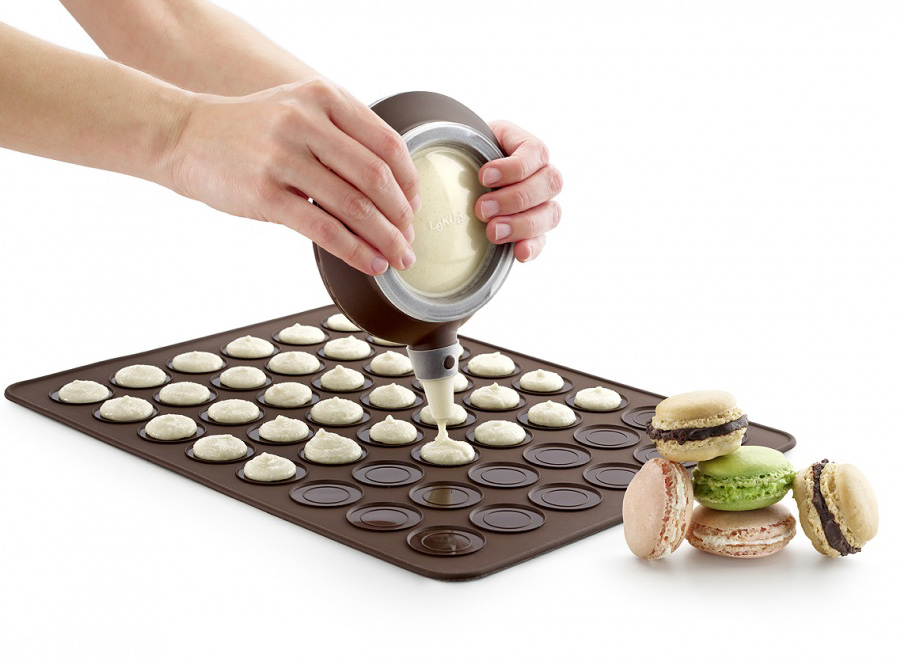
The macaron making kit itself is very simple. It consists of a 40cm x 30cm silicon matt with circles marked out in ridges and a squeezy bottle (or Decomax pen to give it its proper name) with interchangeable nozzles. I’m told half that battle of macaron making is getting even circles of mixture onto the tray, and that’s what this kit is designed to help with.
It won’t improve your recipes and it won’t magically cook your macarons perfectly, but it will help you make evenly sized blobs.
The kit comes with a small booklet with some recipes in multiple languages, but they all seemed a little complex, so I found a basic macaron recipe, and thought I’d make a simple ganache filling to go with it.
The recipe is relatively straightforward, but the part where it’s easiest to go wrong (and thus, the part where I went wrong), is mixing the ground almonds and sugar into the egg whites. In my attempts to make sure the colouring was evenly distributed, I ended up over mixing.
Still, I persevered. Gently pouring the mixture into the squeezy bottle and piping blobs onto the matt.
Blob, Blob, Blob
My friend Edd (who knows a thing or two about baking), had told me not to let the mixture go up to the circular ridges when using this kit, so it was soon clear I was going to have a problem – the mixture was spreading even before it was in the oven.

Again, I persevered. The squeezy bottle and mat did actually make this part very, very easy. It was both mess and hassle free.
After baking in a low oven, my excitement turned to disappointment. Rather than rising and leaving those trademark macaron “feet”, they had spread outward. They still looked somewhat like macarons, but they weren’t the masterpieces I had been hoping for.
Still, as they cooled on the matt, I whipped up a simple ganache with some Duffy’s chocolate and cream. I left it to cool in the fridge before assembling my macarons.
That was very easy – they peeled away from the tray with minimal effort, then I simply used the same squeezy bottle (this time with a smaller nozzle) to pipe some ganache onto one half before sandwiching the two together.
Pictured here are a few of the best ones. I won’t be giving up my day job.

I’m told that macaron making requires a lot of practice, and now I’m aware of some of the mistakes I made this time, I think I could improve next time round. Normally I would say I don’t like macarons enough to try again, but given how simple the process is with the Lékué kit, I probably will.
Even if I don’t make macarons very often, I’ll certainly be using the constituent parts again. It made the process simple, clean and fun, and – most importantly of all – just a little bit less daunting for the total novice.

While I was in Paris recently, I thought it was only appropriate that I treat myself to some typically French artisan chocolates.
But I bought these instead.
There is a method in my madness. It’s been so long since I’ve had a mass produced chocolate assortment that I wanted to see just how much my tastes had changed – and whether the likes of Lindt have improved with the rise of the artisan chocolatier.
This little 155g selection box looks as though it’s aimed at the tourist market (that’s me!), but apparently it’s a Christmas special – albeit one you can still buy.

While I have to admit, I quite like the design on the front of the box, open it up and it’s a different story. Inside, the chocolates are pressed into a very cheap and flimsy looking gold plastic tray.
The chocolates look uniform and mass produced. There are some interesting shapes, but to me they just look like they’ve been designed by computer and dropped straight into the box without any kind of human involvement. These days, I’m so used to chocolates that look and feel handmade, I’d almost forgotten just how samey mass produced chocolates can be.

There’s a variety of pralines, caramel and “ganache” fillings. They’re all passable, but quite bland and a little oily. The caramel in particular was more of a flavourless, sweet gloop. But at only 6 Euros for 14 chocolates with a shelf life of a year, I guess that’s to be expected.
My advice? Always avoid chocolate that’s targeted at tourists, even if it’s just a gift. I’m sure the recipient would much rather have a smaller box of fresh, handmade chocolates. And there’s plenty of those to choose from in Paris.

It’s hard to imagine losing a kitchen. In my five room flat, for instance, I’m fairly sure I would notice if the kitchen went missing. But at Hampton Court Palace, they’ve recently “discovered” the missing chocolate kitchen of King George I.
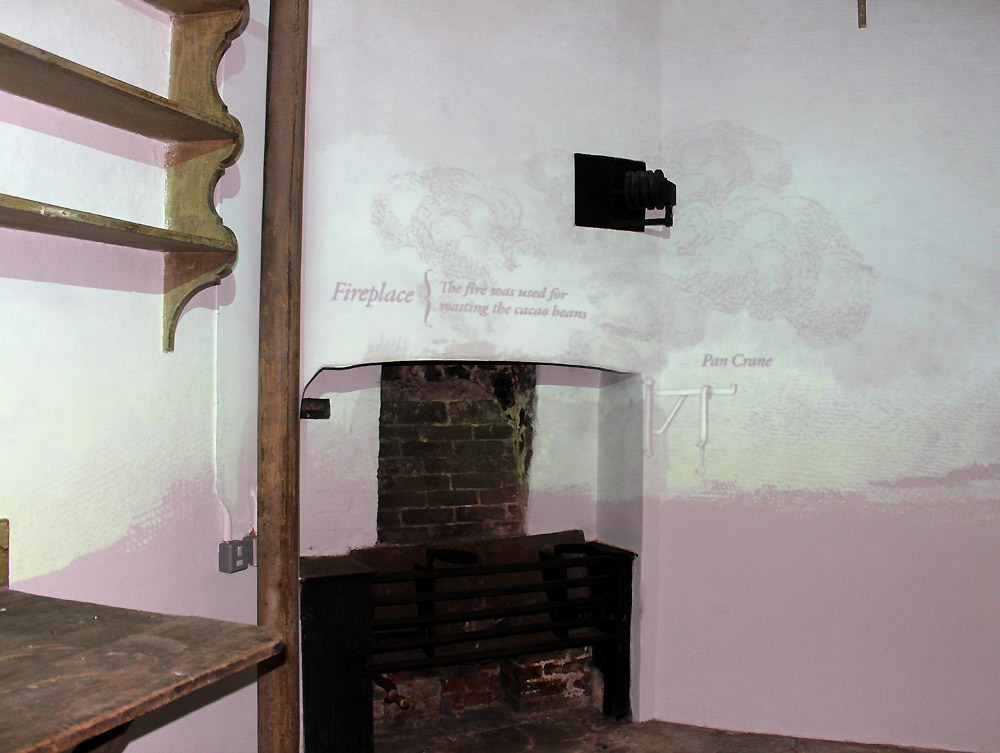
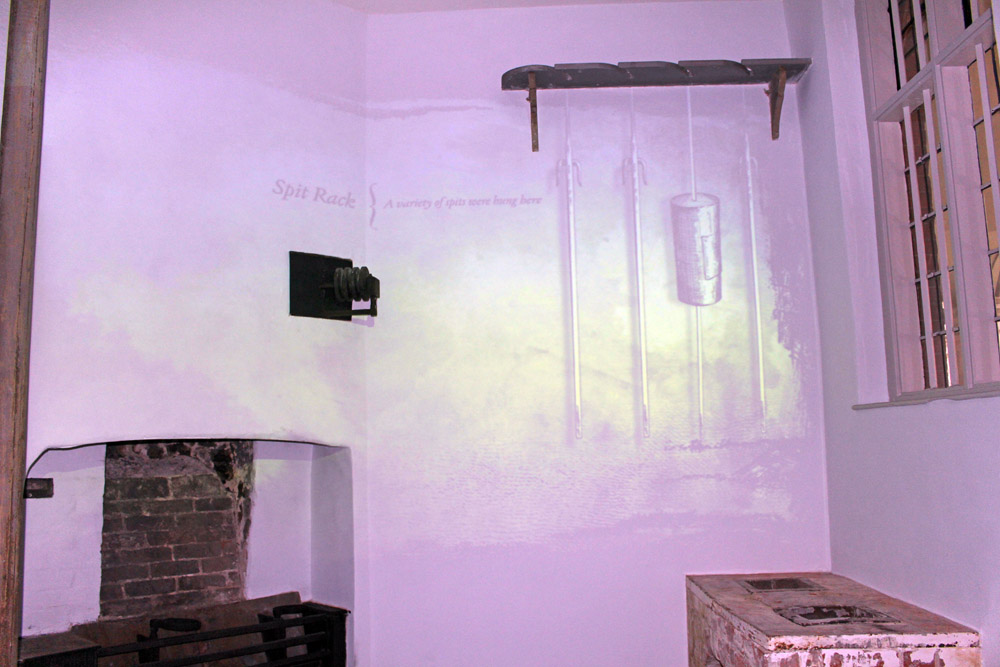
Of course, they always knew it was there somewhere, but nobody was exactly sure which of the thousand rooms in the palace housed the 18th Century kitchen. That was until last June, when an old map was discovered pointing out the exact location. Sure enough, inside a store room adjoining the Fountain Court, a spit – used for roasting cocoa beans – was discovered above a fireplace.
In fact, the original stove and all the fittings were intact, but nobody had put two and two together and realised this was the long lost Royal Chocolate Kitchen.
Thomas Tosier, The King’s Chocolate Chef
In this kitchen, chocolate was transformed from cocoa beans into a rich and spicy drink fit for a King. The hot chocolate, was often fortified with wine or port along with expensive spices like chilli, cardamom, allspice and Grains of Paradise.
Thomas Tosier was the personal chocolatier (or ‘chocolate chef’) to three Kings; William III, George I, and George II. At that time, chocolate was consumed purely as a drink, and Tosier would have been responsible for all kinds of exotic and expensive recipes. Cocoa houses were popular throughout the country, but chocolate was still an even more expensive luxury than coffee.

As we entered one of Mr Tosier’s chocolate rooms, he was busy with his metate making another batch of hot chocolate for the king.
Of course, this was an actor playing the part of Mr Tosier, but the cocoa, spices and metate (used for grinding the beans) were real. The smell of the cocoa combined with spices and alcohol pervaded the air as he talked us through the chocolate making process.

Next door, the palace has recreated a chocolate room, filled with reproduction pewter chocolate pots, cups, glasses and bowls. Hot chocolate would have been served in cups, which were then placed inside a Chocolate Frame – a kind of a pewter saucer that was attached to the cup – to prevent any spills.

In The Kitchen
These first two rooms were simply recreations of their 18th Century counterparts. Historians at the palace decided to leave the actual chocolate kitchen largely untouched. Aside from the original fittings, the room is bare, but brought to life by a projection that maps moving images onto the walls, showing how some of the equipment would have been used.

Although it still wasn’t entirely clear how the chocolate spit over the fireplace would have been used to roast cocoa beans, our guide Marc Meltonville, food historian at the Royal Palaces helped explain the process.
The thing that struck me most is that when it comes to making chocolate in small batches, very little has changed in the last 300 years. They may have ground the beans in a metate rather than an electric melanger or conche, but the underlying techniques are largely the same.

Hot Chocolate
We tried four different hot chocolates at the palace. The first – a simple concoction, similar to what have been served in London’s 17th Century cocoa houses – was made with water, sugar and a little chilli. The second closely resembled a drink that would have been served at the palace and was flavoured with anise. The third hot chocolate was milky and sweet, and the final drink was made with cocoa butter, milk, sugar and vanilla.
I have to say, my favourite was the chilli. Prepared simply with chocolate, water and spices, it’s almost exactly the same way I make my own hot chocolate today.

Hampton Court Palace is a wonderful place to visit, and although a little expensive, it’s a slice of English history that everyone should experience at least once.
Truth be told, the chocolate rooms are quite simple, and there isn’t a lot to see if you’re not into the history of chocolate. But if you are, it’s a fascinating glimpse into a world where cocoa was a sought after and valuable commodity fit for a king.
Opening Times
The Royal Chocolate Kitchen At Hampton Court Palace is open to the public from Friday 14th February from 10am – 4:30pm. Entry to the palace costs £17.60 for adults and for children under 16. For more information, visit hrp.org.uk.
Photo Gallery