Guest Chocablogger and sustainable chocolate consultant Simon Wright takes a look at a new chocolate shop in South West London.

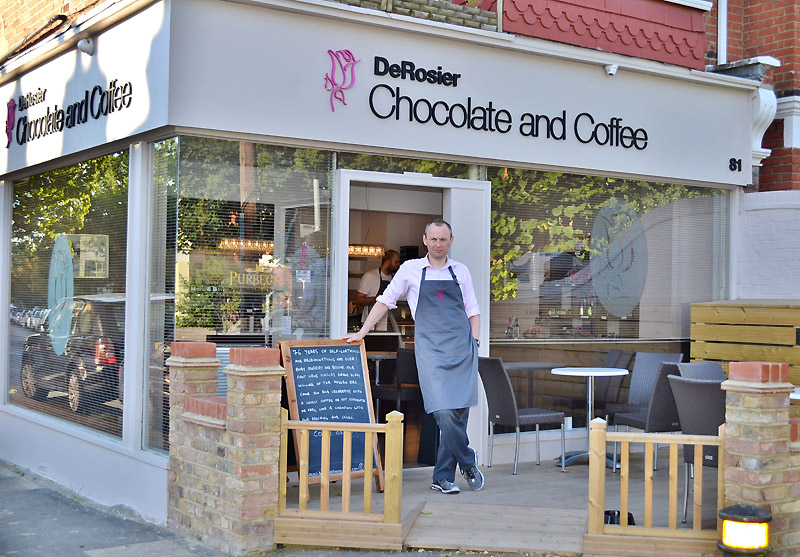
Opened in August 2012, my local coffee shop DeRosier Chocolate And Coffee is coming up for its first birthday so it seemed a good time to talk to founders Leona and Andrew.
Named after Leona’s maiden-name, DeRosier offers gourmet eats and drinks to the residents of Southfields and Wimbledon Park. The selection is based on artisan coffee, Hot Chocolate (praised by Time Out), home-made cakes and of course, handmade chocolates.

DeRosier is a second career for Leona, whose interest in fine chocolate was inspired by not being able to find anything locally she really liked to give on Mothers day four years ago. The Barry Callebaut Chocolate Academy Course and a long search for premises followed. Initially Leona looked for a small shop but she and Andrew decided to combine chocolate with coffee to reach a wider audience.

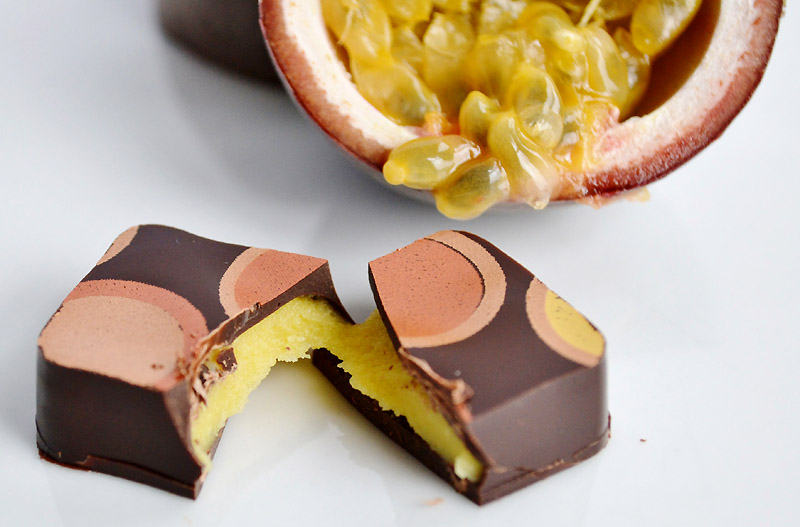
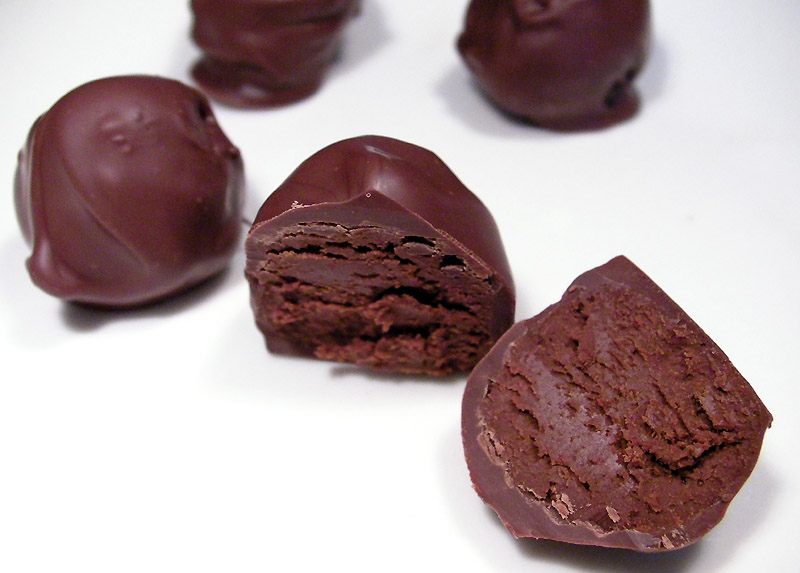
All the chocolates are hand made by Leona using couvertures from Grenada, the Dominican Republic, Ecuador and Venezuela. She tends to eschew “wacky flavour combinations such as bacon and egg” in favour of more traditional products such as Gianduja, honeycomb and Champagne truffles. The most popular filling is passionfruit, with customers buying her entire production for dinner parties. Cocoa bean origin is not yet a hot topic in leafy SW18, although customers do ask about their single-origin hot chocolate.

Considering DeRosier’s proximity to Wimbledon a range of tennis-related items makes sense, and Leona has also been commissioned by the All England Club to make over 1000 small boxes of chocolates which will be offered to guests in the Royal Box during the Championships.
So if you are coming to the tennis this year or if you just want to check out Wimbledon Park’s new Beach Volleyball courts, DeRosier is well worth a visit. And with Leona and Andrew already looking at other locations DeRosier is a name to watch.
DeRosier Chocolate And Coffee
81 Revelstoke Road
Southfields
London SW18 5NL
www.derosierchocolates.com

If you’ve followed any of my own experiments with chocolate making, you’ll know that tempering chocolate is a difficult but necessary step. Without tempering, your chocolate will be soft, crumbly or bloomed. Temper it, and it will be glossy and crisp.
Tempering involves heating, cooling and heating the chocolate to very specific temperatures. Professional chocolatiers have expensive tempering machines or marble slabs to spread and cool the chocolate with.
They also have large quantities of chocolate to work with. As you might imagine, if you’re working with very small quantities of chocolate, it’s much more difficult to control the temperature precisely.

On our recent visit to Halen Môn in Anglesey, Green & Black’s Head Of Taste Micah Carr-Hill demonstrated a quick and simple method for tempering chocolate in a microwave. It’s the method Green & Black’s use in their development kitchen when they want to quickly experiment with a small amount of chocolate.
The key to this method is that you use chocolate that is already tempered (such as a bar straight out of the packet), and during the process, the chocolate never actually leaves a tempered state. You heat it in a very controlled way, so the temperature never goes about 30C for milk chocolate, or 32C for dark chocolate
Microwave Tempering Method
To temper chocolate in the microwave, take a couple of bars of unflavoured milk or dark chocolate and break them into small chunks in a plastic bowl. Plastic is best for this method, as it doesn’t retain the heat as much as other materials, so you’ll have better control of the temperature.
Start by giving your chocolate a 30 second blast in the microwave. If you’re using larger quantities of chocolate, you can probably increase that, but when in doubt, keep the time low. Remember, the key to this method is not to get the chocolate too warm.
After 30 seconds, take the chocolate out and stir it thoroughly. Initially, the chocolate will still be in chunks, but stir it anyway to make sure it’s heating evenly.
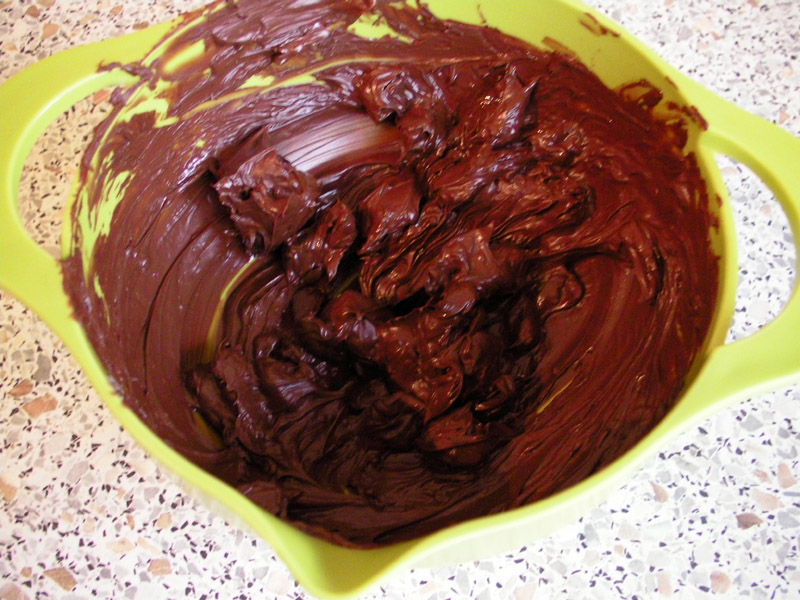
Give the chocolate a 10 second blast in the microwave, stir and repeat. When you’ve done this 2-3 times, you’ll notice the chocolate starting to melt. Initially, it will look a bit of a mess, but that’s Ok.
When the chocolate reaches this stage, start giving it 5 second bursts instead, stirring after each blast in the microwave.

If you have an accurate thermometer, you can start using it when parts of the chocolate start to flow. You want the chocolate to be able to flow, but to stay below 30/32 centigrade. If you don’t have a thermometer, you can touch a small dab of chocolate to your lower lip – one of the most sensitive parts of your body. The chocolate should feel cooler than your body temperature.
You’ll notice that some of the chocolate melts, but you’re left with some solid chunks, so stirring thoroughly is the key. You don’t want to overheat it, but you do want all the lumps to be melt.
You can probably do a better job than I did of keeping the chocolate off the sides of the bowl. That thin layer of chocolate on the side will heat more quickly!

As the chocolate melts further, you can reduce the microwave blasts to 3 seconds at a time. That may not seem like it would have much of an effect, but after each blast, you’ll notice the chocolate becomes thinner. The smaller the quantity of chocolate you have, the more careful you’ll need to be.
When the chocolate is all melted, but remains cool to the touch, it’s ready to go. It should be smooth, glossy, and pourable without being too thin.
If you do overheat the chocolate slightly, you can stir in a few unmelted chunks of chocolate to cool it slightly and seed the tempering process. On the few occasions I’ve used the microwave tempering method, I’ve had to do this once, and it worked well.
And if it all goes horribly wrong, don’t worry. Even Micah says he occasionally overheats the chocolate. That’s why he has an assistant.

It’s been a long time since I tasted anything made by Green & Black’s so finding this Crispy Milk chocolate bar in the ‘reduced price’ section of a local supermarket seemed like a prompt for me to reacquaint myself with their chocolate.
In typical Green & Black’s style, the vast majority of the ingredients for this bar are either organic, Fairtrade or both. The ‘crispy’ part of this bar is made up from five different organic grains and the chocolate has a healthy 37% cacao content. As you can see, there’s plenty of crunch in the bar, which works really well with the sweet milk chocolate.

In many ways this bar is a tastier, better made version of similar milk chocolate/crispy bits bars. The higher cacao content obviously makes for a better tasting chocolate, and the cereal does exactly what it’s supposed to. It’s crisp, crunchy and adds both texture and subtle flavour to the mix.
I’m not a big milk chocolate eater but I found myself going back to this bar, which is probably the best recommendation you can make. The organic & Fairtrade content plus Green & Black’s wide availability also make this one of the more accessible bars I have reviewed recently.
If you like your milk chocolate then you really owe it to yourself to go for something with a higher cacao content, and this is a good place to start.

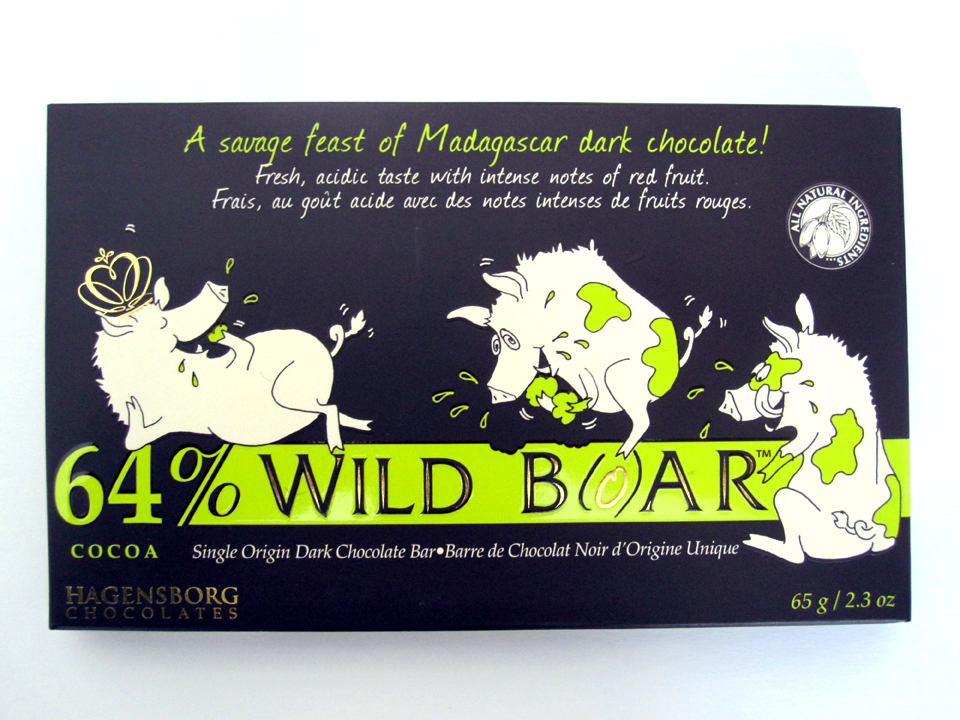
Until now, the only thing I’ve seen on my side of Canada from Vancouver’s Hagensborg Chocolates has been their Truffle Pig Bars which are shaped like 3 pigs and come in a multitude of flavours. I should probably write about them sometime. That’s why I was surprised to see they had expanded into making single origin bars although I’m always happy when a Canadian company starts making some good chocolate. They make three varieties: a 39% Ecuador Milk Chocolate, a 70% Santa Domingo and the one I picked out – a 64% Madagascar.
The outer box is very jolly. I’m overlooking their terrible Wild B(o)ar joke on the outside because I didn’t notice it for a few days – if you drop the o from boar, it spells bar. Hagensborg are a little pig fixated. It is definitely a little more light-hearted than most single origin bars though.

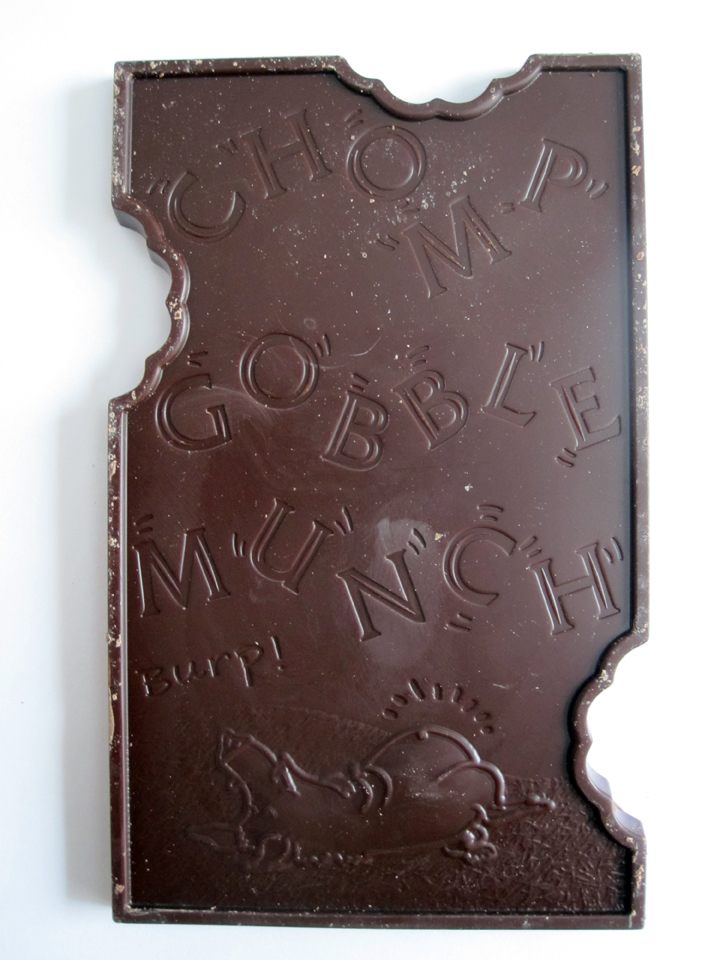
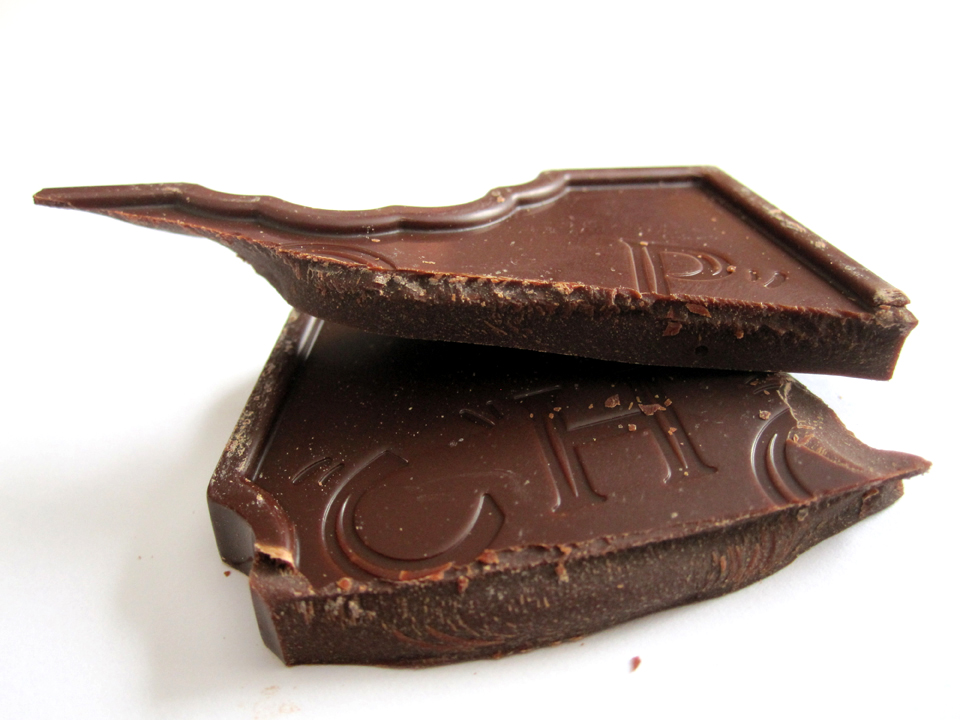
The bar itself is adorable. Really. I was just expecting a normal bar but as soon as I took it out of the box still wrapped, it felt a little unusual in the shape department. Unwrapped, the strange shape explained itself – the bar looks likes someone took three sneaky bites out of it. In addition, the bar’s surface is decorated with the company’s signature pig and some appropriate chocolate eating sounds. I must admit, it made me smile because almost every bar that I cross paths with is plain and businesslike and while I wouldn’t want every bar to go for my funny bone, I really liked this one.

As for the chocolate. Well, the first mouthful was a bit on the disappointing side because it was sweeter than I was anticipating. That appeared to be more about my adjusting my expectations because subsequent bites were better. Like most Madagascar bars, the predominant notes are fruity and there’s plenty of them to go around but it stops short from being a really bold bar of chocolate which is what I want from my bars, even if they are cute.
It isn’t really meek as such, but it needs a bit more punch which could come from a boost in percentage or a pinch of salt. It does succeed as being a well-balanced bar of easy-to-eat chocolate and is a nice gentle introduction to the world of single origin bars.