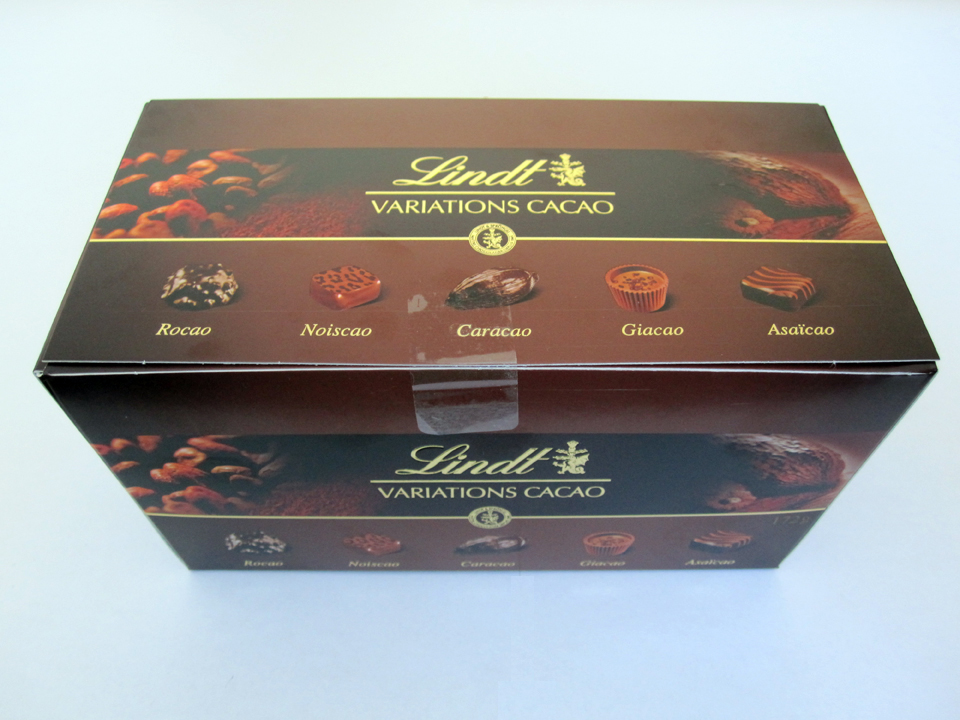
I’ve mentioned before that I don’t have too many chocolate options in the town that I live in, but that doesn’t mean there aren’t any surprises from time to time, especially in the sales. That’s when I’m willing to take a chance and pick up the boxes of chocolates that nobody else wanted to give a home to, and that was the case with Lindt Variations Cacao.
I haven’t picked up a Lindt box in a long time, but this one looked more interesting than most because it appeared to have a theme. Instead of just a generic term like “Truffles” or “Collection” on the outside, I was under the impression that this was all about the chocolate – variations in the cocoa percentages or types. I was only partially right.
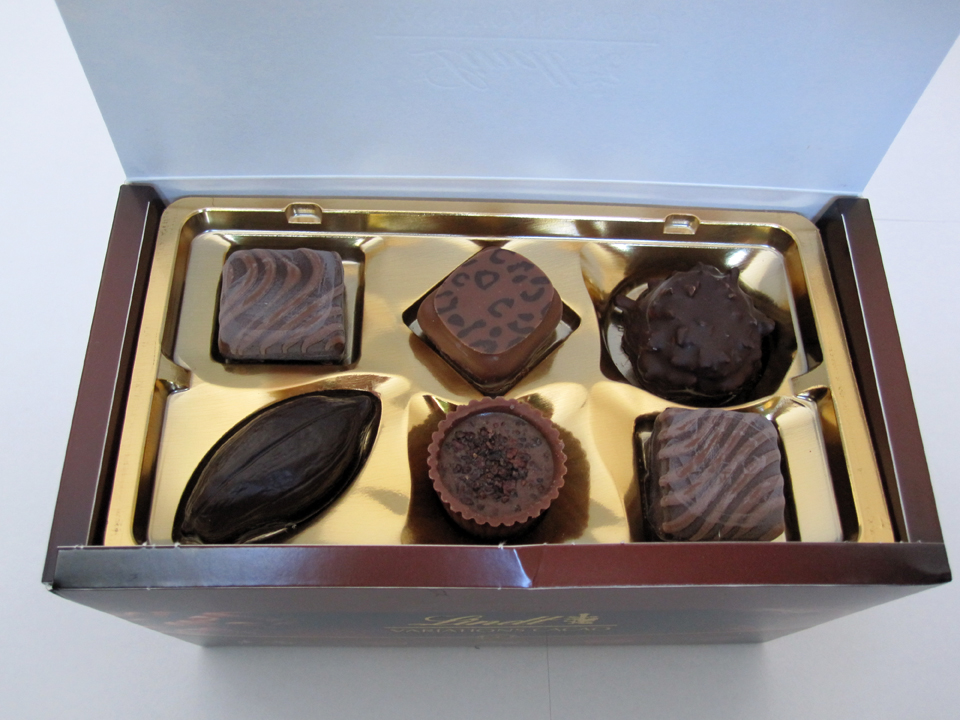
While there is a mix of milk and dark chocolates here, it isn’t particularly obvious because the fillings are almost given a higher billing. And with only five different types in the box, there isn’t a whole lot of variation in there. The five different kinds are:
Asaïcao – the most numerous chocolate in the box; there are six of them compared to three of all the others. And what did it do in order to deserve that honour? Well, it has a nice crisp texture and lots of hazelnut flavour in the praline but not much else. A very businesslike chocolate.
Rocao – a lovely dark truffle with a very generous number of cocoa nibs scattered throughout. Not too sweet with a fairly subtle flavour, but a little on the dry side which makes it a bit more crumbly than it needs to be.
Noiscao – some more of the hazelnut praline, but with some nibs thrown in to give it a bit of crunch. A bit too similar to the Asaïcao, but slightly preferable because of the sweeter milk chocolate and, of course, the nibs. I like nibs.
Caracao – definitely the prettiest chocolate in the box. The chocolate pod design looks great, with a nice chocolate caramel inside. Rather one dimensional, but a good rich flavour that stands up to the rugged 70% dark shell.
Giacao – just like the name suggests, this has gianduja inside the milk chocolate cup, along with some other chocolate paste. It doesn’t quite get the balance right because the flavour is dominated by chocolate with very little hazelnuttiness being able to break through. Nice to see more nibs on top; I’m loving all those nibs.
So while this wasn’t an unpleasant experience by any means, it wasn’t the most exciting box I’ve worked my way through either. With just five varieties, it is a bit one note especially with its love of hazelnuts that permeates three of the five chocolates and that makes the “Variations Cacao” moniker a little redundant. That puts my thumbs very much in the middle when it comes to this box.
Here’s a little something I picked up in Brussels the other week. Café-Tasse is one of hundreds of shops selling chocolate, but as the name suggests they actually sell more tea and coffee than chocolate. That said, there are still a fair number of bars available to buy. This particular bar caught my eye simply because it contained a hitherto untried combination of flavours. We’ve seen lemon and pepper more than once, and I tackled a strawberry and pepper combination last year, but never orange and pepper. Until now.

At 58% cocoa solids, I’d categorise this as ‘bittersweet’ chocolate. All of the principle ingredients are organic (the only one that isn’t is the natural orange flavour) and as you can see, the chocolate has a dark hue and a glossy sheen. The Café-Tasse logo is stamped across each of the six chunky fingers of chocolate that make up this 85g bar. There’s a definite citrus whiff to the bar, but it really comes into play when you pop a piece of this chocolate into your mouth. The orange flavour is there from the instant it hits your tongue, and it’s there until the last of the chocolate has melted. Then it’s the turn of the pepper, which builds gradually as the last of the chocolate tails off. It’s slightly unusual to begin, and I did find myself wondering if this might turn out to be one of those slightly scary spicy chocolates, but the pepper never reached threatening levels, providing a warming spiciness to the finish.
I found myself rather enjoying this bar. As I write this I still am.I doubt you’d find this outside Belgium, but if you happen to find yourself in Brussels it’s worth your while keeping an eye out for the Café-Tasse shop.
I’ve known Claire Burnet from Chococo for some time, so when the publishers of her first Chococo cookbook offered to send me a copy, I jumped at the chance.
The first thing to say about it is just how beautiful and colourful it is. The cover takes cues from Chococo’s packaging design, and inside is packed with photos. It’s beautifully laid out with each recipe and accompanying photo covering every page of the book.
The book starts with a brief introduction to how chocolate is made, the kinds of chocolate to buy, and what to avoid (anything with added vegetable fat). There’s also a brief guide on how to temper chocolate – something I tried and worked flawlessly.
There are 144 pages and more than 60 recipes, many inspired by Chococo’s own products. They’re categorised under ‘truffles & treats’, ‘cakes & bakes’, ‘cookies, biscuit cakes & drinks’, ‘desserts’ and ‘ice cream & sauces’. So there’s something for pretty much any occasion here.
The recipes are written in a clear and simple style, that even I can follow. Importantly, you don’t need fancy kitchen equipment to make any of the recipes either. I’m not a cook, but looking through this book, I’m tempted to try just about everything. I’ve not har a chance to make anything yet, but I’m definitely going to give a few some of them a go as soon as I can.
Highly recommended – and if you buy it direct from Chococo, your copy will be signed by Claire.
Chococo Chocolate Cookbook is published by Ryland Peters & Small. RRP £16.99.
Not called a Special or Limited Edition, Amano’s Chuao bar is a step above in the Signature Collection. As Dom and Michael recently explained when they looked at Soma’s version, Chuao is special of itself. Special enough to give this a $9.95 price tag (most Amano bars are $6.95). You’ll want to particularly note the artwork on the card box: it shows cacao beans drying in front of the Chuao church.
The coloring of this bar is slightly darker than in the Cuyagua bar; it’s a blue bar instead of a yellow. (Sidenote: perhaps it is Amano’s affluence with assigning colors to their bars that makes me like them.) Tasting notes given here are plums, blueberries, molasses, coffee, and almonds. I can’t say that I was so perceptive as to pick up up all of that, but it is a proper tone-setter to this 70% chocolate.
Starting off my journey were the berries, with some saltiness sparking up the halfway point. It’s deep like a black ocean. “Dark” doesn’t quite work because there is a grain of sweetness flowing through; “deep” works better. Like an ocean, it is ever increasing down and down, one-toned yet multi-faceted. There is a depth like wine to its richness.
I agree with Dom that it’s still an opinion whether or not this is the absolute best and most breath-taking chocolate; it is, however, also completely worth it.
I also received from Amano a larger selection of their boxed chocolates, so I’ll finish up with a quick look at the last of those.
Yemini Sidr Honey Ganache With Guayas Chocolate – A yellow dome with a smooth filling that is as bold and sweet and golden as real honey.
Cardamom and Pepper Ganache With Dos Rios Chocolate – The more adventurous spices are kept to a low enough key as not to offend; their tangy spark mirrors the melting pace of the chocolate.
Ocumare Palet D’Or – Shaped like two mountains moving past each other, there is a pleasant zip of sweet and spicy in this one that murmurs against the smooth chocolate.
Guayas Palet D’Or – With a sweeping and wavelike mark marking, this one is deeper and darker, tasting rich like raisins while remaining gentle.
It’s wonderful to watch as Amano expands: they’re on a roll of quality right now.