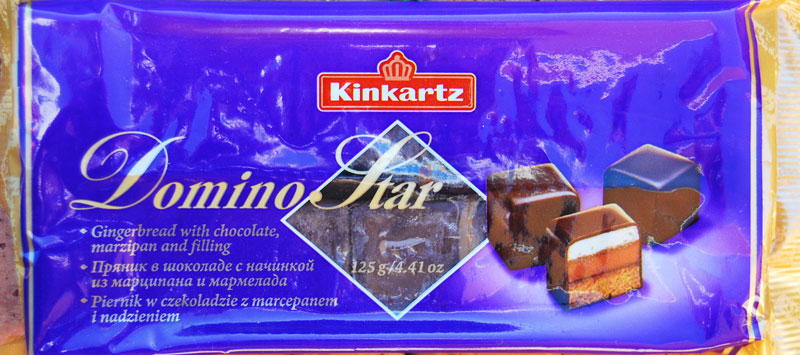
A while back I reported on a journey to our central food market, where I picked up a range of goodies. This is another from that haul. At the time, I had no idea what I was buying. It looked chocolatey, and I haven’t seen it in a supermarket. That’s good enough for me.
Today about 11am, I’d just come back from a trip to the bank. A cup of tea and something nice was called for. Elevenses. Those who remember their Paddington Bear books would of course know what I’m on about. Time to open something from the stash and see what it’s like.
Kinkartz, it turns out, is a German baker and gingerbread specialist, founded in 1872. Today they are owned by the German Lambertz group – itself founded in 1688. It’s quite astonishing for a company to still be in operation after such a time. A bit more hunting around reveals that Domino Star is a seasonal item – perhaps caused by the fruit jelly filling?
Each of these little morsels has a very soft chocolate coating. Even in a cool room, it’s slightly sticky / tacky to touch, which feels a bit unusual and is slightly off-putting.
Inside, the layers of gingerbread, a fruit jelly, and marzipan are quite clearly visible. How they are kept separate, and how the gingerbread does not go soggy are a bit of a mystery.
Eating these is a mix of flavours and textures. This starts with the chocolate – sweet and not very strong. The marzipan is powerful, the fruit jelly is sweet and sticky. And the gingerbread gives the whole lot a bit of body and a subtle flavour. It all certainly delivers a sugar hit. I’m not a huge marzipan fan, nor a huge sugar / sweet fan. In spite of that I found these to be quite pleasant, and I’ve been delving back into the pack – to confirm my original thoughts. Purely for scientific purposes, of course.
If you like your marzipan, seek these out. They’ll put a smile on your face.
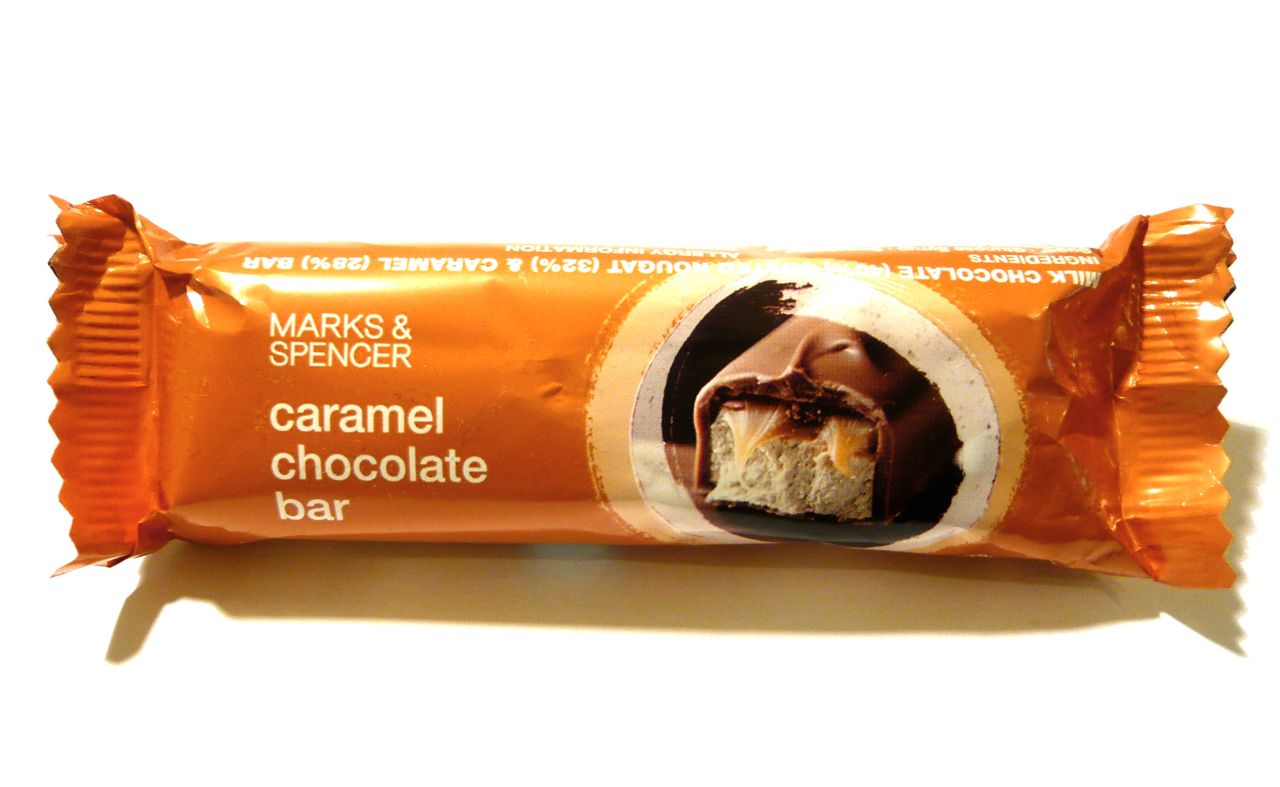
This, as you may have guessed, is an M&S Mars Bar. A 100% Made-In-Germany fake. I know it’s not just a coincidence that it looks a bit like a Mars Bar because they also do a Fake Twix, Fake Bounty and Fake Snickers (reviews coming soon, you’ll be excited to know!)
As you can see, once you get past the wrapper it looks exactly like a Mars Bar. There’s no cocoa percentage listed on the wrapper, but I can tell you the top ingredients are sugar, glucose syrup, sweetened condensed skimmed milk and vegetable oil. So you can guess that the actual cocoa content falls somewhere between “not much” and “practically none”. Just like a real Mars Bar!
It’s been a long time since I had a Mars Bar, but the taste seems pretty close to the real thing too. It’s very sweet, very sticky and after two bites quite sickly. In other words, it replicates the Mars Bar experience very well.
My initial impression was that there was less caramel her, but having looked back at some of my old Mars Bar photos, they actually look quite similar. Hardcore experts might be able to tell the difference, but I doubt I would.
So, for 40p you have a 55g bar that looks, acts and taste exactly like a Mars Bar.
My question is this: WHY??
M&S are known for quality foods. They’re a step up from other supermarket chains. What on Earth are they doing copying something as mundane as a Mars Bar? I don’t know if Mars/Masterfoods were involved in this or licensed the ‘design’ – I have to assume so because it’s only Mars products that have been faked – or if it’s an unauthorised copy, but that’s not really the point.
Admittedly, I purchased this in the M&S Simply Food in Marylebone Station where it’s obviously meant to appeal to passing travelers who want nothing more than a quick snack, but I still find it a little mind boggling that they would put their name to this. While the rest of the chocolate industry is slowly becoming more aware of quality, Marks & Spencer is putting its good name on what can only be described as junk food.
Note: You can read Simon’s review of the Strawberry & Pepper block here.
Lovely, kind, talented and generous chocablog reader Hannah read my tepid review on Hachez’s sea salt and tomato block a while ago and said that she’d found some other flavours in their range that seemed a lot more appealing. We’ve made a deal where she agreed to post me some from Canberra and I’ll find something equally unusual-but-delicious for her in return.
Hannah sent me two dark Hachez Cocoa d’Arriba blocks that use beans from Ecuador. Hachez’s website states that they make their chocolate direct from the cocoa beans that are exported from Ecuador in jute sacks direct to their factory in Bremen. This is comforting because manufacturers who make it ‘from scratch’ tend to be more loving in their preparation. Hachez don’t disappoint, as they conch (warm and mix) the cocoa liquor for three days instead of the eight hours of larger conglomerates which makes a much smoother and richer chocolate.
Considering that these blocks have travelled by shipping container from Europe to Australia on the high seas, been unpacked in a Canberra shop, purchased and wrapped in an postpak and sent on to Melbourne, they’ve survived remarkably well.
Hachez ‘Cocoa d’Arriba’ is their range of mild superior dark chocolate that all contain at least 77% cocoa solids and have a range of flavours. As you can see, the chocolate is still glossy (remarkable considering the miles it’s travelled) and beautifully dark, almost black.
The Strawberry & Pepper (on the left) smelled faintly of strawberry when it was unwrapped and snapped cleanly. In the mouth, it is the strawberry flavour that emerges first but not overpoweringly so. It then allows the fine dark chocolate to come to the forefront and enables the strong cocoa content to be fully noticed and appreciated. A few moments later, a slight peppery tingle makes its presence felt with some crunchy green peppercorn pieces to nibble on after the chocolate has disappeared.
Blackberry and Cocoa Nibs sounded even more interesting. As with the strawberry, it was the blackberry that I could detect first, then the melting richness of the chocolate and the scattering of crunchy cocoa nibs. This one was much harder to let melt slowly in the mouth because it was so much more fun to chew it and enjoy nibbling the nibs as they provided a tiny but strong burst of flavour to the very end.
These two blocks are really, really good. Neither are overly sweet and have ‘real’ ingredients that highlight the quality of the dark chocolate used and the flavours chosen by Hachez enhance rather than fight the main ingredient. Thanks, Hannah!
Some time ago (prior to a dose of what may have been swine flu which rendered my palate inactive for over a month) the people at Organic Meltdown sent over a brace of their bars for my attention.
If you’re looking for chocolate with good green/Fairtrade credentials then these bars have them in spades. All of the ingredients are BOTH Fairtrade AND organic, and to cap it all off, every bar has a code inside the wrapper which, when registered on the website, results in a tree being saved. Highly commendable for ethics and effort, so I was hoping that the actual product(s) would measure up on taste.
The first bar was a 58% Dark chocolate bar with raspberry and rooibos tea.
As soon as I popped a piece in my mouth I knew there were raspberries involved. The light, fruity tang is tempered by the rooibos and assisted by a little orange oil. It has a distinct yet subtle citrus zing which weaves its way in and out of a rich yet light chocolate. The cocoa flavours are light and the chocolate is smooth in the mouth, with a clean finish which leaves a hint of summer on the tongue. I enjoyed the smoothness of the chocolate as well as the flavour. Raspberry and chocolate are not an uncommon pairing but they aren’t always done well, and this bar delivers good fruit as well as the all-important chocolate.
Bar number two was a more straightforward 71% cocoa bar. The rich, almost earthy aroma hints at the flavours to come. Like its predecessor this bar is smooth on the palate, and it has a very upfront, slightly acidic start note which mellows as the piece melts on the tongue. Once again, it leaves the mouth clean and ready for more.
I found myself liking both of these bars for slightly different reasons. The Raspberry bar was very much a taste of summer – light and fruity with delicate flavours. Very much a lazy afternoon chocolate.
The dark bar presented good flavours and mouthfeel coupled with a similarly smooth finish. It’s a perfect ‘everyday’ dark chocolate, made all the more attractive by it’s fair trade, organic, treesaving credentials.
The main point about these products is of course that they offer the conscientious shopper products that give the producers a fair cut of the proceeds, support organic farming and promote conservation. Fortunately they also taste pretty good as well. It would seem that Waitrose stock them in the UK (along with a handful of health food shops) but for more detailed stockist information consult the web site.