It’s funny the things you find where and dressed up as what.
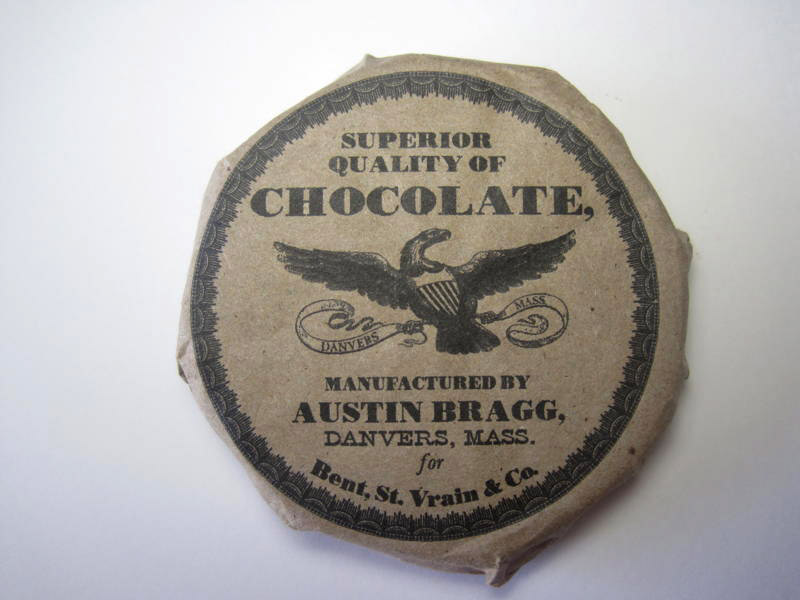
This chocolate here is my second New Mexico finding, this time from Taos. Specifically, the Kit Carson museum there. If you’re not familiar with Kit Carson, he is a figure of the West: trapper, trail guide, one-time military officer. A mountain man. The museum in Taos is at the home where he lived with his third wife, Josefa; the gift shop is small, but does contain a few goodies. Of most interest to me were blocks (yes, hard as wood) of tea and “Mountain Man Chocolate,” designed to give visitors a taste of the kind of fare Kit would’ve had. Labeled as immune to melting and priced at $3 (the tea was $4), it seemed the perfect chocolate to pick up. Raw and true novelty, I thought.
When I came to photographing it and unwrapping it (I’m a fan of living history), I again reveled in the brown paper packaging. As I expected, the chocolate circle is divided into eight wedges, each with a marking, like Mexican hot chocolate.
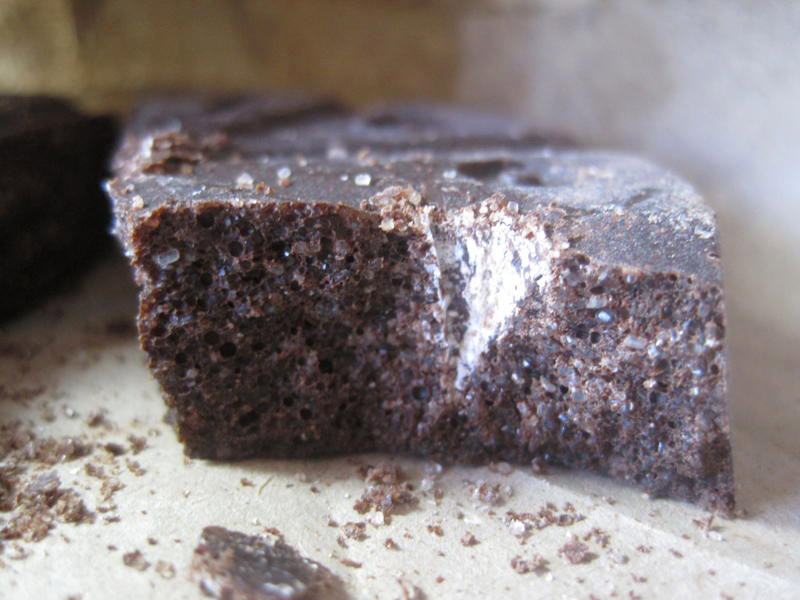
But the sugar crystal-studded texture was more similar than I’d been thinking. I had a disc of Ibarra hot chocolate on hand, so I brought it over to compare ingredients. Guess what? They’re exactly the same: sugar, cacao nibs, lecithin, and cinnamon flavor. Well . . . they are similar products, right? Then the final observation came in. What do those letters on the Mountain Man Chocolate spell? Ibarra. Even the two little circles on the extra pieces are identical.
Wait, you say, that says it’s made by Austin Bragg for Bent St. Vrain & Co., and Ibarra is made by Chocolatera De Jalisco. Well, I can’t tell you who Austin Bragg is/was, but a quick search reveals that Bent St. Vrain & Co. was a trade company in the West — Bent St. is right by the museum. If there’s a modern connection, I can’t find it (there is no other info on the label); all this appears to be is a little historical play. I’m guessing the museum is the one to repackage it.

That out in the open, the product itself isn’t terrible. You can nibble on it as is, but all of those sugar crystals can be a bit much this way. The intended use is generally the best one. To make hot chocolate, you just break off the pieces you want, put them into hot milk, and mix with a whisk. That grainy texture means that it settles if you don’t drink it right away, yet there isn’t anything quite like some Mexican hot chocolate. The cinnamon flavor and even the rougher texture. It also, I think, has a benefit from containing cocoa nibs versus cocoa powder. If only this was what I knew I was buying.
It isn’t a bad idea to repackage like this, and I don’t feel gypped. Just disappointed. The label should include a line that lets me know I’m getting something I can find in a regular grocery store.
It’s not often we write about chocolate related events before they happen, but I’m really excited about this one and wanted to tell you about it. This year, Chocolate Week coincides with London Cocktail Week, so what could be better than to celebrate them both at the same time.
Jennifer Earle of Chocolate Ecstasy Tours is organising an evening of chocolate & cocktails on Thursday 14th October at the swanky Longitude Bar in Piccadilly’s Le Meridien Hotel.
Earlier this week, I was lucky enough to be asked to “help out” tasting some cocktails and chocolates for the event, and based on what I tried, I think it’s going to be an amazing evening.
There will be introductions to the chocolates and the cocktails from Jennifer and the bar’s resident mixologist and you’ll learn how to properly taste the chocolate. Then you’ll get to sample some amazing cocktail and chocolate pairings, including chocolates from Demarquette, Paul A. Young, Lauden and Matcha Chocolat.
Some of these pairings will feature chocolates chosen for their complementary flavours, others will be cocktails that have been specially created to go with the chocolate. All of them are awesome.
You’ll get two full sized and five mini cocktails, with chocolates to pair with them. You’ll also get a little goody bag to take home with you. But best of all, you’ll get to spend a few hours in a relaxed atmosphere with lots of chocoholics. Is there a better way to spend Thursday evening?
We’ll be there, and we’d love to see a few of you too. Jennifer has been kind enough to set up a special offer to Chocablog readers – get £5 off the entry fee if you book online using the coupon code CHOCA1410.
Unfortunately there was a bit of an incident involving the outer wrapper of this Meybona mini bar which means I couldn’t photograph it. Luckily the rest of the bar was just fine, as you can see. Meybona isn’t terribly well known in the UK, although HF Chocolates in Milton Keynes do import and distribute these bars, so they must be available somewhere in Britain.
The chocolate seems to be a ‘standard’ for Meybona – there are a number of bars that they make using this blend. It’s a 34% organic chocolate and this bar contains coconut flakes rather than creamed coconut – something a lot of people will either love or hate, depending on how you feel about having bits of coconut floating around in your mouth I suppose.
As far as the taste goes, it’s… very average. Slightly greasy chocolate with (obviously) coconut flavour there from the off, but the cocoa notes just weren’t there. Compared to similar milk chocolates (notably the Cocopia mini slab I loved so much and almost anything made by any other ‘upmarket’ chocolate company) this just doesn’t deliver enough taste. It’s somewhat bland, slightly oily, and a little unpleasant.
My initial tasting was during a bit of a taste ‘session’, so thinking I might have overdone it, I set some aside for a second go, but the results were pretty much the same. Given that this bar is likely to be sold at a premium due to the fact it’s both organic and imported, it’s a bit of a let down.
Done better by many others, so why bother?
You might not guess it from the name, but Jeff de Bruges was started by a Frenchman called Phillipe. Personally, I think I would have gone for “Phillipe de Paris” as a name for my shops because “Jeff de Bruges” sounds about as sexy as “Darren de Dagenham” to me.
I digress. I happened to find myself in their Mayfair store at the weekend and decided to try these Gianduja “cornets”. I paid a princely £6.36 for 6 of them, making them a rather pricey £1.06 each. They’re not really cornets, but cone-shaped lumps of gianduja wrapped in little foil discs to look like an ice cream cornet.
We’ve talked about Gianduja before – most recently in our Hotel Chocolat Gianduja review. It’s simply a mixture of hazelnut paste and chocolate. It has a soft consistency, and it’s often used as the filling for chocolates, or for making desserts.
In this case, we have three varieties of gianduja – “original”, “dark” and “crispy”. You get two of each in a box, which is great for sharing – but not so great if you’re eating them alone, because gianduja can be quite rich and sweet.
These cornets are no exception to that, being just a little too sweet for my liking. The dark chocolate version is made with 52% cocoa solids chocolate, and the others with 30% milk chocolate, so even before the hazelnut paste is added, there’s a lot of room for sugar (and it is in fact top of the list of ingredients).
That said, they have a nice texture and a decent flavour if you eat them in moderation. I like the presentation, and the fact that you do get three different varieties here, but on balance, I think I preferred the Hotel Chocolat version.