Honeybuns are a Dorset-based company that specialise in gluten-free cakes, cookies, brownies and whole range of other baked goods. Started in 1998 by the the amazingly named Emma Goss-Custard, who cycled around Oxford delivering cakes to local business and cafés. Relocating to a farm in Dorset in 2001, the company now employs 26 people but still makes its cakes by hand using locally sourced ingredients where possible.
They were kind enough to send several samples to try, so let’s jump right in…
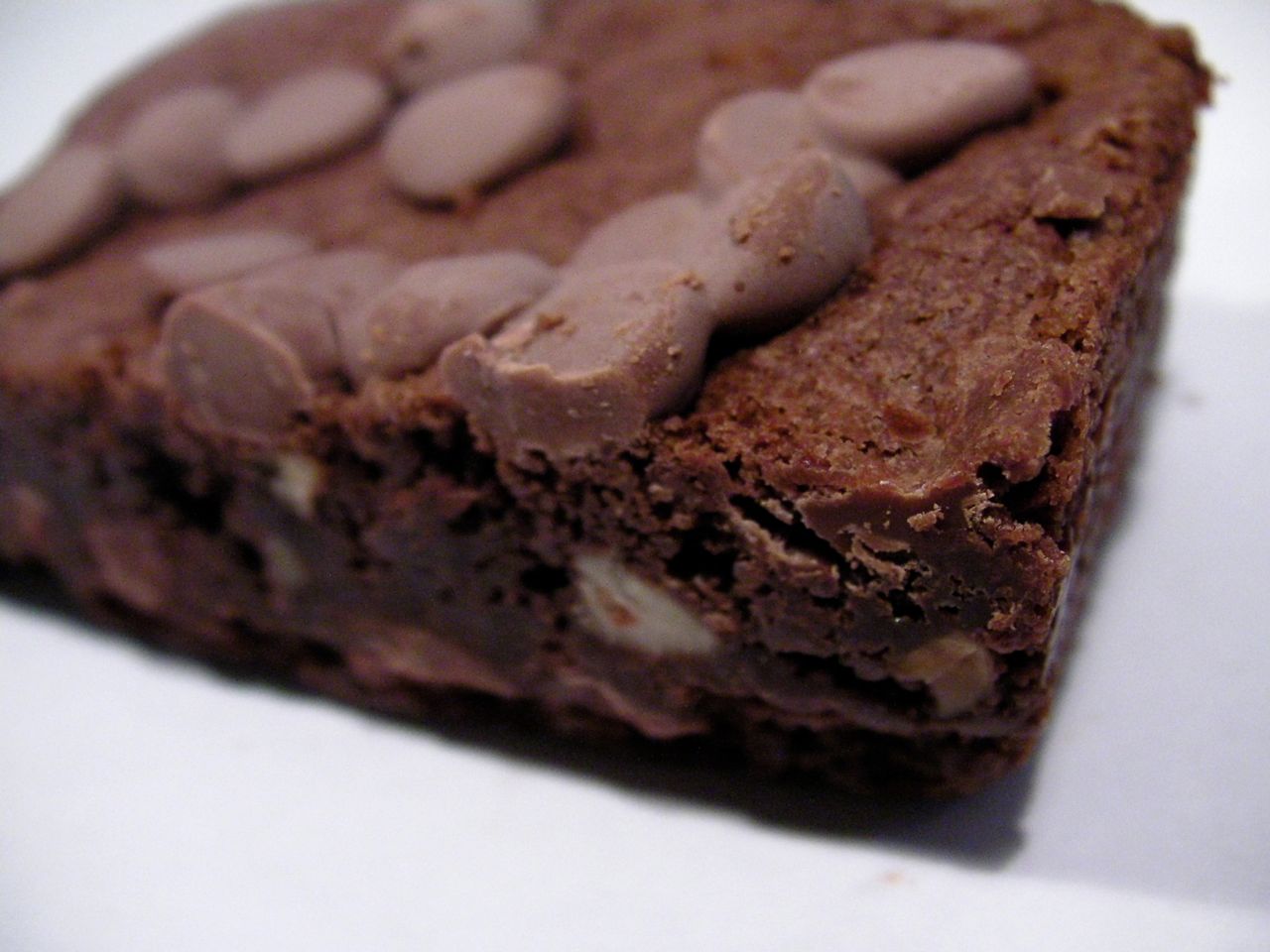
Milk Chocolate Brownie With Coffee
These come in 85gram or 40g “mini” sizes, are gluten free and come decorated with chocolate chips. I’ve sampled a lot of brownies over the years, and these are definitely worth trying. They’re soft and quite dense in texture, but taste light and chocolatey.
The coffee flavour is very subtle, but that’s just the way I like it, as the chocolatey flavour comes through rather nicely. Overall, one of the nicest brownies I’ve had recently, although it doesn’t compete with my all time favourite.

Coppice Cake
A gluten free sponge cake with chocolate chips and cranberry. Like the brownie, it’s light and moist and melts in the mouth. Made with hazelnuts, almonds, polenta and free range eggs, it’s not particularly chocolatey in itself, but the dark chocolate chips are sizeable and add a chocolatey dimension. A great cake that went down very nicely with a cup of tea.
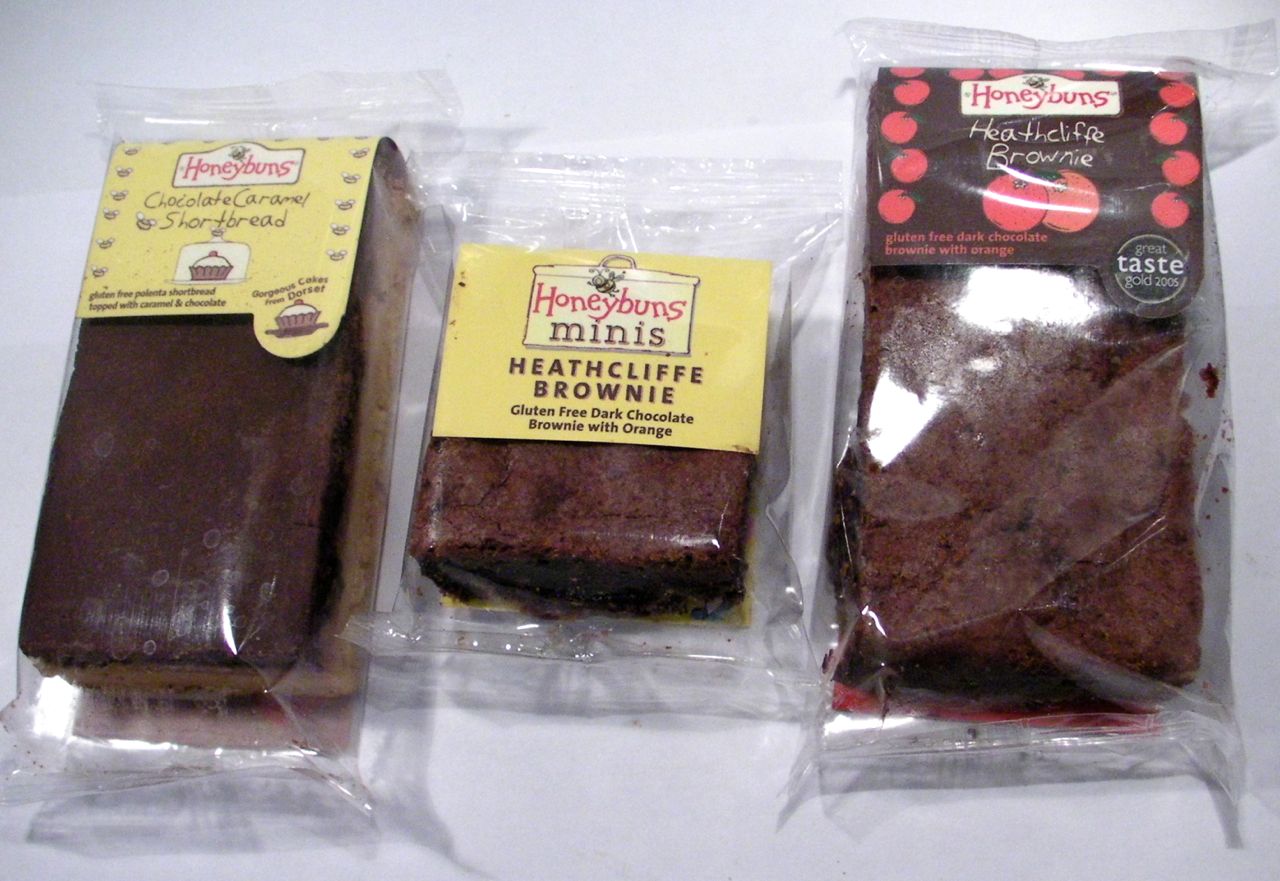
Chocolate Caramel Shortbread
A thick slide of shortbread covered in caramel and Belgian dark chocolate. Like the cake, the shortbread is made with polenta and is gluten-free. It has a nice crunchy texture and a good flavour although it is a little too sweet for me. That probably just means that normal humans will love it.

Triple Chocolate Tinker Cookie
A 50g chocolate chip cookie made with almonds and rice syrup. This one wasn’t quite my cup of tea as the texture just wasn’t cookie-like. It’s soft and chewy, but more like a very dense cake than a cookie. The flavour wasn’t quite right either, with a slightly burnt aftertaste.
Heathcliffe Brownie
Finishing up with another winner, this brownie is made with dark chocolate and orange oil. The scent of the orange hits you as soon as you open the wrapper. Like the coffee brownie, the texture is dense but light and it melts in your mouth. The orange is perfect, tasting natural without being overpowering. Very tasty indeed.
Overall, with the exception of the cookie, an impressive and tasty gluten-free range. Worth seeking out.

Although Zorba’s Chocolates is based out of Ashland, Oregon, founder and chocolatier Todd Bjornson calls Sedona, Arizona the place where he was first introduced to raw chocolate; this is of interest to me since I spent most of my time growing up less than an hour away from Sedona, the town known for its beautiful Red Rocks and, er, hippie tendencies. Zorba’s started as an in-home thing that soon expanded out to friends and family. The company believes in being local, raw, organic, and sustainable; their chocolate is sourced from a co-op of farms in Ecuador and is never heated above 118 F (48°C).
I have received several items from Zorba’s, starting with this clear bag of Spiced Chocolate Almonds. The chocolate ingredient is raw cacao powder, accompanied by such things as coconut palm sugar, ginger, cinnamon, vanilla, Cayenne, Himalayan Sea salt, and essential oils of orange. Since they’re raw, the almonds are more chewy than crunchy; this suits me just fine as I usually eat almonds raw, anyway.

What occurs, though, when you eat these is the forgetting that you’re even eating nuts–there is so much flavor that it’s almost more like eating a brownie or even a truffle. Note that the name says “Spiced,” not “Spicy.” I imagine only those most intolerant to spiciness would call these spicy. It’s the ginger that’s fairly strong, with the vanilla and orange oil having as much say as the Cayenne and cinnamon. Being accompanied by all this, the chocolate tastes rich and not black-dark. These are the perfect flavor complements for raw almonds.
The coating on the almonds is difficult to properly describe. It’s like chocolate, but more crumbly. Yet it stays in place and doesn’t make a mess, which is a very nice characteristic. Although a couple of the almonds are lone, most exist in clusters. Personally, I would prefer more individual almonds. Eating individual pieces is part of the fun of eating nuts.
Yet this is a great product, the perfect treat for the health-conscious person. As a hiking snack or something to keep in your desk, a bag of these almonds will do you and your palate good.

In a previous post, I wrote about a Mikado chocolate from Croatia which was ok but not outstanding.
As the weekly meeting rolled around, we found that this time we had one with a much higher cocoa percentage; something to keep us Dark Side Dwellers happy. And orange peel – interesting. As I, and others, have written before – chocolate and orange is a classic combination which can be good – and can be awful.
Refreshing my memory here at Chocablog, I noticed that many of the readily available block-n-bar-and-lumpy-bumpy choc-orange thingies tend to limit the cocoa content to about 50% or perhaps 55%. Thinking about this a little, I’d hazard a guess that this is done to try and use sugar to balance the overall bitterness of a dark chocolate with the bitterness of the orange peel. Too much cocoa, or too much orange, and I can see how the combination might be a little unpleasant. A 72% cocoa chocolate with orange is really only comparable to the Kaoka Noir Orange which I tried a couple of years ago.

Apart from balancing sweetness and bitterness, one of the other effects of putting the cocoa at around the 50% to 55% range is that the chocolate seems to break more easily, and melt away a little faster. High cocoa chocolates (in theory) should be more intense in flavour but they also seem to have a bit more “snap” and melt away a little slower.
After the weekly meeting the collected opinions of the chocolate-munchers tasting panel was divided. One person who does not like dark chocolate was quite unimpressed: “Too bitter – I could not eat more than one piece” I disagreed, I didn’t really detect a lot of bitterness. But then again I happily munch on a Whittakers Dark Ghana 72% which is a fairly intense gob-smacking dark chocolate.
A few of the group quite liked this, without really passing any other more criticial judgement. But what struck me was that the flavour of orange was not very strong, and the chocolate flavour took a long time to develop. This led me to the two ways of eating chocolate: Crunching it up and gobbling it down like a pig just led to disappointment. The chocolate is not very chocolatey, and the orange is not very orangey. In fact, you would struggle to tell there was any orange in it at all.
Letting this slowly melt tells another story. The chocolate flavour develops slowly and builds to a pleasant intensity. It is not a strong dark chocolate, but it’s not bad. During this slow melting there is a little orange flavour, but not a lot. Once the chocolate has melted, the orange pieces then do have an orange flavour, and are a pleasant thing to suck on (noisily if you can get away with it!) or just chew up.
So to really get the enjoyment, you need to work at it. That’s actually a bit disappointing – there are other orange chocolates that are better.
The last words go to one of the tasting group who summarised it thus: “insufficiently orangey”.

When I first observed sweetriot about three years ago, their only products were the tins of chocolate-covered cacao nibs; I enjoyed these for their uniqueness and quality. Now sweetriot has introduced, in three flavors, what they call the riotBar. Anyone who has ever come across sweetriot before will recall their particular brand of marketing, which aims to convey world awareness, peace, healthfulness, etc. So the set of bars sweetriot sent me are all Fair Trade Certified and USDA Organic, wrapped up in art by Lindy Gruger Hanson in a similar way to the style of the tins. They tag in at around $4 each, which is pretty average for bars of this size that are both organic and Fair Trade.
The first of the three is a 60% with cacao nibs, giving it some semblance to the original chocolate nibs. The bars all break into thirty small pieces of what I find to be the ideal bite size for chocolate; the idea here is supposed to be portion control, with each piece being either 20 or 21 calories depending on the bar. With all of its cacao nibs, the 60% is much like the experience of eating nibs, only with more chocolate to bate it all out. That blueberry taste nibs have is all over this one.
With the 70% came a strong reminder of Ghirardelli; the two have a similar levelheadedness of tone. I do believe they must be siblings. There are warm undertones to the chocolate, though probably they’re a little more developed than Ghirardelli’s. The problem that I have is that all of these bars are a little hard, melting very slowly like chocolate that’s starting to get old. I hope and expect that this isn’t usual.
When people ask what percent chocolate I like best, I usually respond with the 80’s; though higher cacao percentages can be amazing, they’re also more difficult to get right. Consequently, sweetriot’s 85% bar was bound to befriend me. It gives bitter and dusty hints before mellowing out, making it almost like a combination of the previous two bars. It’s entirely like a flourless chocolate cake with its flavorful weightiness. At the very last portion, the strong chocolate notes really start to get into your bones.
These are quality bars, and I appreciate sweetriot’s ethics. The last bar obviously pleased me, but I feel like I want something more from the first two. Don’t get me wrong; they’re nice. It’s just that the look of sweetriot is bright, half-crazed, and shouting with a voice to be heard. The 60% and 70% don’t seem to quite reach that kind of expression; when I’m promised much, I want much.