Last week Chocablog’s Canadian correspondent Michael was visiting the UK, so I took the opportunity to show him round some of London’s chocolate shops. We visited eight shops in total, and I picked this bar up at Rococo’s Motcomb Street shop.
It’s a 70g bar of 65% organic dark chocolate, made with beans from Rococo’s “Grococo” farm in Grenada. Produced with the Grenada Chocolate Company, it’s one of the most ethical chocolates money can buy, but of course what really drew me to this was my almost fanatical love of ginger.

The chocolate follows the same format as the other Rococo artisan bars, like the Basil & Persian Lime I reviewed last year. It has a nice glossy finish and a good clean snap. Like that bar, this one uses essential oil for flavouring, and for me that’s where the problem lies.
The ginger flavour is subtle, very subtle. If you don’t like ginger as much as I do, that’s fair enough, but when I bought a bar called ‘Crystallised Ginger’, I was hoping for chunks of ginger embedded in the chocolate. Preferably very large chunks. Alas, this chocolate is entirely smooth, and while it does have some ginger flavour, there’s no heat at all.
I don’t know that I was ever going to be completely satisfied by a ginger bar without a real kick, and that’s not necessarily Rococo’s fault. The chocolate is nice enough, it’s just too subtle for me!

With the hot and sunny weather we’re currently having in the UK, it’s easy to forget that it’s almost October, and for chocolate lovers that means just one thing: Chocolate Week is just around the corner!
From October 10th – 16th, there’ll be a huge variety of events happening up and down the country, so we thought we’d give you a quick preview of a few of them. You can search for events near you using the Chocolate Week Event Calendar.
The Cocoa Time Bomb
For those who are serious about chocolate and sustainability, SeventyPercent.com are holding a discussion about some of the threats and challenges facing cocoa production. The event takes place at Waterstones, Piccadilly and entry is free but you need to book in advance. Details here.
Rococo
Rococo Chocolates are organising a range of events including a chocolate dinner at Hardy’s Brasserie, a recipe competition and several themed tasting sessions. You can find out more about there plans on their website.
Fortnum & Mason
Fortnums & Mason are celebrating Chocolate Week with tasting events, demonstrations and talks from Monday to Friday. Full details of all the events are available on their website.
Chocolate Walking Tours
Chocolate Ecstasy tours have two special walking tours of Belgravia’s chocolate shops including chocolate high tea! Full details here.
Tastings & Demonstrations
There are chocolate tastings and demonstrations happening up and down the country all week, so if you’re in the UK, there really is no excuse not to try some great new chocolate. There are far too many events listed here, but you can find one near you by clicking here.

Chocolate Unwrapped
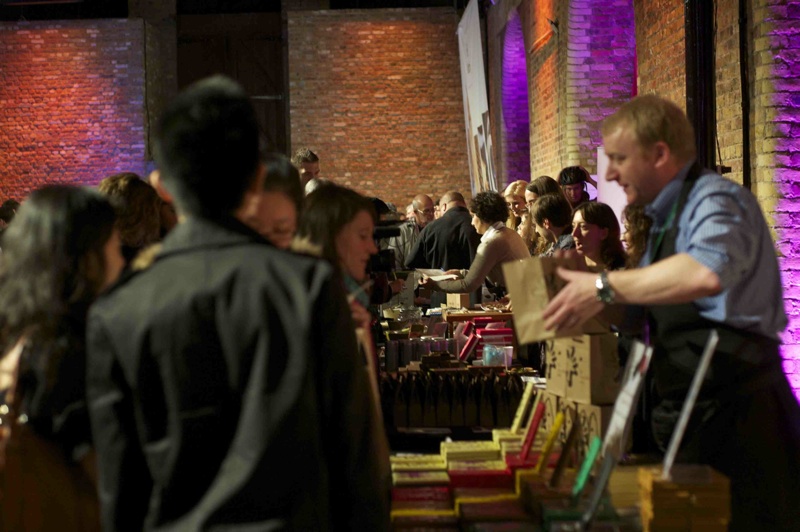
The highlight of the week is once again Chocolate Unwrapped at Vinopolis in Borough, the heart of London’s foodie district. The chocolate show takes place of the weekend of the 15th & 16th and brings together chocolate makers from all over the world. There are demonstrations from some of the top names in chocolate (including William Curley, Paul A. Young, Chantal Coady) and over 40 companies exhibiting their products.
Tickets for Chocolate Unwrapped are £8 in advance (buy online here) or £10 on the door.
Great Chocolate Cake-Off
If you’re a home baker, why not enter the Great Chocolate Cake-Off! This chocolate cake baking competition is open to everyone, with entries being judged at Chocolate Unwrapped on Sunday 16th October. I’ll be helping out with the judging, so I’m looking forward to sampling some really chocolatey recipes!
As well as the chance to win some great prizes, all Cake-Off entrants get free entry to Chocolate Unwrapped. But the competition is limited to just 30 entries, so act fast! Full details here.
There’s loads more going on all week, so do check out the web site. And let us know if you’re doing anything special for Chocolate Week yourself!
httpv://www.youtube.com/watch?v=2-ZRlFygB7M

Dom has already had a taste of the Åkesson’s Milk Bar with Fleur de Sel (which sounded rather lovely), and now it falls to me to investigate a dark bar made with cacao from Åkesson’s Brazilian plantation.
This time the distinctively moulded bar is a dark, rich reddish brown colour and is made with 75% Forastero beans grown by the fifth generation of cacao farmers in a region of Brazil that has the highest biodiversity on the planet. The variety of beans grown is known as ‘parasinho’ and is grown on 150 hectares on land in the middle of the Mata Atlantica in Bahia.

The chocolate has quite a woody, citrussy smell about it, and when it hits the palate it’s immediately incredibly smooth and soft on the tongue. Those woody, acidic notes are there right away, backed up by quite mellow, well rounded cacao with a hint of deep red fruit. The finish is clean, with a lingering citrus/wood note. The packaging blurb mentions that this cacao has a hint of the local Pitanga fruit about it, but of course I’m not in a position to be able to confirm or deny that particular claim.
What I can say is that this is further proof that Åkesson’s are a company with a future. They were very popular at the Academy of Chocolate awards this year and I recall tasting their wares. Dom was quite keen on their 43% Fleur de Sel bar, and its darker sibling is certainly worth a look if you like your chocolate fruity, acidic and smooth.

I’m excited! There’s a new chocolate maker in town. Well, in Australia. And this time, it looks like the real deal.
So what am I excited about? I’d better explain.
First: some terminology. Cocoa is used to make chocolate, but it comes from the Cacao tree (Theobroma cacao). I’ve seen an explanation for the difference in spelling being attributed to variously, non-standardised spellings until the publication of Samuel Johnson’s Dictionary of the English Language in 1755, or to just plain spelling or clerical error somewhere between about 1650 and now. Whatever the cause, it seems fair to assume that the explanations are probably apocryphal. Here, I use Cacao to mean the tree, and Cocoa to refer to anything produced from the tree – this seems a fairly common usage.

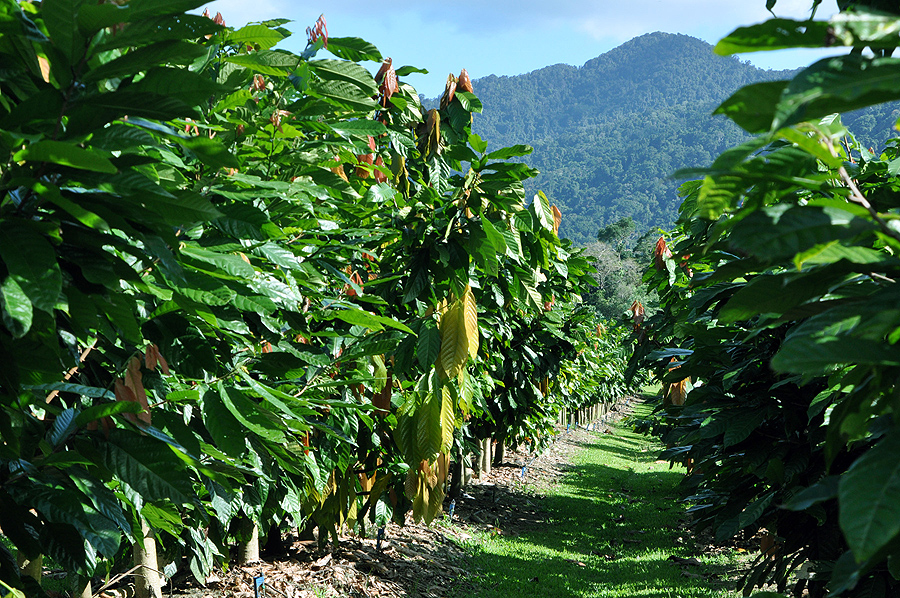
Cacao trees grow in a tropical, hot, humid environment – hence coming from places like Central South America, Africa, and so on. The rough rule of thumb is “within 20 degrees of the Equator”. And that puts northern Australia into the regions that could grow Cacao. In particular, parts of northern Western Australian, Northern Territory and far north Queensland, provided the soil, rainfall and so on were suitable.
The various Australian State Government departments of agriculture have conducted a range of studies into Australian Cacao, in some cases going back to the 1960’s. In the late 1990’s the possibility of growing Australian Cacao became a lot more serious, when Cadbury Schweppes Australia and the various northern government departments of agriculture formed a steering committee to examine the feasibility of an Australian Cocoa industry.
The committee was not just limited to doing academic studies. Feasibility was examined by study tours of Cacao growing in other countries, as well finding trial sites, obtaining plants, doing trial plantings, examining yields, production methods, flavours, farm economics – you name it, it was considered. The project ran for around 8 years, and the various government departments have released one of the most comprehensive reports ever written (4Mb PDF link) about Cacao growing. Reading the report, I’ve learned a great deal – one of the most interesting topics being fermentation. I’ll leave that for interested readers to dig into more. Suffice it to day, the methods might come as a bit of a surprise.
Some of the trial sites mentioned in the report are no longer growing cacao, while others were destroyed in a cyclone. But some are still going – and in spite of various commercial intrigues there is a small industry just getting started at Mossman, far north Queensland. Whilst Cadbury Schweppes Australia may have had an initial involvement, this is no longer the case.

Based on the promising results from the trials mentioned in the report, several sugar cane growers started Cacao plantations in 2007, and in 2010 joined forces with a consortium of chocolatophiles to form Daintree Cocoa.
At less than 10,000 trees in total, the estates now established are very small by world standards. The growers are taking a gamble – especially knowing that so much of the processing must be by hand, and labour costs in Australia are high. The company has decided on a vertically integrated business; doing everything through growing, picking, pod splitting, fermenting the beans, drying, conching and chocolate making.

Some of this may sound familiar. We’ve heard before about an Australian chocolate company that was making grand claims about sourcing raw material in Australia, which later turned out not to be the case. We at Chocablog were caught in the crossfire of this little fight. To avoid being caught up in similar dubious claims, we’ve done quite a lot of fact checking. This time we seem to have the real deal.
This ambitious project has just taken its first few steps – they have actually made chocolate, with 100% Australian grown Cacao and sugar from the Mossman Central sugar mill. Currently, the beans are processed to the nibs stage in Queensland, then sent to Melbourne for making into chocolate. This arrangement will soon change, with chocolate making equipment on its way to Mossman, where the whole process from tree to blocks of chocolate will be performed locally.
The first commercial batch has just been made, and I’ve been fortunate enough to have received a sample. A proper product launch is expected in October/November 2011 – so we’re fortunate in having a sneak preview.
Commercial chocolate is just like commercial winemaking – great care and attention is paid to sourcing, processing, and blending to get a consistent flavour from batch to batch and year to year. The big makers have their house flavour, and if they deviate too much customers may be surprised or disappointed and might stop purchasing the product. If, like me, you are fortunate enough to live in a region where lots of grapes are grown and wine is made, then an interesting weekend can be spent touring a wine region and tasting the products of the smaller winemakers. Why the smaller? Because with the large makers you know what you will get, and you can pick it up in your bottle shop or supermarket any time. The smaller makers have variety, curiosity, interest, and a high likelihood that nothing from one year to the next will be the same. The vagaries of nature mean you can always find something interesting which will be hard to find anywhere else. And different is good!
So this is the plan for Queensland / Mossman chocolate – single estate origin chocolate will vary between the growing sites, and will vary from year to year. If you want consistency, go to the supermarket. Single estate origin will be interesting, curious, and challenging – so we have an interesting time coming. If the growers can pull this off then there will be chocolate tourists heading to Queensland the way that wine enthusiasts visit the Barossa Valley. Even if it all ends up blended, Australian chocolate will be different to what you will get from other countries. And we can be sure that while the industry is small, there will be variation from year to year.

After all this explanation and build-up – what’s it like?
Firstly – my samples arrived in a post bag, and opening it gives a very pleasant, slightly earthy aroma. Clearly, the bag has chocolate in, but the aroma is has an unusual richness and complexity. It’s hard to describe but imagine a mix vaguely like dark cherries, stewed apricots and brown sugar and you might be getting close.
There are two chocolates: a milk, and a dark.
The milk is 45% cocoa solids and has quite a rich and creamy aroma. Creamy is surprising, and not something I think you can normally smell – but that’s the only way to describe this. The flavour comes in layers, starting very mild and building in complexity – there’s quite a hit of caramel, and it is hard to know if this comes from the cocoa content or the sugar. Because I’m a dark side dweller I’m a harsh critic of milk chocolate, but this I like. It’s a little unusual and I’d happily eat quite a lot of it.

The dark has a closed aroma – you have to work to sniff anything out of it. Nor does it have the same caramel flavour as the milk. This is mild, subtle, sweet, and very very smooth. If I did not know better, I would never have picked this as a 70%, it is however absolutely delicious and by the time a single little sample square is gone I’m ready to open another. Sometimes comparisons help: a Lindt 70% is stronger and more intense in flavour; the readily available Green & Blacks 70% by comparison is huge, big, sharp, and almost prickly. Imagine being caressed by silk handkerchief on a cool spring day.. and compare that hitting your thumb with a hammer. That’s the kind of difference.
This is a very easy eating chocolate and I could scoff it down all day.
Update: You can read Dom’s review of Daintree Estates Australian Chocolate over on the World Chocolate Guide Chocolate Blog.