This was always going to be an interesting bar for me. Just how do you marry together the flavours of fine chocolate and something as earthy and powerful as black truffle? Well, those Mast Brothers have done just that with this 74% dark chocolate bar, adding a pinch of Maine Sea Salt as a counterpoint to Italian black truffle..
Have you ever eaten black truffle? If you have then I’m sure you know how strong a flavour they have. Not something one would necessarily associate with fine chocolate, but of course if someone like the Mast Brothers offer it as part of their range you know it’s going to work. The origins of the beans in this bar remain a mystery, which is the case for almost all of the Mast bars, and it’s a little strange given that if you take one of their factory tours you are presented with the whole range of beans they use in their bars and allowed to taste each individual variety. When it comes to the bars themselves though, no information is given about which beans were used in which bar, and in what quantities.

I would have been surprised if the first flavour had not been the black truffle. As the small rectangle of chocolate met my tongue, that deep, earthy flavour sprang out at once but it was only the main flavour for a few short moments because as soon as the chocolate began to melt balance was achieved. The rich, mellow flavours of the chocolate (kicked up a notch by the additional sea salt) flooded my mouth, pushing the earthiness of the black truffle back and delivering deep fruit and wood notes with that sweet & sour combination holding up to the last. The truffle is there to the 9Long) finish but it’s never allowed to get out of hand, being held in check by some fairly powerful cacao.
How did I feel about this bar? Personally I liked it a lot. I might even go as far as saying it’s one of my favourite Mast Brothers bars, but I’d be hard pressed to say it was an absolute favourite. It’s certainly unusual, definitely ‘grown up’ chocolate, and absolutely worth tracking down if you like your sweetness tempered with a little salt and some dark, earthy flavours.

I was browsing for chocolate in my local Foodland the other day, and stumbled on Alter Eco. They have a range of chocolates, so I bought a few. This is the first of those that I have tried.
If you’re into Fair Trade ideals, this should push all the right buttons: 100% natural, no artificial anything, small-scale farmers, co-operatives, traditional farming methods, unrefined cane sugar, almonds, helping Bolivian families in the Amazon. Gosh. There is just enough room left on the pack to say what the ingredients are.
This all sounds very fine and idealistic, so I had high hopes of an exceptional product. Sadly, I’ve ended up pretty disappointed. I even gave this a decent chance, opening it on a warm late-summer day when aroma and flavour should have been released quickly and easily.

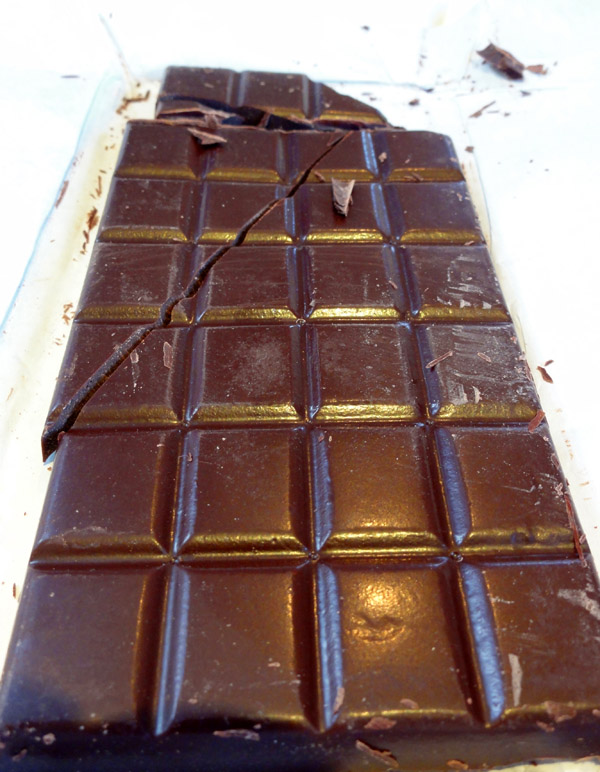
As you can see from the photo, there are is a fair bit of nut showing from the back of the block – the labels says almonds are 12%. The block is simply formed and compares to other commercial products. From there, though, it’s pretty much downhill.
The chocolate is quite hard, and has little aroma. It melts slowly, and during eating it develops very little flavour. The nuts are not very nutty.
This chocolate should be good – use of unrefined cane sugar should give a sweetish fruity / earthy tone, but it’s not there. The almonds could have been roasted or better toasted or something to lift their flavour and crunch. The chocolate, perhaps would benefit from some blending. It’s very unkind but the best analogy I can come up with is that this chocolate is comparable to eating vaguely cocoa flavoured cardboard. OK, that’s a bit harsh but you get the idea.
The texture is disappointing, the flavour and aroma are disappointing, the whole experience is disappointing – and especially so when this is about 3 times the price of a comparable block of Lindt.

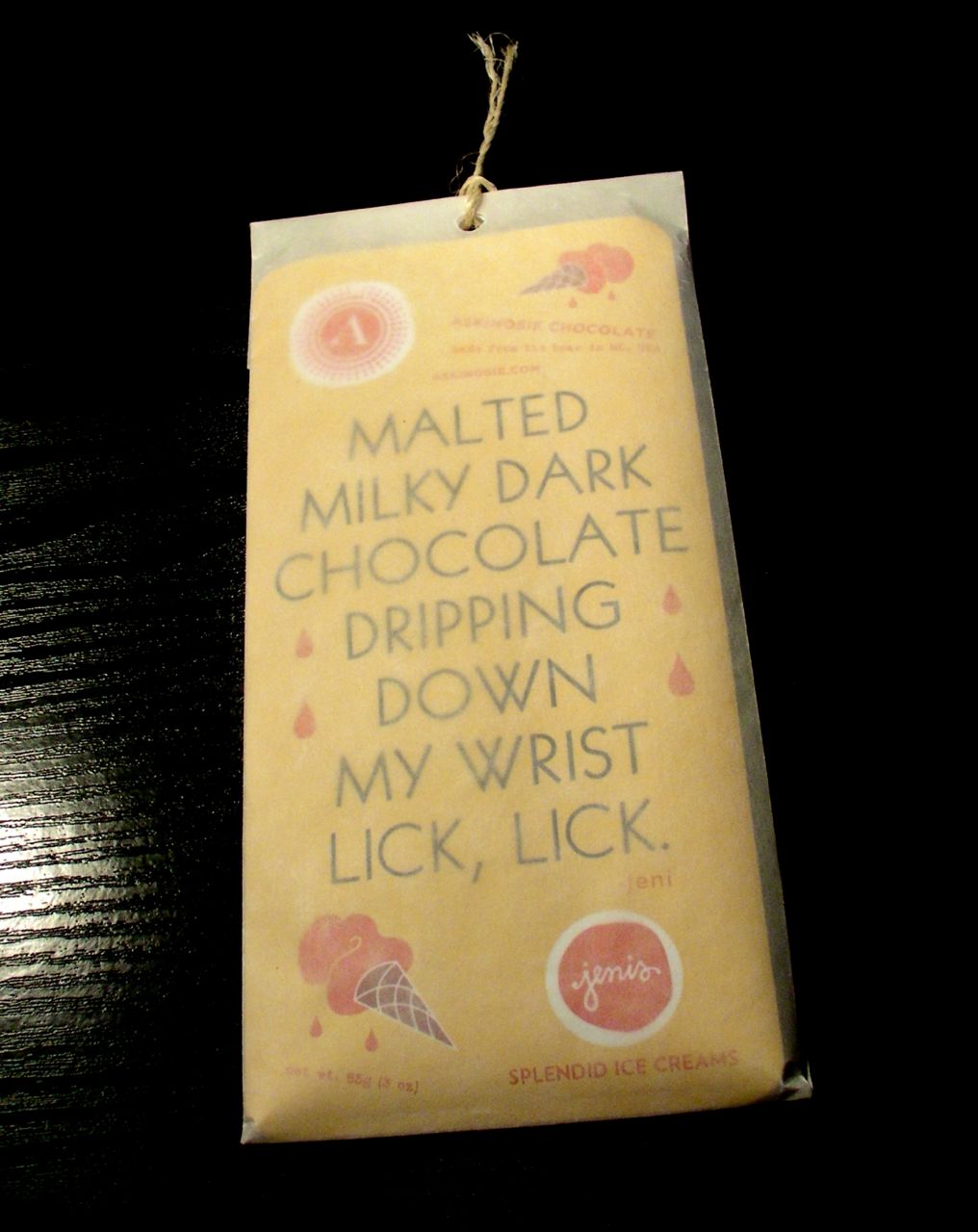
The first thing I noticed about this bar was the packaging. The simple translucent paper, showing a card insert underneath is a step up from the rustic Askonosie packaging I’m used to, but still retains a handmade feel.
The second thing I noticed is that there’s no cocoa bean origin listed anywhere on the packaging. More surprisingly, there’s no cocoa percentage listed either. That’s very unusual for a bean-to-bar chocolate maker like Askinosie, so I can only assume it’s by design rather than an oversight.
The information was easy to find though. A quick look at the website shows that this bar is in fact 60% cocoa solids – very impressive for a dark milk – and a tweet to @Askinosie and I quickly get the answer that the beans are from Tanzania.

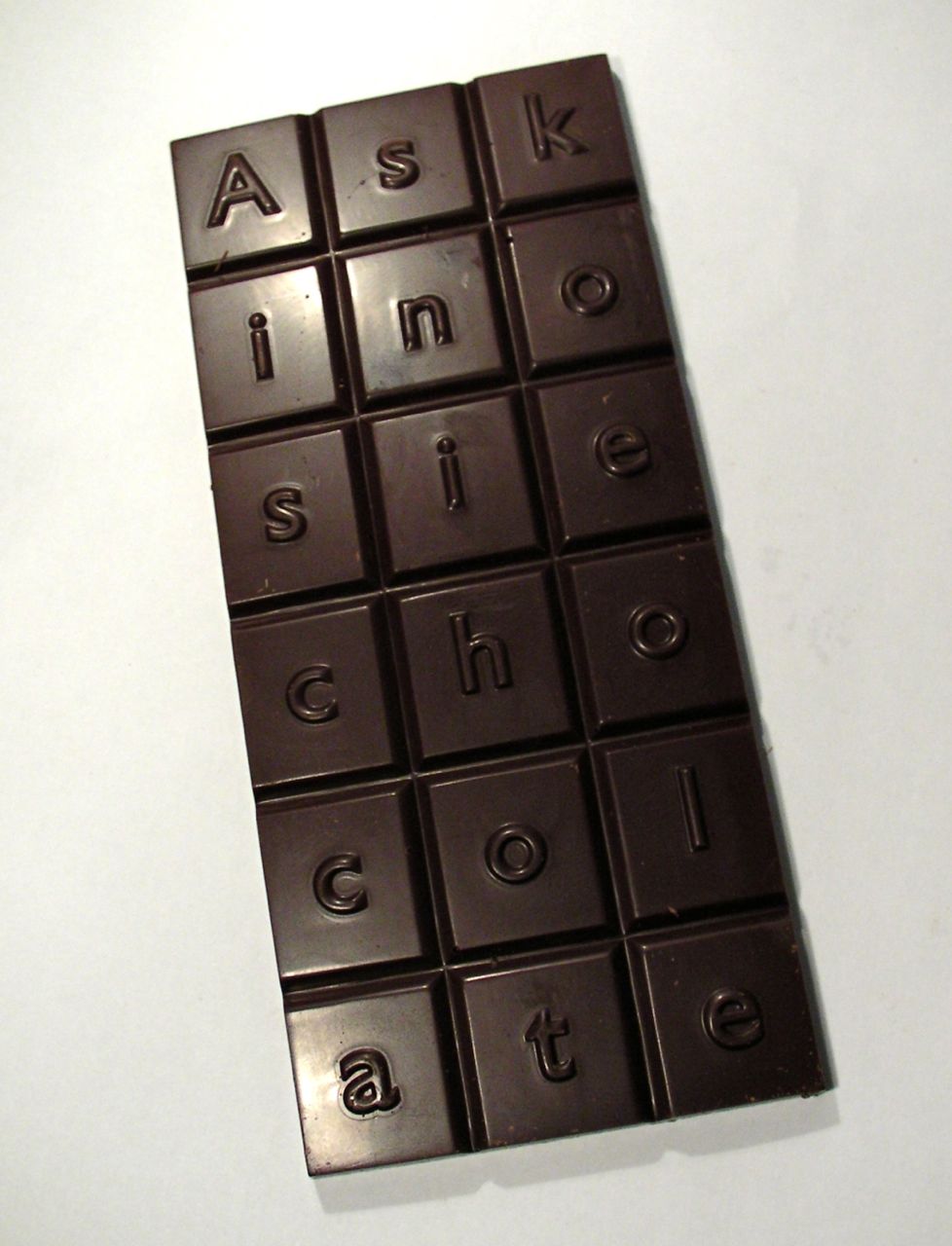
As you can see, it’s a beautiful looking bar, following Askinosie’s usual format of one-letter-per-square, with a rich, dark colour and beautifully glossy finish. It’s almost a shame to break into it.
I really like the flavour. After an initial fruity, dark chocolate burst, the flavour evens out to a rich, smooth malted milk. It’s not sweet, thanks to the hefty cocoa content, but it is very smooth and creamy. There’s a very slightly bitter aftertaste, but not an unpleasant one – it’s just enough to make you want another piece.
The malted milk powder works so well with this particular chocolate, and the result is something that really stands out from the crowd. And I can’t stop eating it.
Certainly one of my favourite dark milk chocolates, and well worth seeking out.
Thanks to Judith who gave me this particular bar.

Those of you who follow me on Twitter may have noticed that lately I’ve been experimenting with making my own chocolates.
I’ve not been doing it because I have ambitions of being a chocolatier, but simply because it’s fun and I want to learn. I think it’s a great way to help understand the time and skill that goes into producing the chocolates we review on Chocablog every day. The more knowledge I have, the more accurate my reviews will be.
But of course the main reason for doing it is simply because it’s a fun way to spend a weekend afternoon!
I want to write about some of the things I’ve made, but more importantly, share what I’ve learned along the way. This post should not be taken as any kind of chocolate making tutorial – my chocolates just aren’t that good and I’ve had no training. I’m sure there are better ways to do many of the things mentioned in this post, but if it inspires you to have a go and experiment, then I’d love to see the results.
Equipment
The one thing I don’t have a lot of is specialist chocolate making equipment, so I had to use a bit of lateral thinking and use what I had available. In reality, you don’t need a lot of equipment, and you can get away with a saucepan, a couple of bowls and some imagination.
One thing I wanted to do was to try making square chocolate ganaches dipped in chocolate. For this, I knew that I needed some kind of tray to cool the ganache down to a point where it was firm enough to be cut into squares. I have nothing like that, but I did have a tupperware container and some baking paper I could line it with, so that’s what I used. The baking paper not only stops the ganache sticking, but means that when set, you can lift the ‘slab’ of out of the container and cut it on a flat surface. Simple.

First Experiments
Aside from leftover chocolate from reviews, I don’t tend to have a lot of chocolate making ingredients around the house. So for my first attempt, I wandered down to my local Budgens to see what they had. Not a lot, as it happens. But they did have some flaked almonds and a punnet of blackberries, so that’s what I bought.
I decided to put the almonds into a caramel, so I quickly made a batch of salted caramel according to Marc Demarquette’s instructions in this video. Very easy to do when you know how, but still possibly not the simplest start to my chocolate making adventures!
I whizzed up the almonds in a food processor, and added some of the caramel to the nuts before spreading a nice thick layer into the base of my tupperware container. I put this into the fridge to harden up a little while I made a blackberry jelly.
I just put the blackberries into a saucepan with some water and sugar. I didn’t measure quantities, I just used what looked right. After simmering for a few minutes, I sieved out the skins and added a couple of sheets of gelatin to the liquid. In retrospect, I should probably have used pectin, but I only had gelatin, and wanted to make sure my jelly would set to a point where I could cut it. Once made, I let the liquid cool a little before pouring it over the nuts/caramel mix and returning it to the fridge for a few hours.
To my surprise, it worked, and I was able to lift the set nut/caramel/blackberry ‘slab’ out of the container and cut it into neat looking squares.

After that, I lifted the pieces with a small fork and dipped them in melted dark chocolate – but more on that later.
Making a Ganache
Most chocolates you make will probably start with a simple ganache. At its simplest, a ganache is simply a mixture of warm cream and chocolate. Simply heat a carton of double cream until it starts to bubble, then pour it over an equal amount of chopped chocolate, mix together thoroughly, then leave to cool.
Of course you can add flavours to your ganache simply by adding them to the cream. The thing to remember is that if your flavours are liquid based, reduce the quantity of the cream, so your final ganache isn’t too liquid.
My second experiment was a strawberry and balsamic ganache. I started off by making a puree from a punnet of strawberries, a little bit of water and sugar, sieving it, then stirring in a dessert spoonful of balsamic vinegar. I added a small amount of cream to this, then stirred it into dark chocolate pieces, poured it into my trusty Tupperware container and left it to set.

Once set, I simply cut the ganache into squares before dipping. I found some edible cupcake glitter that a friend had left in my cupboard and decorated my finished chocolates with a tiny sprinkle of this. The results can be seen at the top of this post.
I was particularly happy with these as they looked and tasted like something I would actually pay money for. Of course, I only photographed and talked about the best looking ones. You should do that too…
Tempering and Dipping
My biggest issue throughout all this experimentation has been tempering. I’m just not very good at it. It’s a problem made even more difficult by the fact I’m working with tiny quantities of chocolate that cool very quickly.
Tempering is necessary if you’re dipping your chocolates and want a nice shiny finish. If you don’t temper the chocolate, or don’t do it right, your chocolates will quickly become dull and the chocolate won’t have a nice snap to it. The process involves heating the chocolate to a specific temperature, cooling it down to another temperature, then heating it again. This allows exactly the right kind of crystal to form in the chocolate.
I’m not going to go into the details of tempering, as there are many ways of doing it, and given my mixed results, I’m hardly one to give advice! Wikipedia has some background information, and if you’re planning on doing it yourself, but the simplest way to temper chocolate at home is using what’s called the seed method.
Keep some unmelted chocolate pieces back when melting your chocolate, then when remove your melted chocolate from the heat and stir in the remaining pieces thoroughly until they’ve completely melted. These form a seed for the right kind of chocolate crystals to form around. I recommend Googling ‘tempering chocolate’ and ‘seed method’, for more information.
Once your chocolate is tempered, dipping is easy. I’m lucky enough to have a small dipping fork (basically, just two very thin prongs), so I just picked my chocolates up and submerged them fully in the chocolate. Lift them out quickly so the ganache doesn’t melt, then just leave them to cool on baking paper. If the chocolate flows down and forms ‘feet’ on your chocolates, it’s simple enough to trim those off with a sharp knife once the chocolates have fully cooled.
Blueberry Creme Eggs!
I was fortunate to be sent the latest issue of Baked & Delicious magazine, which came with a couple of silicon moulds, some of which are egg-shaped, so I simply had to make use of them! The egg-half moulds don’t quite fit together to make a whole egg (and they’re a little big anyway), so I decided I would make half-eggs.
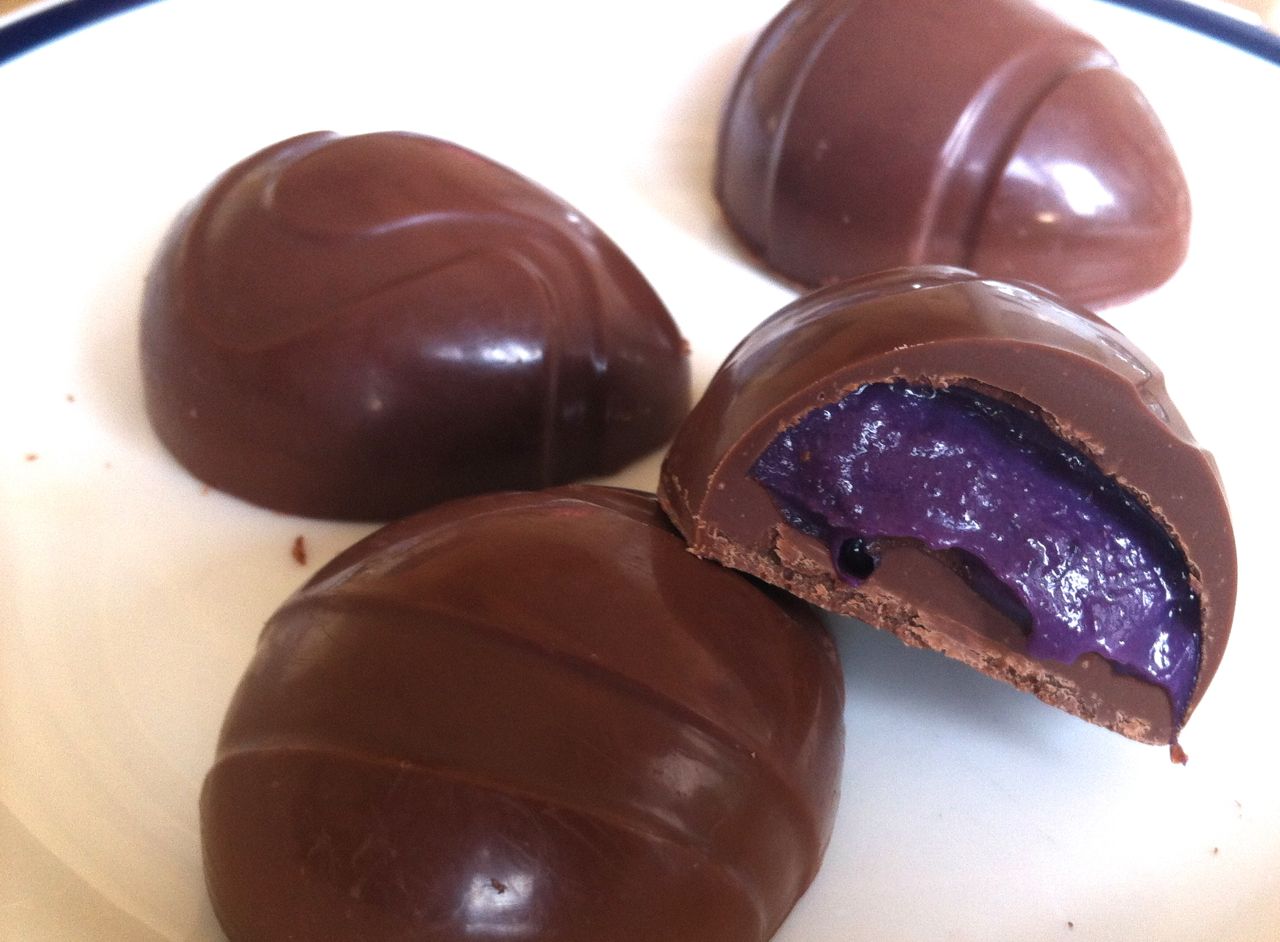
My first task was to make a ganache filling. This time, my local Budgens had blueberries, so I used them to make a puree, then added 50ml double cream and added the whole lot to 150g of white chocolate.

The white chocolate was kindly supplied by Kokoa Collection’s Paul Eagles, but really any white chocolate will do for these. I didn’t really know what I was making at this stage, but I was pleasantly surprised when the bright purple mixture turned out to have almost the exact consistency of a creme egg!
I tried using two different kinds of chocolate shell for this, but what I found worked best was a simple bar of Green & Black’s milk chocolate. It has a similar flavour to Cadbury’s milk chocolate, but is much better quality, has no added vegetable fats like Cadbury chocolate does, and made exactly four egg-halves.
I put a small amount of chocolate into each mould, and simply kept the chocolate moving until it set. This does takes a while and can be a little tedious, but it’s necessary, or you’ll just end up with a thick puddle of chocolate in the bottom of the mould. Once the chocolate has stopped moving around the mould, I put it into the fridge for a while to completely cool.

I then put a generous spoonful of my blueberry ganache into each mould (leaving enough room to add another layer of chocolate on top) and shook it gently to level it out and get rid of any air bubbles. When completely cool, I simply filled the moulds with chocolate, gave it a gentle shake to remove air bubbles, then let it cool.
The results were pretty good, if I say so myself.

Somehow (much more by luck than design), the texture and sweetness is an almost perfect match for a real Creme Egg, but the subtle blueberry flavour just gives an extra dimension to it. I’m so happy with how these came out.
I’m going to keep experimenting with chocolate making. I don’t have a plan, other than go out and see what interesting fresh ingredients the local shops happen to have in and find new ways of using them. I don’t expect every experiment to work, but that’s part of the learning process. The ones that do make it all worthwhile.
Finally, I’d like to say a quick thank you to Meridian Packaging who provided me with an array of chocolate boxes to put my creations in. If you’re more serious about making and distributing chocolates, you could do worse than give them a call.
A Few Photos