I had walked past this Chocolate Shop Wine a few times before deciding it had to be tasted. As someone who used to taste wine for a supermarket chain part of me wanted to know if it was possible to combine wine and chocolate in the same glass, while another part of me was just shouting “No! It’s wrong!”
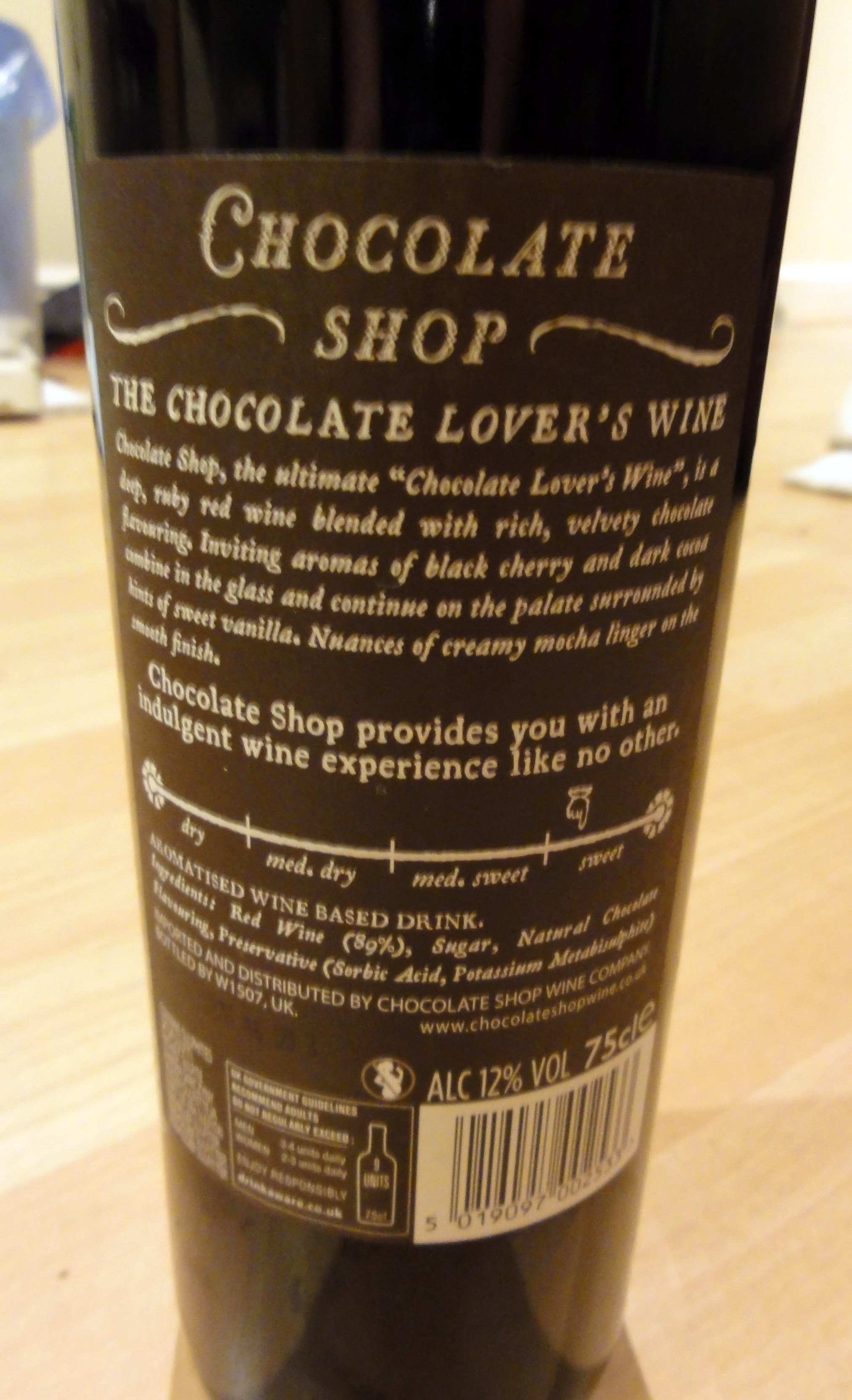
This rather elegantly labelled bottle contains an ‘aromatised red wine drink’, or as the makers prefer to put it ‘”a deep ruby red wine blended with rich, velvety chocolate flavouring.” There’s a little ‘sweet-dry’ chart on the back, and the arrow is almost right at the ‘sweet’ end. Checking the ingredients I find that only 89% of what’s in the bottle is wine. Additional ingredients are sugar and chocolate flavouring, as well as some preservatives, and that had me worried. If adding 1% salt to a bar of chocolate can radically change the flavour, what would up to 10% sugar do to a bottle of wine?

According to the label, this drink has ‘inviting aromas of black cherry and dark cocoa’ with ‘notes of creamy mocha’ lingering on a ‘smooth finish’. In the glass it looks like any other wine, but even while pouring it I was immediately aware of the black cherry aromas coming from the wine. It smelled like a slightly boozy Black Forest Gateau. My first mouthful confirmed what I had suspected about the sweetness, with the cherry flavour sitting right on top of a fairly light wine. It’s certainly sweeter than any wine I have drunk in a long time, but not overpoweringly so. The finish is a combination of vanilla, cherries and wine and taken in the context of ‘a glass of wine’ it’s a little odd. Taken in the context of a glass of chocolatey booze it’s less disturbing and kind of pleasant, although I doubt I could go a second glass – it’s far too sweet for that!
As a sweet dessert wine (possibly eaten with fruit or some sort of sticky, sugary pudding) I think this would probably go down quite well with a lot of people. Drunk on it’s own the high sugar content and unusual flavour make it hard to take more than a small glass. I suppose it would make the perfect companion drink to a classic Black Forest Gateau, but you’d never get away with having this alongside a cheeseboard!
Worth trying for the novelty value, but this is never going to become a regular purchase – for me at least.
Information
- Buy it online from:
- Filed under wine.

The closest comparison for Zorba’s truffles is the set of chocolates from the Momotombo Chocolate Factory I looked at a year or so ago. The key similarity is, of course, that both are raw. Further, I have now come to the conclusion that while raw chocolate bars are often quite approachable, raw truffles are more of an acquired taste.
In my third selection from Zorba’s, we have three square brown boxes, each containing two each of two truffle flavors. The truffles are in clear bags, nesting in very finely shredded paper and gold strips. I particularly like the addition of the gold, as it gives a twist of elegance to the usual eco-chic style. The truffles are all fairly basic looking dark chocolate squares topped off with things like salt, coffee beans, and shredded coconut. No complaints in appearance.

The six flavors are Espresso, Olive Oil-Sea Salt, Rose, Vanilla, Ginger Snap, and Cayenne Coconut. Their chocolate is very dark and very rich, which works better with some of the flavors than others. The Espresso truffle I find swoon-worthy: its pairing is perfection. And while it does have some coffee grains, I can’t say I mind when the truffle already has a rougher, more crumbly kind of texture. The Olive Oil-Sea Salt was a little freaky for my tastes, though still intriguing, and Rose is a flavor everyone either likes or doesn’t.

I hit a road block when I got to the Vanilla truffle. Initially, it completely confused me: in the midst of all that dark chocolate is an exceedingly feminine, old-fashioned ice cream type of vanilla flavor. On top of that is the flavor from the salt garnish. I’m feeling much better about the truffle now, but I really want the salt out of the picture: the all-consuming strength of the vanilla, probably the most potent I’ve tasted, is enough.
I had to stop imagining the Ginger Snap as a milk chocolate (which isn’t going to happen with a raw company and really isn’t even necessary for this truffle). There is a better flavor balance here, with the ginger spiced to a level like a strong cookie would have. The Cayenne Coconut truffle is like playing hide-and-seek with the cayenne, but the coconut is amazingly fresh. There’s a warm/cool effect that’s satisfactory enough, so I suppose I ended up more comfortable with this one than I had expected to.
The fact is, these truffles may be harder to get into for the regular population, not only because of their more crumbly raw texture but also because Zorba’s goes for the slightly exotic flavor combinations. Yet neither of these is a bad thing. As I said for the other raw truffles, just assess first if raw chocolates flavored this way are your style.
This post is a little off-topic for Chocablog. There is chocolate in it, but it’s more of an aside than the main feature. Today I want to talk about bad PR, stereotypes and treatment of the disabled. Oh, and Bowmore whisky.

Yesterday I was invited to attend an event organised by Bowmore Whisky. Not the usual PR event we get invited to – this was open to the public for a small fee – but one that I was invited to (and did not pay for) because chocolatier Paul A Young was involved with it.
The idea seemed fairly simple, a magical exploration of the senses exploring whisky, chocolate and the isle of Islay where Bowmore is made. Sounds fun, but alarm bells started ringing during a last minute conversation with the PR company. I happened to mention that I have some mobility problems, and it was only then that I find out this event was to mainly involve climbing a lot of stairs in the dark.
The event took place in an old town house in East London. A building that is apparently lived in, but has not been modernised in any way. This was supposed to evoke feelings of being on a far-off Scottish Isle where simple luxuries like electric lighting haven’t yet reached. Through creaky floorboards you could see the cellar below, and steep narrow staircases shot off the main reception room, where around 100 people crammed in, waiting for their experience begin. I’d love to show you photos, but we were asked to turn our newfangled electronic devices off – and it was probably far too dark to do so anyway.
For those of you that don’t know me, it’s worth mentioning something about my medical history at this point. I won’t go into detail, suffice to say I have a bone disease called Avascular Necrosis (warning: do not click that link if you’re currently enjoying some chocolate!). It’s similar to arthritis and caused by having had lots of steroid treatments following a couple of kidney transplants and cancer. These days I’m mostly Ok, but the stairs – and the dark – in this place scared me.
Had I been seriously disabled, I would have been unable to take part in the event at all. A minor detail that was missing from any of the public information about it. I wondered if a disabled person who had booked without knowing would simply have been left on the street.
The event began with organisers pinning random objects to people’s lapels. I got a red button, some got feathers, others got strips of tartan. With these objects, people who had paid to experience Bowmore with friends and partners were immediately split up and forced to do the whole event with a group of strangers. Knowing I was going to have difficulty getting around, I ignored my button and decided to stick with my feathered friends. I can imagine others who paid for a shared experience didn’t get to share much at all.
And so we were led down some rickety steps where astronomer Gary Fildes talked to us about the sky. He spoke eloquently for 15 minutes or so about how many stars and galaxies you can see from the island of Islay where Bowmore is distilled. The answer, in case you were wondering, is “quite a lot”. It was an interesting talk, if somewhat basic. It didn’t have much to do with whisky, but it’s always nice to hear real experts talking about their passions.
So we made our way back up the stairs in the dark, where for some inexplicable reason, a series of bad actors funnelled us into ever smaller rooms and talked in ever more bizarre Scottish accents about absolutely nothing of consequence. The highlight was when we climbed two flights of stairs only to spend 5 minutes listening to a girl lying in bed talking shit about a cat.
I can’t help but think that if I were a resident of Islay, I’d be a little offended by the way “the locals” were being portrayed here. If Bowmore are to be believed, then the lack of electric lighting on the island has caused some kind of mental illness that makes them spout nonsense about cats and ghosts in bizarre accents. Very few of them ever leave their beds, and when they do, it’s only to tell stories about the wind to unsuspecting sassenachs.
For me, this was a bizarre way to sell a product that is, as far as I’m aware, a quality single malt whisky, made by a passionate and highly skilled workforce from natural ingredients. The whole thing was presented as some kind of low-budget Disney experience.
The highlight, as you might have guessed, was the room containing Paul A Young. He served a simple dairy-free hot chocolate in china cups and didn’t talk in a fake accent. Along with the hot chocolate was a bonbon made from Bowmore, which we were told to stir into the warm drink to release the flavour. Paul took time to explain the ingredients he’d used, why he’d chosen them and how the flavours complemented the whisky. For the first time all evening, the 20-odd people in our group did not wear looks of bemusement, but instead smiled, talked and asked for more. This was good stuff.
After descending more nasty, loose stairs into the cellar, the final part was due to be the whisky tasting, but I was in so much pain by this point, I only managed to try one before making my excuses and leaving. I had to pick my own coat from trom the unattended coat rack (I did consider taking a nicer one) and find my own way out as nobody wanted to help. Everyone involved seemed more concerned with keeping in character.
Now I recognise that my viewpoint is somewhat unusual and that there were people that would have got a kick out of it, but two things bothered me about this evening. The first was that so little thought was put into making the event accessible – or at least publicising its inaccessibility. Obviously, an event in an old house isn’t going to be suitable for everyone, but it didn’t seem to cross anyone’s mind that someone might require assistance. It doesn’t take a great deal of planning to let a disabled person experience an event like this in a comfortable and inclusive way.
More importantly though, I found it strange that a quality whisky brand should want to present itself in such an artifical manner. It was the complete opposite to the way Lindt had presented themselves at an event earlier in the week. They managed to make a large multi-national brand seem fun, approachable, and most importantly of all, real.
Granted, there was a tasting at the end of the Bowmore event, and Paul Young clearly understood what people wanted, but the majority of this two and a half hour event was taken up by a group of actors trying to convince people they were part of the star attraction at Disneyland Islay. Some undoubtedly enjoyed it more than me, but the looks on most people’s faces indicated more confusion than pleasure.
I had hoped to learn a little and to experience the real passion and tradition that goes into making whisky. Instead, it was a painful experience.

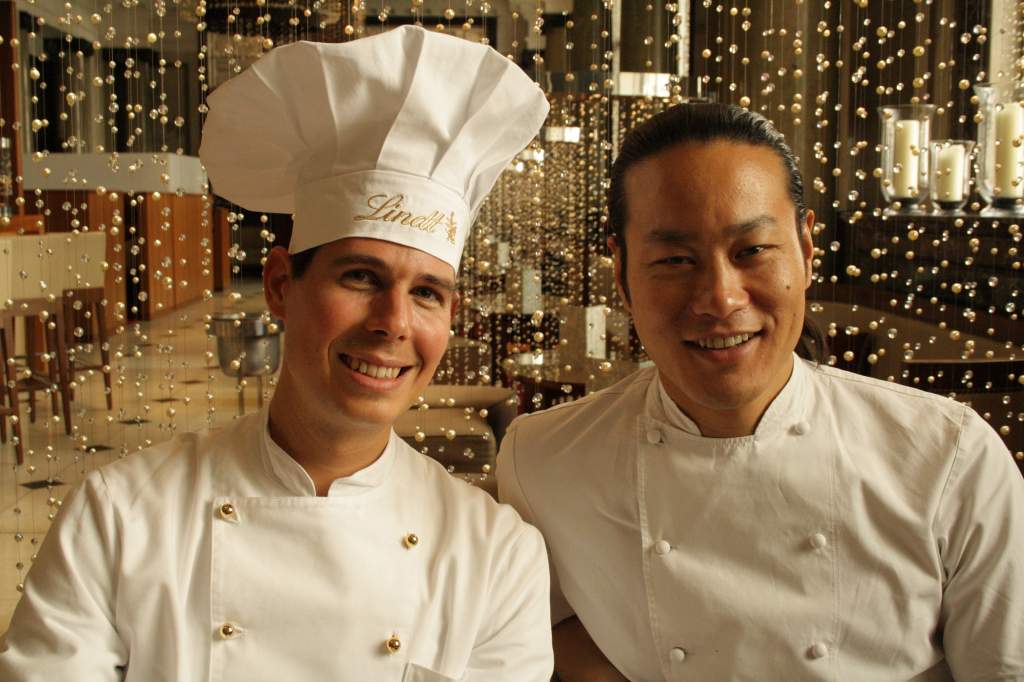
On Tuesday evening I was invited to a rather interesting Lindt event. Hosted at the famous Pearl Restaurant & Bar by executive chef Jun Tanaka, the event was designed to showcase some of Lindt’s Excellence range, in particular the newest addition to their line up, Lindt Excellence Wasabi.
Also in attendance was Lindt master chocolatier Stefan Bruderer, complete with silly outfit and over the top chef’s hat that made him look exactly like the chef from Ratatouille. I did not see any evidence of rats, but that might simply be because they were hard at work in the kitchen.

The focus of the evening was on three flavours; wasabi, sea salt and chilli. Jun and has team had prepared four dishes each showcasing these flavours, with three of them featuring Lindt chocolate. Each dish was also paired with a wine, designed to complement or enhance the flavours. The first dish, cured salmon with pickled chilli & wasabi mayonnaise was the only one which contained no chocolate, but was designed to show off the three other flavours in a single dish.

Next up came the highlight of the evening; braised chilli chocolate beef cheeks with celeriac mash and glazed beetroot. This was simply divine, and the beef just fell apart on the fork. The flavours of the chilli chocolate sauce worked perfectly with the meat. It was genuinely one of the nicest dishes I’ve tasted in a very long time. Unsurprisingly, everyone in the room cleaned their plates.

Next up was a wasabi chocolate maki roll which Jun informed us had to be dipped in the sauce and downed in one. Some people managed that, but it was just too big for my delicate mouth, so I ended up making a mess. An enjoyable mess, but a mess nonetheless.
Our final course was a dark sea salt chocolate molleux with cherry and yoghurt sorbet. This was a delicious and rich dessert, with the yoghurt sorbet being the perfect palate cleanser at the end.

But of course, one of my main reasons for going was to try Lindt’s new Wasabi bar. After having reviewed chocolate wasabi peas recently, I was interested to see how this stacked up. I’ll be doing a full review of the bar soon, but my initial impressions were positive. Lots of the wasabi flavour came through, and it wasn’t frighteningly hot.
I have been criticised in the past for saying nice things about Lindt when some people would prefer we concentrate solely on fine chocolate, but the fact remains that Lindt is much more accessible than most other brands in its class, and is vastly superior to the Cadbury, Nestlé and Mars confectionery that it’s usually sold alongside in the UK. As an introduction to better quality chocolate, this can only be a good thing, and while I’d love for Lindt to be talking more about bean origins and ethics, Lindt’s excellence range is a great introduction to real chocolate.

I found myself being surprised at just how much fun this event was. Jun Tanaka’s food was incredible, went well with the chocolate and was perfectly matched to the selection of wines we tried. While I don’t buy a lot of Lindt myself, I enjoyed what I tasted, and it clearly went down very well with people in the room who don’t eat quite as much chocolate as I do.
But most of all, I appreciate the fact that Lindt are taking time to talk about their chocolate here in the UK. Having a name like Lindt getting involved in promoting real chocolate in the UK is a great way to raise people’s expectations of what to expect from their every day chocolate bar. We have lots of amazing smaller chocolatiers, particularly in London, and it’s great to see one of the bigger names taking notice of our changing tastes in chocolate.
And don’t worry, I’ll be posting some of the recipes from the evening very soon!
Photo Gallery