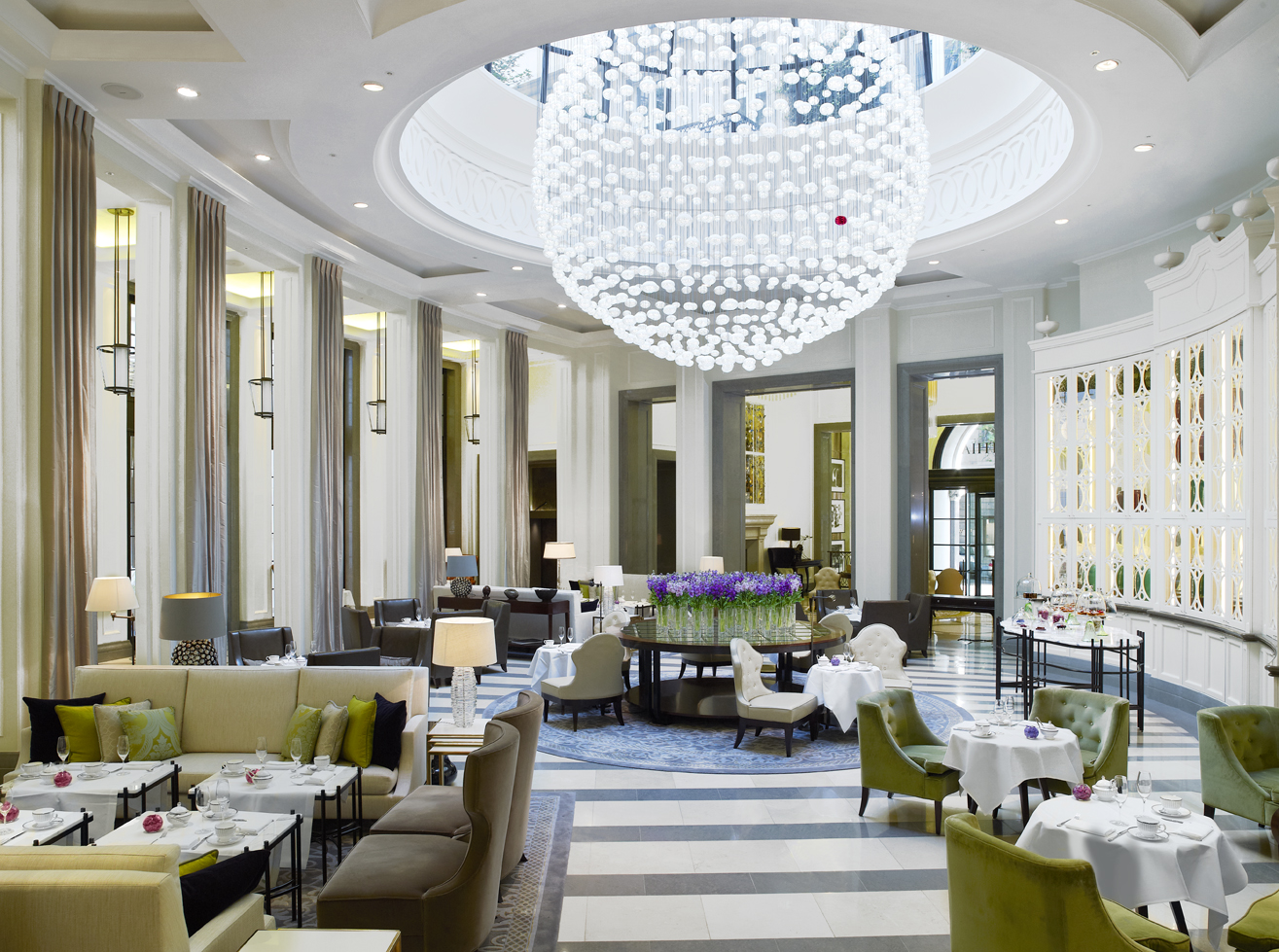
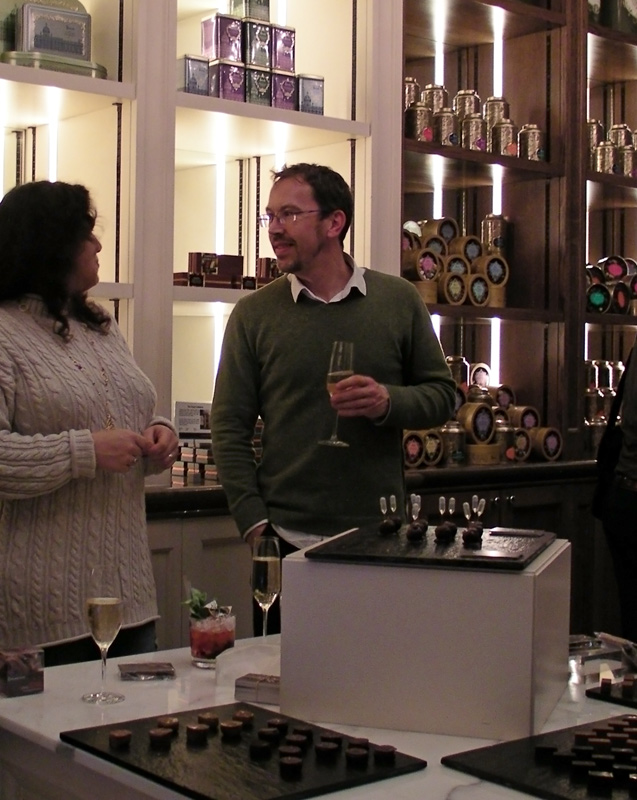
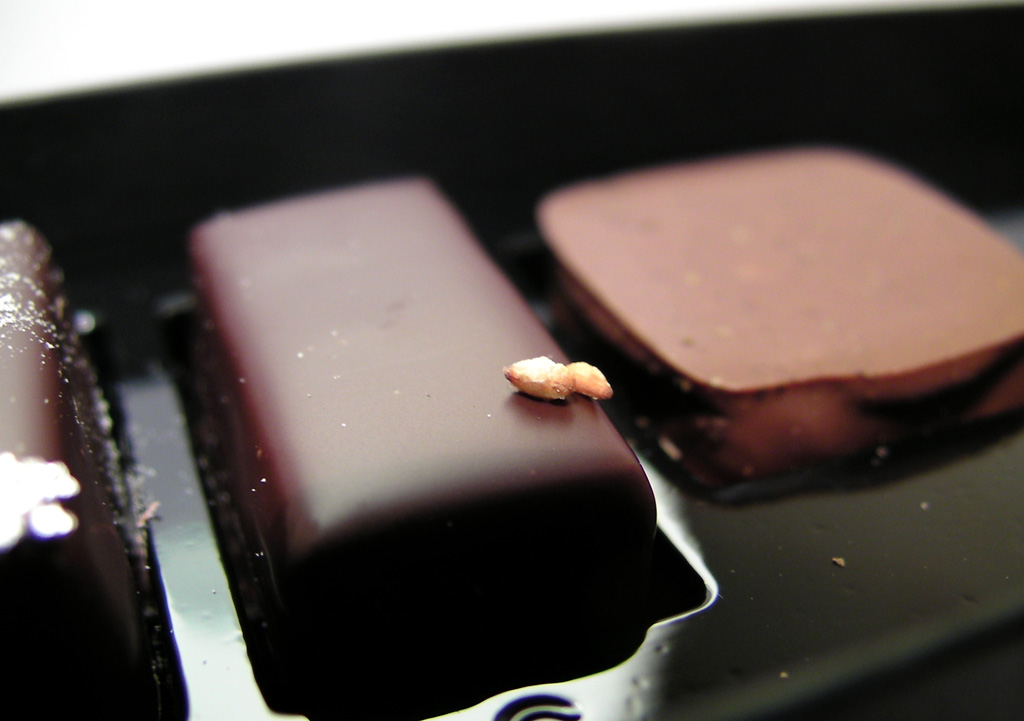
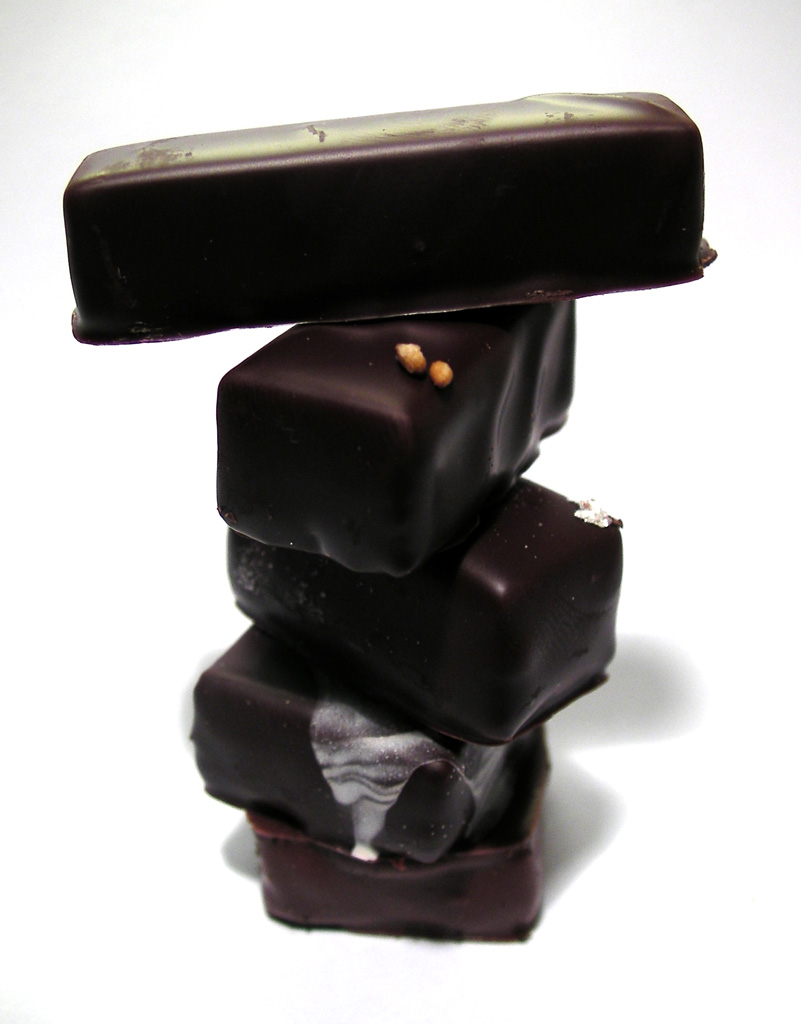
Pop-ups are all the rage with our favourite chocolatiers at the moment. Recently we’ve been to the opening of Paul A Young and Paul Wayne Gregory’s pop-up shops, and last night we were invited to the launch of Damian Allsop’s Christmas pop-up shop at The Corinthia Hotel in Central London.

The shop can be found just off the lobby and shares the beautiful space with a florist. On display are a selection of Damian’s ‘Eat London’ chocolate bars, his famous ‘cloud’ chocolates and his speciality water ganaches, including a small collection made especially for the hotel (review coming soon). We had a chance to try most of them, and they were universally wonderful.

Also on sale will be these slightly mad ‘Tequila Slammer’ chocolates. Flavoured with lemon and salt and served with a pipette of tequila to squeeze onto your tongue before eating the chocolate whole. They’re guaranteed to make you screw up your face in delight.

Chocolates are available to buy in boxes, or loose. They’re very reasonably priced too, starting at just 75p each for the lighter ‘cloud’ chocolates and £1 for the water ganaches. That compares very favourably to other top chocolatiers in London. If you’ve not tried Damian’s chocolates before, this is the perfect opportunity to try a few while picking up some Christmas presents.

The Pop-Up will be open 11am to 7pm on the following dates:
Thursday 22 November to Saturday 24 November
Thursday 29 November to Saturday 1 December
Thursday 6 December to Saturday 8 December
Thursday 13 Dec to Saturday 15 Dec
Monday 17 Dec to Sunday 23 Dec
Corinthia Hotel London
Whitehall Place (Shop entrance on Northumberland Avenue)
London SW1A 2BD
United Kingdom
Tel: +44 (0) 20 7930 8181
www.corinthia.com

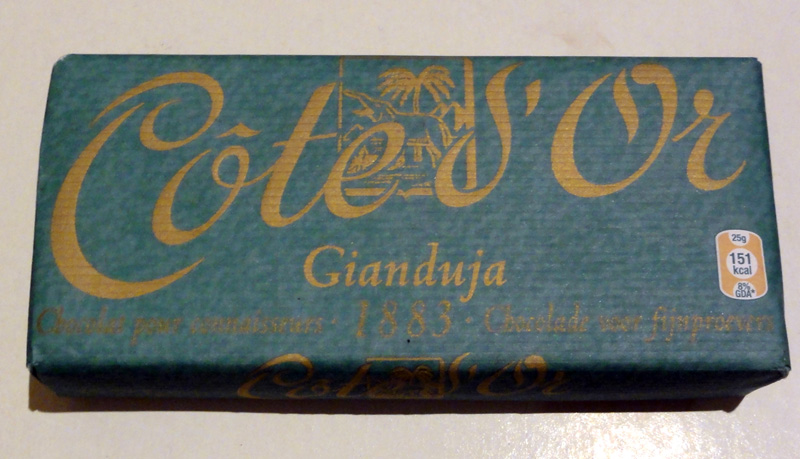
This rather lovely packaging caught my eye when I was away a few weeks ago. The old fashioned shade of green and elegant gold script made this double pack of 75g Côte d’Or Gianduja bars stand out a mile from the assorted other bars that surrounded it. It smacked of tradition and a sort of olde worlde refinement that made me want to see what was inside.
Happily, the contents are as elegant and old fashioned as the wrapper. The two seventy five gram bars of chocolate are moulded using very traditional Côte d’Or moulds – in fact I would swear that these moulds (or ones very much like them) are on display in the chocolate museum in Brussels. The thick foil used to wrap each bar gives the chocolate a feeling of quality (and again, tradition), almost as if these bars had been produced to commemorate an anniversary for the company.

The chocolate itself is classic Belgian 35% cacao milk chocolate, smooth and sweet with the buttery, rich gianduja filling melting rapidly over the tongue. It’s timeless stuff, done by every Belgian chocolate house and a heck of a lot of other companies as well. It’s also fairly difficult to distinguish it from any one of a dozen other Belgian praline / gianduja chocolates, other than by the retro wrapper.
In short, it’s a timeless classic chocolate bar (well, two actually) presented in a very elegant, old school package which elevates it to ‘special treat’ or ‘gift item’ instead of ‘yummy snack’. Well worth it if you find one, but offering nothing surprising or outstanding.

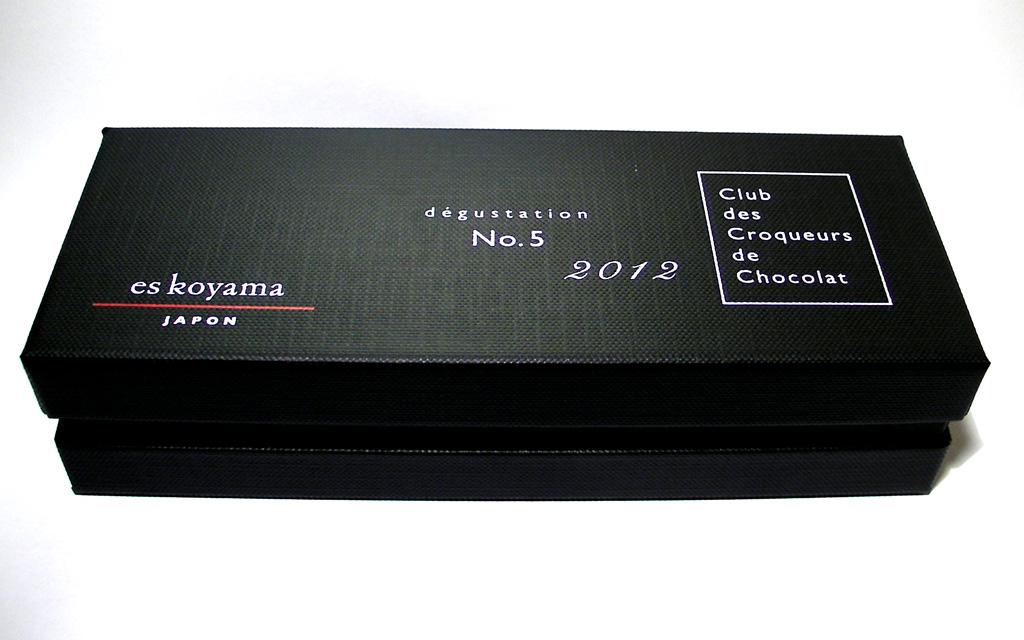
This tempting looking box is one of the few purchases I made at Salon du Chocolat earlier this month.
Es Koyama and head patissier chocolatier Susumu Koyama were one of the highlights of Salon for me. Not only were they some of the best tasting chocolates in the entire show, but Mr Koyama even gave us a personal tasting in front of a Japanese TV film crew!

So what makes the chocolates so special? Well it’s all about the flavours. They’re both delicious and uniquely Japanese.
They’re also rather beautifully presented, with each of the five chocolates in this box sitting in its own perfectly sized bed. In terms of quantity, you don’t get a lot for 12 Euros, but this collection is purely about the experience.
The chocolates are (from right to left in the photo below) Madagascan Criollo, Fukinoto (Japanese butterbur shoots), Praliné Japonais (sesame praline), Saké Japonais (made from the solid sediment left over from sake brewing), and “Ninja” (infused with smoked cherry wood).

Madagascan Criollo
I started out with what should be the simplest chocolate – an unflavoured ganache made with Madagascan criollo beans. Except this is far from simple. It’s a deep, rich and fruity ganache that has a bit of a kick to it. It has a wonderfully smooth texture and a flavour that builds from sweet and fruity to intensely chocolatey.

Fukinoto
A milk chocolate which according to the English tasting notes ‘evokes the splendour of a Japanese spring’. Not having been to Japan yet, I can’t vouch for that. Nor can I say what Japanese butterbur shoots are meant to taste like. But I can say that this milk chocolate ganache is incredibly smooth and quite sweet, but also fresh and delicate. When the chocolate has gone, you’re left with a gentle peppery finish. It’s subtle, but unlike anything I’ve had before.

Praliné Japonais
A praline made with sesame seeds rather than hazelnuts! And not just any sesame seeds either. These are local golden sesame sesame seeds (kingoma) that taste amazing. I’m not usually a praline fan, but I could eat these chocolates all day. Such a shame there’s only one in the box!

Saké Japonais
I have to admit, I know nothing about the sake making process, but I’m told sake-kasu is the solid sediment left over from the brewing process. In this chocolate, the sake-kasu is split into two layers. The bottom layer is combined with caramel and white chocolate, and the other with the top layer is combined with Madagascan dark chocolate. The resulting flavour is as wonderful as it is unique. It’s soft, caramelly and mildly alcoholic in flavour. But like the other chocolates in this collection, the flavour of the filling never overpowers the chocolate.

Ninja
Clearly, this is the best possible name for a Japanese chocolate, and as you might expect, it’s a bit special. Inside the Ecuadorian dark chocolate shell is a milk chocolate that’s infused with a cherry wood smoke that overwhelms the senses. This isn’t some artificial smoke flavour, but one so natural that it’s like being in the centre of a raging bonfire. A hint of sea salt just intensifies the flavour, yet as quickly as it appears, it fades. No wonder this chocolate is named for the smoke bombs Ninjas used to escape their enemies. As the smoke fades you’re left with just the deep chocolate flavour and the memory of that intense wood smoke. And then it’s gone.
And with that, this simple box of chocolates has disappeared too. It is uniquely Japanese, with a healthy dose of French style and is something you really should try if you can get your hands on it. Unfortunately, you may have to visit Japan to do so. I think it’s worth the trip.

Three years ago, I confessed my affection for turkeys when reviewing Splendid’s Thanksgiving turkey place settings. My lukewarm reaction must not have been alone since I haven’t seen them again. This Thanksgiving, I decided a wider turkey analysis would be in place. So I brought together a Godiva turkey and two from World Market, made by Sweet Works and The Madelaine Chocolate Company. Perhaps it would be enough to say that the only thing special about this cocoa flock is that they’re turkeys, but I will take a more detailed approach.
I mentioned that Splendid’s turkeys might be something for guests to take home, but those were unwrapped turkeys and needed to be put in a small bag to be brought home. All three of these turkeys, which I christen Godiva, Sweet, and Madelaine, come already wrapped in foil. That makes things simpler. Plus, since these are all sold separately, you can buy however many you need or want without having to work with the number that come in a box.

As for the numbers, Godiva is a 2 oz., $6.50 turkey; Sweet is 1 oz. and $1.99; and Madelaine is 3/8 oz. and $0.74. Assuming they were priced the same way but all 2 oz., Sweet would be $3.98 and Madelaine would be $4.67. So Sweet is the least expensive and Godiva is the most.

There is a direct parallel between foil shininess and turkey size. Godiva’s foil is closest to matte, giving it a more refined air; Madelaine’s high shine sends it into the candy category. Of the three, I want to say that Godiva would look nicest on a semi-formal Thanksgiving table except for a couple of key points. While in resting position, it is the only one to show lettering. The ingredients are listed on both sides of the rail, and one side of the foot section says, “Godiva,” while the other marks that this is a 2 oz. milk chocolate. None of it is hugely prominent, but it sort of ruins the effect for me, nonetheless. Sweet, instead, carries a collar on his neck that’s attached to a tag with the company and ingredients info. It can be left on or easily removed before setting the turkey to decorate place settings. Madelaine just has a simple sticker on the back where the foil edges come together. The other difficulty with Godiva is the slight bump on the bottom part where the two pieces of attach; Sweet has this, too, but not to so great a degree. It doesn’t keep Godiva from standing, but would make him fall more easily.
As I began unwrapping the turkeys, I was (once again) reminded of what a horrible person I am. After I adopted Godiva at the mall, I put him in my purse while going about to some other places for the rest of the day–now he appears to have melted slightly and taken on the pattern of the foil. I would regret this more if Godiva’s own pictures of the turkey don’t seem to show a terribly detailed mold, anyway. Not, say, like Sweet’s mold. I wasn’t sure what to think of the bright colors of Sweet’s foil, but he’s molded beautifully. Every feather is clear, and there are many. The two halves of the turkey come together in a very fine line, finer than Godiva’s. There isn’t much to say about Madelaine: he barely even looks like a turkey.

Despite all three being milk chocolate turkeys, there are still flavor distinctions. Madelaine comes out the weakest, with both a low cocoa content and quality. It isn’t compounded chocolate, but it does have artificial vanilla. Godiva’s standard milk chocolate is very sweet, maybe even more than Madelaine’s, though in a different way. I enjoy it every so often as an indulgent thing. Sweet, ironically, is the least sweet of the three–which you must not take to mean that it isn’t sweet. It just has more to it. The caramel notes move into a milky richness, and it becomes a decent chocolate affair.
So what kind of chocolate turkey do you want? If you want tiny ones to put on the kiddie table, The Madelaine Chocolate Company works. If you’re giving gobbling gifts, Godiva will serve. I would recommend either Godiva or Sweet Works if you’ll be putting these on your Thanksgiving table. It depends on what colors work better for you and also what size you want. The smaller 1 oz. offering is more likely something guests will finish at the table, whereas the 2 oz. size is probably one to take home along with leftover pumpkin pie. Anyway, does Godiva’s foil design really even look much like a turkey?