We’ve been making videos on Chocablog for years, but I thought it was about time that there was a central place to watch them all. With that in mind, I’ve created a new video hub on the site which pulls in videos directly from our new YouTube Channel. Just click on a thumbnail to watch the video from within Chocablog.
I’m still in the process of uploading archive videos, but soon we’ll start producing regular, fresh video content.
If you can, please take a moment to subscribe to Chocablog on YouTube, and let us know the kind of chocolate videos you’d like to see on the site.

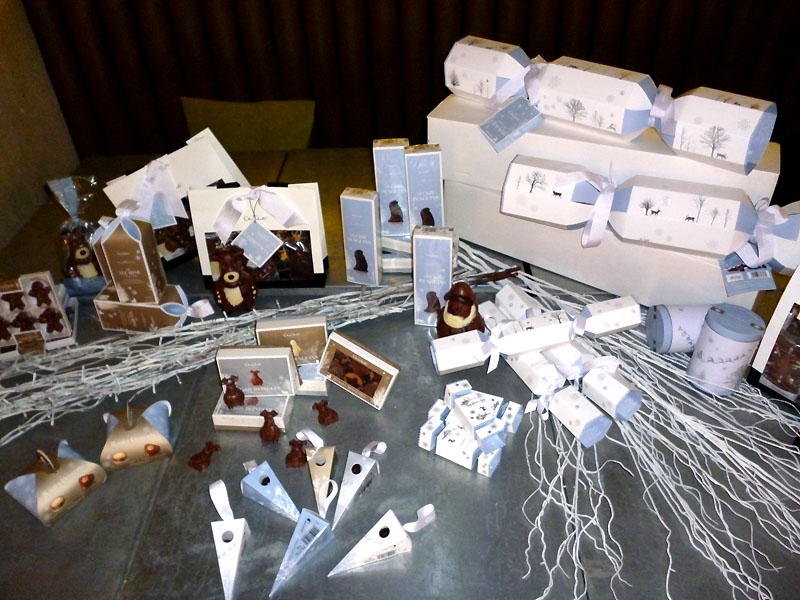
Hotel Chocolat recently launched their Christmas range, and we were invited along to their Roast + Conch café and shop in Covent Garden to take a look at it, and see what else is new in the world of Hotel Chocolat.
While many of the core products are similar to previous years, one thing that has changed is the packaging. Colours have been toned right down, with predominantly white packaging, and lots of subtle, pale blue. There’s no garish reds, greens or golds in this range.
The range is huge, with everything from small Christmas decorations to giant centrepieces that rotate like a lazy Susan. It’s all very clever.

Also launching was the Halloween range, which again is similar to previous years. We thought these ‘Tiddly Vampires’ were particularly cute.
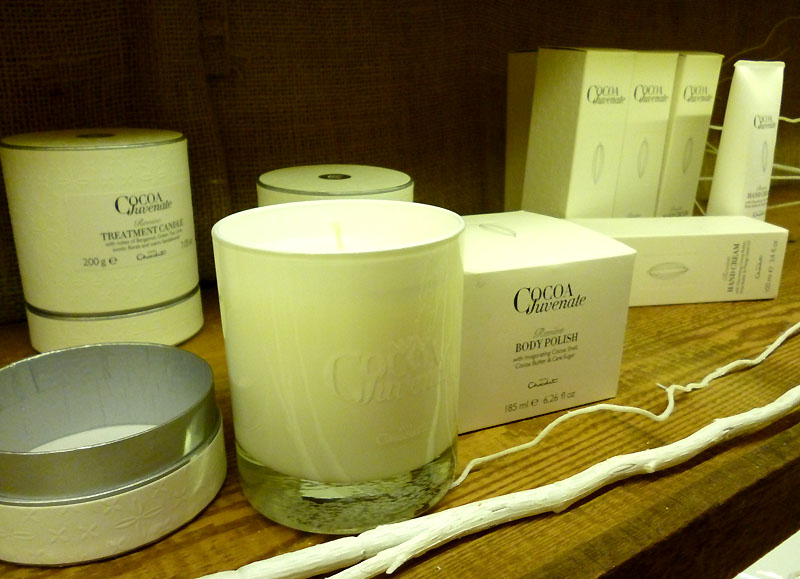
Perhaps the biggest surprise was to find that Hotel Chocolat have launched their own line of beauty products. Made with cocoa butter, and in some cases exfoliating cocoa shells and fresh cacao pulp, the Cocoa Juvinate range is simple, emphasising purity and the revitalising nature of cocoa.

While I’ve seen a lot of the novelty Christmas & Halloween items before, I’m always impressed by Hotel Chocolat’s ability to go off at complete tangents, while remaining true to their vision and ethics. With a cocoa estate, a hotel, cafés, restaurants and now a beauty range, you have to wonder where they will go next!
You can find more photos from the launch event on our Facebook page.

The more observant may notice that there are two different bars in the photo above. They are both made by Danish bean-to-bar chocolate maker Mikkel Friis-Holm. They are both 70% dark chocolates made from the same Nicaraguan beans, sourced directly from the farmers. Neither bar has any added vanilla or soy lecithin. The ingredients are exactly the same: cocoa beans, sugar and cocoa butter. Nothing more, nothing less.
There is just a single, seemingly tiny difference between them. The bar on the right has had the beans turned twice during the fermentation process. The bar on the left has had the beans turned three times.

For the uninitiated, when cocoa pods are harvested, they are cut open and the cocoa beans and surrounding pulp are fermented for a period of days in large containers. Every few days, the beans get turned to ensure an even fermentation.
After the fermentation process has completed, the beans for both bars are processed in exactly the same way. So why on Earth has Friis-Holm gone to the trouble of creating two chocolate bars that to all intents and purposes are exactly the same?

You could consider it a simple experiment, but I like to think it’s to illustrate a simple point; namely that every single step of the chocolate making process has a tangible effect on the finished product. Some people may consider that factors like terroir, cocoa bean genetics or roasting time have only a minimal effect on taste, but Friis-Holm has made two quite different chocolates by changing the simplest of parameters.

The flavours of the two bars are quite noticeably different. The tasting notes on the twice turned bar describe it as
“Full body, nutty, black olives, spicy and complex. Very smooth finish.”
This turned out to be my favourite of the two bars. I’ve never been good at articulating flavour notes, but this certainly had the more complex and interesting flavour.
The triple turned bar’s tasting notes say:
“Straight, almost simple, classic chocolate flavour. Good pronounced acidity. Distinct notes of black olives and citrus peel.”
This is an accurate description. The flavour is much simpler and more gentle than the twice turned bar. The underlying deep, chocolatey flavour notes are present in both bars, but the chocolates themselves are quite different.
Both bars have an ultra smooth texture and are very approachable. I would happily buy either of them, but they are most interesting when purchased together. Tasting both bars together, you can really appreciate the difference that a single change in the chocolate making process can have.
It also serves to emphasise the skill of the chocolate maker, and the importance of having a direct connection with the cocoa farmer. Without that connection, Friis-Holm would never have been able to make these bars.

For another interesting comparison to this chocolate, take a look at Simon’s review of Duffy’s Chuno bar, which is made using the same beans.
Every now and again I get sent samples. What’s not to like about samples? The Australian importer of the Ki’Xocolatl range sent me some of their products to try – what a nice chap!
Checking their web site, Ki’Xocolatl seems to be a Belgian / Mexican chocolatier. Because there are quite a few products in the range, I thought it best to review half now, the other half will follow a little later.

Cocoa Beans Roasted Covered with Milk Chocolate
Crunchy cocoa nibs in a chocolate seem to have become fashionable in the last few years; and some are better than others. In some cases, the nibs kind of just disappear in the chocolate, becoming a kind of hard / crunchy texture but where the flavour is difficult to determine.
So it is nice, then, to have something completely different. These cocoa beans would seem to be pieces of a cocoa bean, roasted, and coated in a 36% milk chocolate; a little like a coffee bean coated in chocolate, except it is coated cocoa pieces.
The first thing to notice about these little marvels is the size: small – smaller than a pea. Eating just one is not possible – it’s best to pour a handful and snuffle them down. But then wait… let the flavour develop. The milk chocolate coating is quite sweet – but pleasantly so, not excessively. There’s also a slight fruity flavour that reminds me of a good aromatic plum or apricot jam. As this melts away, the harder cocoa bean is left. Crunching it up reveals an unusual texture – normal for cocoa beans, but unusual nonetheless, along with a subtle burst of a deeper, more complex cocoa flavour and slight bitterness which wells up, rushes past, and then slowly fades and lingers.
I took these in to the office and plonked them on the table during a meeting. It was interesting watching the reaction: the dark chocolate hater went back for more. And one of the other chaps kept scarfing them down as kids would lollies. At the end of the meeting his remark was: I could eat the packet in a sitting!
This is one of the best cocoa bean / cocoa nib products I’ve tried.

Dark Chocolate with Pink Pepper from Veracruz
This 70% chocolate contains pink peppercorns. I don’t actually know what they are, but they certainly give this chocolate a quite strong, slightly peppery, fruity aroma. When tasting, the unusual flavour really jumps out.
A quick diversion into peppers. I take “pepper” to be a generic term which includes chillies and capsicum, as well as the better known white and black pepper from peppercorns. In this chocolate, the pepper is reminiscent of a good freshly ground black pepper, but more subtle, more aromatic, and quite a lot more fruity.
The combination works! Unlike many eating chocolates where it’s possible to scarf down a block at a sitting through sheer greed, the stronger flavours here encourage moderation, and eating it slowly. Some might not like the flavour – but I do – but in smaller doses.
This is one I took to a meeting in the office as well. Talk about mixed reaction: I had one “hmm, not sure”, another “ok, but not to my taste”, and the dark chocolate hater kept going back for more and more – she loved it.
If you want something interesting an unusual, hunt this down.

Milk Chocolate (Sugar Free)
This one comes with a mystery. It is sugar-free, and uses our old friend Maltitol as the sweetening agent. At the same time it is certified organic. How can one have organic Maltitol? Perhaps the organic thingy just applies to the other ingredients. Whichever way, it seems a bit incongruous.
This is also the biggest disappointment – the chocolate is quite pale, and at 36% cocoa, it’s fairly mild and unchallenging. I can’t call this a bad chocolate, but neither does it have anything which leaps out and shouts at me in excitement: it is just a plain bar of milk chocolate. The others are better.