I love experimenting with chocolate at home, so I’m always on the lookout for interesting chocolate making classes where I can pick up a few tips. There are plenty of them about, but most of the classes I’ve seen are more about “experience” than learning. They’re often very basic, and hope you’ll be satisfied just getting your hands dirty making some ganache and rolling some truffles.
If you want to learn a little bit more about the chocolatier’s art, your choices are limited. That’s why I jumped at the chance to try Paul A Young’s new salted caramel class this week. Paul’s caramels have always been his best selling chocolates, and they’re still one of my favourites. The class promised to reveal all the secrets of making this award winning chocolate, and for the first time, Paul was going to share the full recipe and technique.
I, however, am not going to share the recipe. Not because I was asked not to, but purely because this fantastic class is one that you really need to try for yourself. Having a recipe is one thing, but having a master chocolatier guide you through every step of the process is quite another.

The class takes place in the development kitchen below Paul’s flagship store in Soho. It begins with full explanation and demonstration of tempering. Paul doesn’t miss a detail as he talks you through the best kind of chocolate to use, how to melt it, and why tempering is absolutely essential. He then guides you through the (actually quite simple) process of tempering on a granite or marble slab. Other classes give only a very basic introduction to tempering, but Paul manages to explain the process in a way that will make sense for absolute beginners, but doesn’t talk down to those with a little more experience.
Once tempered, you’ll learn hot to mould the chocolates, and this is where you’ll have a chance to get stuck in yourself. Because of space and time limitations, not everyone will get a chance to try it, so you’ll need to be proactive if getting your hands dirty is your thing. But I know that many people are more than happy just to watch the demonstration and ask questions, and in our class of 9, the setup worked very well.

Next, you’ll learn about the caramel. Paul’s salted caramel is incredibly easy to make. It uses muscovado sugar and milk chocolate as a stabiliser, so it’s quite difficult to mess up. Here, the class splits into two groups to make batches of caramel, which you get to take home in jars.
Paul demonstrates how to pipe the cooled caramel into the moulds, how to cap them with chocolate, and his special technique for ensuring perfect bottoms every time. The finished caramels are mini works of art.

I absolutely loved this class, and would recommend it to anyone. If you’re a looking for a “hands on” experience, you should be aware that limited space and time means you might not get to try every stage of the process yourself. But if you want to learn how to make award winning chocolates from a master chocolatier, this is definitely the class for you.
Keep an eye on the Paul A Young website or join their email mailing list for future salted caramel class dates.
Photo Gallery

Regular readers will know we’re big fans of The Chocolate Tree in Edinburgh and their recent bean to bar creations. Under the simple but elegant new packaging are some truly wonderful chocolates. I’m a particular fan of their 72% Madagascan bar.
So how does the gianduja compare?

A gianduja is like a milk chocolate that’s been conched with ground hazelnut rather than milk powder. The result is a soft, rich, nutty “chocolate”.
The Chocolate Tree have chosen to use fine 42% Ecuadorian Arriba beans in this bar, along with 28% hazelnuts. The 90g pack contains two individually wrapped bars. Perfect for sharing… if you’re into that kind of thing.
As you would expect, there’s no glossy shine to the bar and the texture is soft. But it’s not so soft that it melts the moment you look at it, and it’s actually moulded rather nicely.

The flavour is initially rich and chocolatey – much more so than you would usually expect from a 42% chocolate. But the main flavour note here is intense, roasted, nutty, and really rather tasty. It’s not too sweet and not too bitter, and very moreish indeed. It’s one of those bars that’s quite difficult to stop eating once you start.
If you’ve not had a gianduja before, this would be a great place to start. The balance of chocolate and nuts is just right, and it’s been made with care and attention to detail. I personally prefer The Chocolate Tree’s dark chocolate bars, but with an expanding range, they have something for everyone.

I love visiting food factories. I’ve been lucky enough to look around several chocolate factories in the last few years, but I was particularly excited when I was invited to visit an ice cream factory last week.
Jude’s Ice Cream is based in Twyford in Hampshire. Since starting out in 2002, they have grown to become one of Britain’s best known artisan ice cream makers, supplying some of the best known restaurants and chefs in the country.
Small Beginnings
In 2001 Theo Mezger left his job in banking and began searching for something new to occupy his time. After some research, he hit upon the slightly mad idea of ice cream making. Theo saw that there was a gap in the market for a British-made premium ice cream, and despite some skepticism, enrolled on a week long course at Reading University and started making ice cream in an out-building behind the family home in Easton in 2002.

That’s where we started our visit, and we were greeted at the house by Theo, his son Chow and the adorable family dogs.

We sat in the garden with Theo as he explained the history of the business and how it slowly began to involve the whole family and much of the local community. The base ice cream recipe hasn’t changed since 2002 and is made with local ingredients where possible. The company have a strong focus on ethics; they give 10% of their profits to charity and love to get involved in local school projects. What better way to teach children about the benefits of quality, local ingredients than through the medium of ice cream.
Even the milk in Jude’s Ice Cream comes from the company’s own herd on a local farm, where they buy direct from the farmer. As we’ve often seen in the chocolate industry, when producers buy direct and cut out the middle men, they get a better deal and the supplier gets a better price. It’s a win-win situation.
Growing The Business
It didn’t take long for other people to catch on, either. Theo quickly found that people only had to the ice cream try it once to be converted, but the challenge was getting them to try that first taste. With that in mind, they began approaching chefs, who quickly saw how good it was. Raymond Blanc, Marco-Pierre White and Gordon Ramsay all began serving Jude’s in their restaurants, and that market quickly became central to the business.
After a few years of growth, it was clear that the building behind the family home simply wasn’t big enough. After a short search, they found a unit on a converted chicken farm a few miles away in Twyford. There was plenty of room for growth, and space to get some serious ice cream making equipment in.
On the way to the factory, we stopped off at the dairy farm that supplies the bulk of the milk used in Jude’s ice cream. Despite growing up in the country, I’ve never found farms particularly exciting, but this was a bit different. These were ice cream cows.

The 220 Freisian Holstein cows are milked twice a day and in total produce a staggering 1.6 million litres of milk per year. That’s enough to make a lot of ice cream!
Tasting The Ice Cream
Our final stop of the day was the ice cream factory itself. It’s an impressive looking facility, but one that we couldn’t take any photos of due to commercial sensitivities. Before our tour began, we had a light lunch and got to taste some of Jude’s current range.

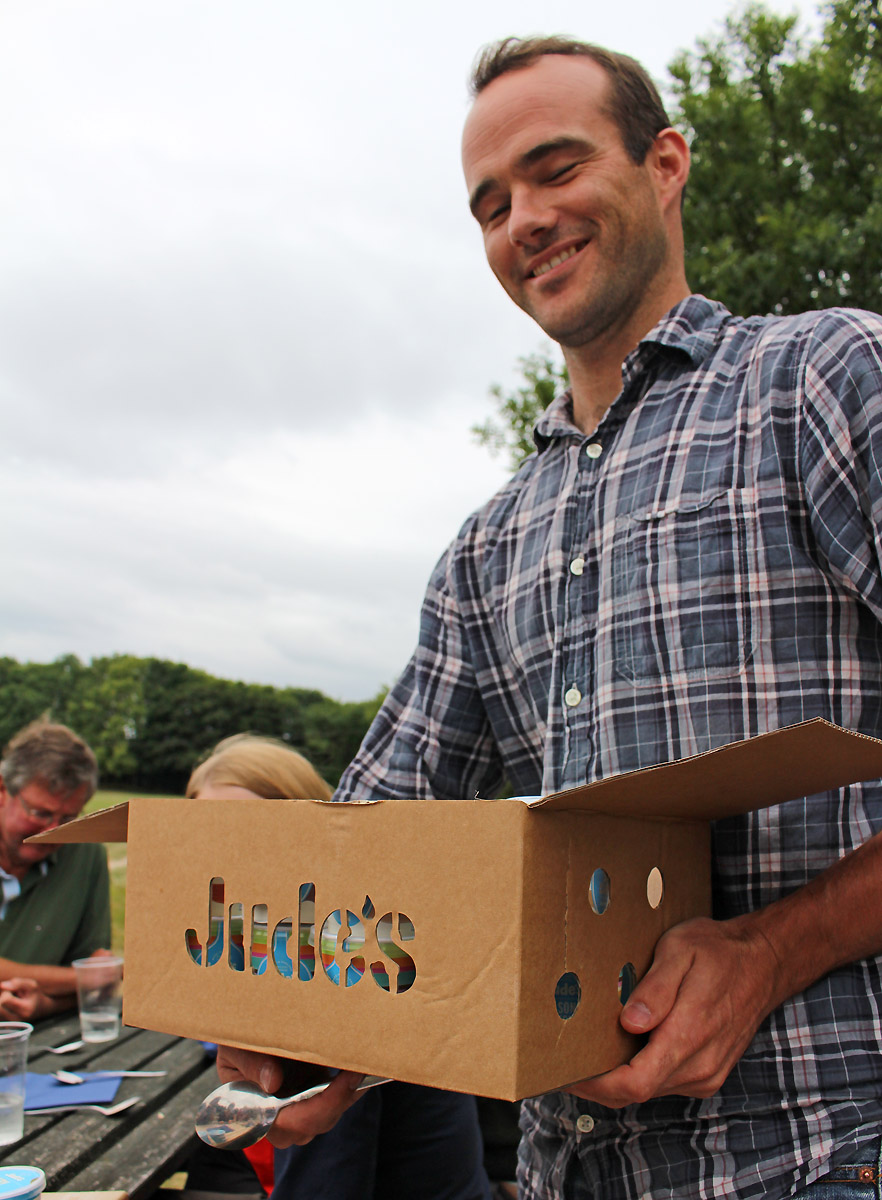
Chow Mezger with a box of ice cream!
The ice creams are beautiful. All feature a wonderfully smooth and soft texture that melts evenly in the mouth. Of the ones we tried, I think the Ginger Spice – made with crystallised pieces of stem ginger – was my favourite, closely followed by the wonderfully smooth Salted Caramel. The good old-fashioned Very Vanilla was also a strong contender and the Mango Sorbet was very refreshing.

And that brings me to the chocolate flavours. The Double Choc ice cream is great, with a good balance of sweetness and and chocolate flavour. The new Valhrona chocolate sorbet didn’t quite manage to win me over though. I love a good chocolate sorbet (see my recipe here), and even use Valrhona in my own sorbets, but the balance of Jude’s version just wasn’t quite right for me. That said, it’s a very personal thing, and you really need to try it yourself to make up your own mind.
All too quickly our tour of Jude’s Ice Cream ended and it was time to head home. It was inspiring to spend time with people who care so much about what they make and how they source the ingredients. For me, the only sad point is that I’ve never actually seen Jude’s for sale locally. That is the nature of an artisan product though, and part of me likes the fact that it’s quite difficult to find. If you do see it for sale, I highly recommend picking up a few tubs, but be careful who you share it with. They’ll probably want to take the whole tub.

Menakao are one of my favourite chocolate makers. Not only is there Madagascan origin chocolate delicious, but they make it at source in Madagascar. I’ve been enjoying their range of dark chocolates for a while, but this is the first time I’ve tried a milk chocolate.
Madagascan chocolates are often intensely fruity, so in my mind they work better with dark chocolate. That fruitiness can sometimes clash with the creaminess of a milk chocolate. This bar also contains a healthy dose of Madagascan vanilla and a pinch of salt to enhance the flavour even more.

The chocolate has a pleasantly fruity aroma, but the first flavour notes that come through are creamy and chocolatey. As the chocolate melts though, the fruitiness builds to a wonderfully intense level. The hint of salt certainly lifts the flavour even higher, but also seems to bring it all together. The creamy, fudginess and intense fruitiness never clash.

Interestingly, coming back for a second try at a different time of day, I picked up more of the chocolatey and creamy notes and the fruity notes were a little less intense. It’s quite surprising just how different a chocolate can taste at different times of day, and this bar illustrates that very well.
I may have fallen in love with this chocolate a little bit. It’s complex, yet accessible and very easy to eat. I picked up this bar in Paul a Young’s shop in Soho, but you can also find it online – it’s well worth seeking out.