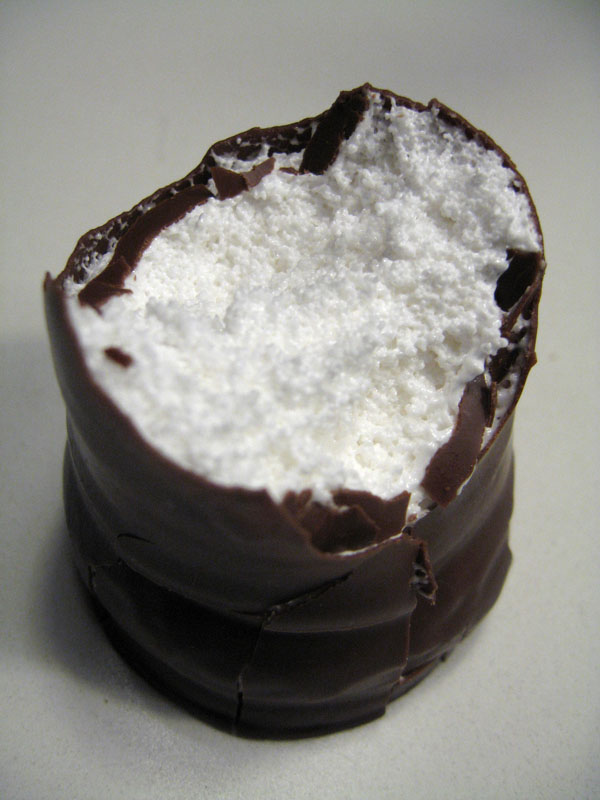
While Israel is enjoying its two annual weeks of winter, I decided it was time to return to yet another classic. Behold the Krembo, a somewhat controversial chocolate-covered sweet that originated in Denmark and somehow found its way to Israel, where it became one of the country’s fabourite winter treats. Similarly to a Tunnock’s tea cake, It’s composed of a biscuit base, topped with a sort of marshmallow fluff (made out of egg whites) and dipped in a thin layer of dairy-free chocolate (to make it parev Kosher). The fluff is usually of a plain, sort of vanilla flavour, but you can also get a mocha flavoured filling. There used to be some bizarre chemical-tasting fillings like banana and strawberry, but those never made it very far. The whole thing is then wrapped in a colourful foil wrapping, which has stayed more or less the same for as long as I remember.
I tried one with the standard filling – a fluffy, not quite creamy, super sweet mass, less dense than the tea cake filling. The unwrapping of the Krembo is an important part of the overall experience. As kids, we used to roll out the foil wrap and save it inside books and things till our parents made us throw them away. Nowadays, you chuck it away, but something of that original excitement remains.

Biting into the chocolate covering, you realise this is actually the weakest link, having very low cocoa content and generally just tasting sweet, rather than chocolatey. The biscuit is a bit less dense than a digestive but loses its freshness quickly and becomes somewhat soggy. When eaten fresh, it’s a pretty standard, slightly chemical biscuit. For me, it’s the fluff that seals the deal – the texture, as well as the flavour, which is reminiscent of Italian “winter ice cream” I’ve had. It does, however, need the biscuit and chocolate elements to tone down its otherwise soon-to-be-sickly flavour. Being quite light and fluffy, means you can eat one (or several) without feeling too weighed down by the experience.
And why is the Krembo so controversial, you may wonder? Well, to begin with, the Danish chose a rather unfortunate name for it when they came up with it over 200 years ago – a name inspired by its dark colour and starting with N. You figure it out.
Those were innocent, non-PC times indeed, but a derivative of the name lasted in Finland till 1998, which is weirder still. In Israel, the Hebrew equivalent of the offending name was done away with in the 60s, when Vitman, a local company, started mass producing the Krembo and gave it its first local brand name. Later, it got bought out by Strauss who now make the official Krembo.
Another uniquely Israeli bit of weirdness is that the Krembo attracted a lot of interest from the religious orthodox community, when a whole load of rabbis debated about various aspects to do with its consumption – are you allowed to separate the biscuit from the cream and chocolate parts on the Sabbath? Should you bless the biscuit or the cream? Never before has a humble chocolate-covered treat drawn so much interest from religious leaders. The interesting thing is that this debate came about because the Krembo is composed of three different elements and opinions are split as to which of the three is the most important. For me, it’s fluff all the way…
I’ve had this bar in my stash box for some time now, but I think I originally liberated it from my local Waitrose. It’s a thin, flat, 100g bar from Swiss chocolate maker Villlars.
It comes in a rather nice thin card box and silver foil, and once you manage to rip the foil away, you’re greeted with one of the prettiest looking bars I’ve seen for some time.
But appearances aren’t everything, and while this bar looks beautiful, a quick glance at the ingredients list on the box reveals the chocolate is only 50% cocoa solids. That’s pretty weak, to say the least.
And the coffee? Well that accounts for 8% of the bar and is described as “coffee crispies” – granules of what look, feel and taste like instant coffee. And those crispies are only 14% coffee themselves. By my calculations, that makes this bar about 50% chocolate and 1% coffee. The rest? Well, mainly sugar of course.
Despite all that though, this bar turns out to be quite pleasant. The flavours are actually quit nice and despite what it says on the ingredients list, it doesn’t taste too sweet. There’s none of the brain-jarring intensity of Green & Black’s Espresso bar, meaning quite possible to eat more than two chunks in one session without dying. That’s one thing it’s got over Green & Black’s.
As someone who isn’t that into strong coffee, that’s a big plus point for me, but the fact remains the actual chocolate just isn’t as good as I was hoping for. It’s a sweet, weak, black coffee, with no real depth to the flavour.
Unfortunately, I don’t think the real coffee lovers will be won over by something like that – and the non coffee lovers probably wouldn’t buy it in the first place.
Until a branch opened up in a local mall, my previous experience with the Rocky Mountain Chocolate Factory was looking at their display of ridiculous chocolate dipped candy apples as I ran from one end of an airport to another, usually in Toronto. But in my mind, I had written them off as not really having anything to offer a serious chocolate lover like myself. So when someone gave me a box, my expectations were low, even if the name of the collection, After Dark, made it sound at least interesting. And it sounded even better in French – Noir Intense.
When I looked at the little guide card, it didn’t look bad at all, with six different dark chocolates with sophisticated names, ranging from 61% up to 91%, and some intriguing flavours and centres like ginger, cranberries and, of course, the ubiquitous chili. Plus there was an impressive number of chocolates crammed into box too. So maybe it’s time for rethink about Rocky Mountain Chocolate Factory?
Or maybe not. Actually, that might a little too severe because the main issue with the box is that despite the promise of so many different types of chocolate, they all taste remarkably similar. Or maybe that should be unremarkably similar and that becomes really obvious because five of them are presented completely naked without anything else added.
Tsaratana, the 61% chocolate, is really boring. It tastes like so many other bland dark chocolate that I don’t care for, and there is nothing memorable about it. Thankfully Ambanja, the 65%, is a step up thanks for its fruity undertones but both the 72% options, Onyx and Quetzalcoatl, are accompanied by a déjà vu that stops them from being anything but more of the same. Nocturne jumps up to 91% on paper at least because in practise, the strong bitterness fades away really quickly in a way that is surprising. But none of them convince me I need to eat much more.
There are two other varieties of solid chocolate in the box although only one of them really needs to be mentioned – the Onyx chocolate with Hot Chili. Now, I like spicy chocolate. In fact, most of my recent favourites have been in that category, but this one is something else. It is completely unpalatable, like they felt like they should have a chili chocolate and simply threw a bunch in without even tasting it. There’s no balance, no clever slow build at all – it just burns. I couldn’t even eat the second half of the square because it was downright unpleasant. I have no idea what they were thinking.

The rest of the box would have had to be spectacular to rescue it, and it doesn’t. There are clusters of almonds, cashews, cocoa nibs, coconut, ginger and cranberry and they all just taste like stuff mixed into the chocolate. They even look homemade with their little paper cups, and with the right chocolate it tastes like anybody could make these. Plus it is kind of tough to tell them apart until the first bite although that isn’t a huge problem unless you really hate coconut.
So not a particularly inspired collection at all, and that means I’m going to keep running past Rocky Mountain Chocolate Factory both at the mall and in the airport.
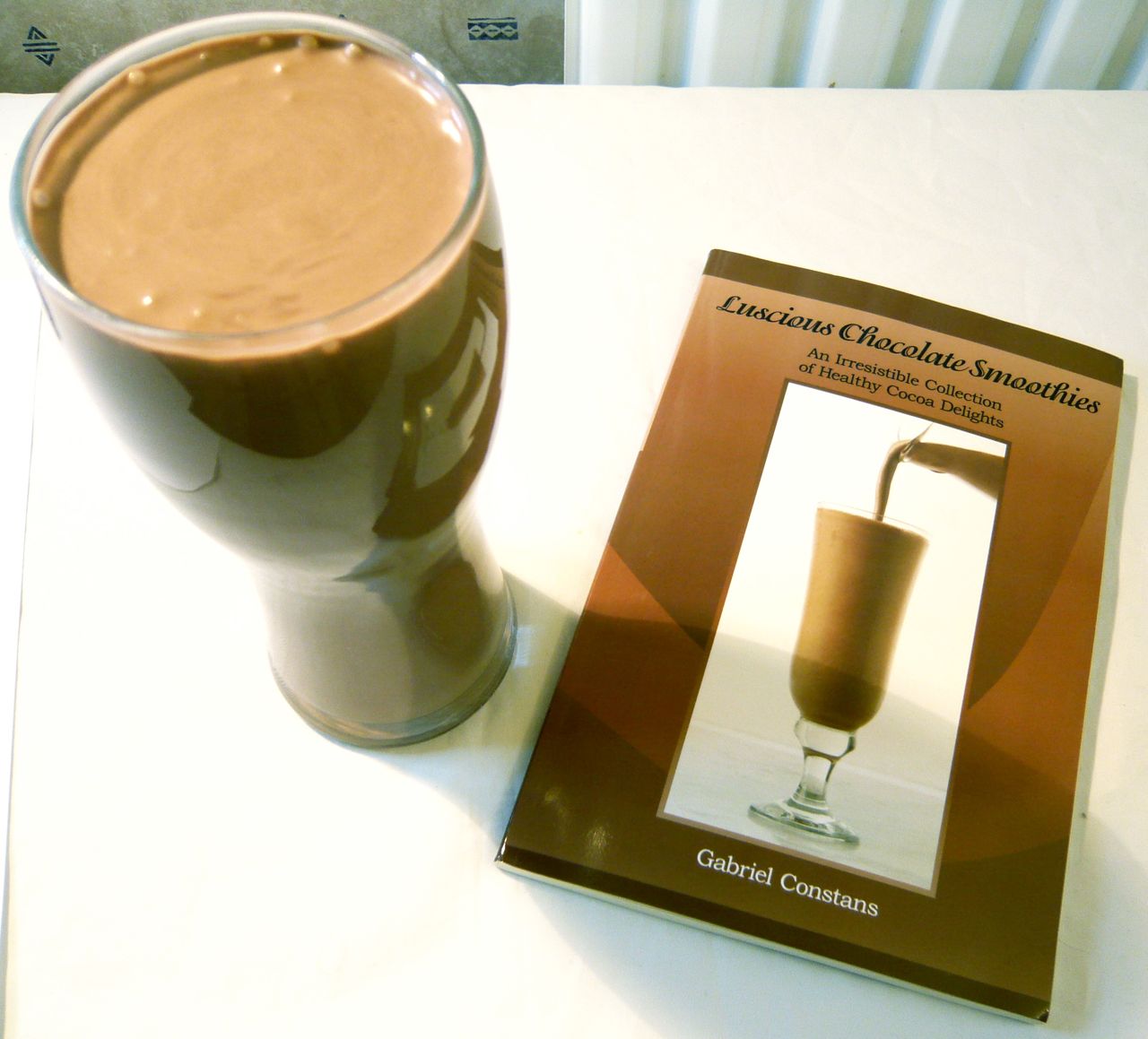
It’s not often we do book reviews here. In fact, we’ve only ever done one before – and that was a murder mystery. This is a little different; an 86 page paperback choc full of chocolate smoothie recipes.
The book itself is paperback and quite plain looking. Somewhat disappointingly, there are no pictures to go with any of the recipes (although I guess all chocolate smoothies look similar), but they’re all so simple that shouldn’t really matter.
As you might expect with a book on smoothies, there’s an emphasis on the the healthier recipes, with dark chocolate and unsweetened cocoa powder being used most often. But more unusual ingredients like tofu are also used regularly. Here’s one example:
Coyote’s Howl
- 2 cup apricot nectar
- ½ cup unsweetened apple juice
- ½ cup plain low-fat soy milk
- ½ (4 ounces) firm silken tofu
- 2 tablespoons raisins
- 1 banana, in chunks
- 1 tablespoon unsweetened cocoa powder
Method: Place all ingredients in a blender and mix for 1 minute. Pour into tall glasses, slurp joyfully, go outside and howl at the moon.
I’m not sure that people will necessarily have some of the more obscure ingredients these recipes call for to hand when the urge for a smoothie strikes, but personally I’m more likely to use a book like this for ideas than to follow the recipes to the letter. Using it that way, I certainly got a lot of new ideas for using up some of my ever-growing chocolate stash.
Overall, a simple book, but one that does exactly what it says. I think you’d really need to be a hardcore smoothie addict to get the most of it, but it certainly has potential to provide inspiration for the rest of us. It didn’t make me want to buy tofu though.
Luscious Chocolate Smoothies is available on Amazon.com for $10.