Simon and I both had one of these ‘Vegetable’ flavour Japanese KitKats, so we thought we’d both give our opinion on it…
Simon’s Take
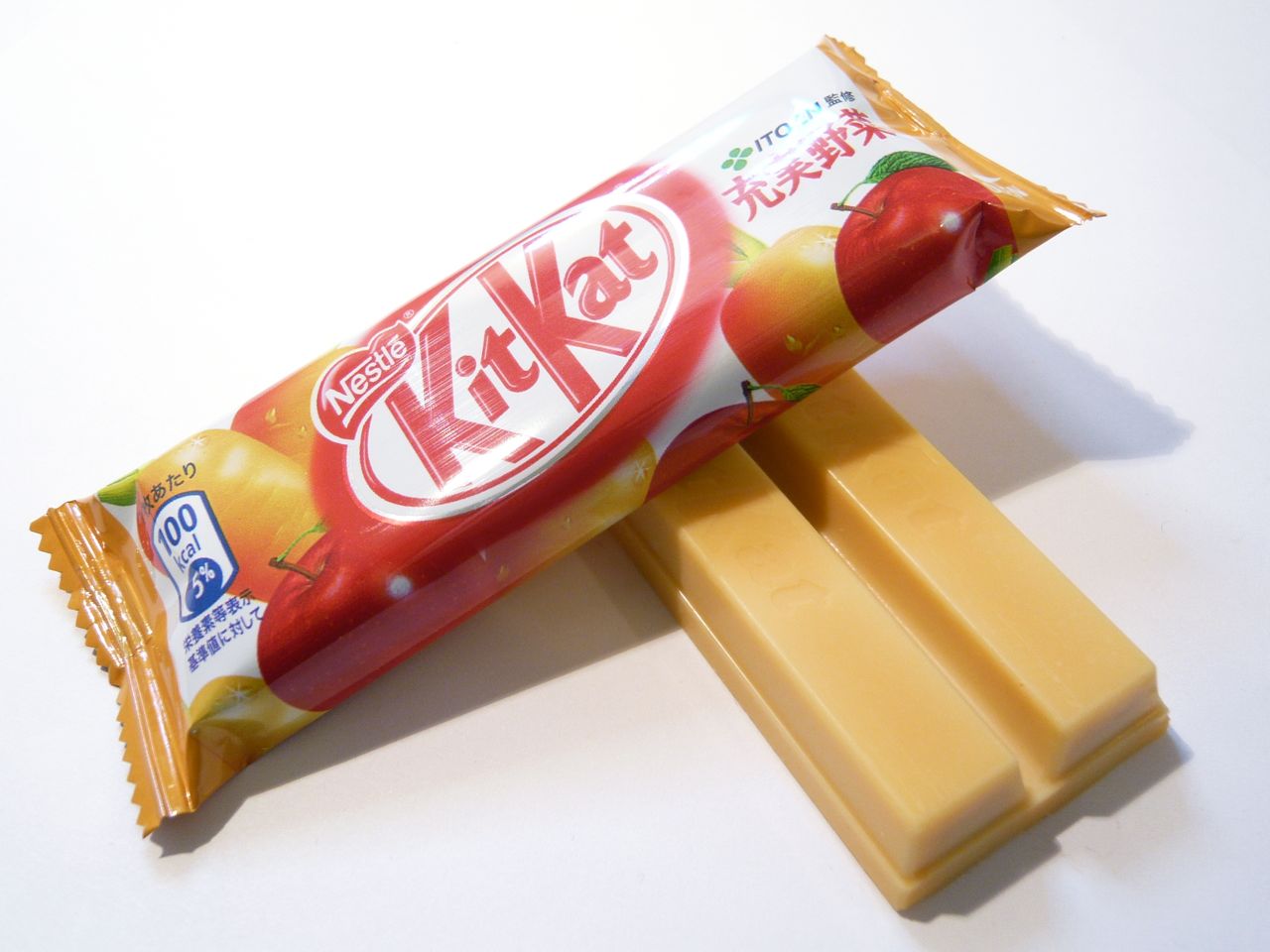
The first surprise comes when you split open the wrapper and discover that the contents are a remarkably similar colour to the packet. It’s made with white chocolate (as seems to be the norm) and has quite a powerful apple aroma. Make that VERY powerful. A deep sniff of this KitKat actually put me off for a few minutes, it was so strong.
Popping a piece into my mouth was quite a shock – when I breathed in it was almost like I’d inhaled the fumes from some sort of solvent! A series of unnatural flavour/aroma compounds assaulted my palate, something akin to a mixture of perfume, hairspray and adhesives with a hint of sugar. After the initial burst of man made scariness there is a hint of sugar and chocolate in there somewhere, but it can barely compete with that initial rush of unnatural apple overkill. It was only once I’d finished eating that more of the flavours revealed themselves.
Once I’d eaten the thing and my palate had cleared somewhat I did find that what was left behind did taste like carrot and apple, but at this point I was ‘running on fumes’ as it were – breathing the flavours rather than tasting them.
I can’t say I liked this at all. I can’t even say “It’s mad, but you ought to taste it to discover how mad it is.” I wouldn’t recommend it to anyone unless they were looking for examples of bad confectionery for some project or other. Shockingly awful.
Dom’s Take
If there’s one thing that stands out about this KitKat, it’s the aroma… no.. smell. Even before you’ve had time to take in the fact that the bar is orange, you’re greeted with the smell of apples. Not vegetables.
Unfortunately, the smell is so strong, there’s no way it could be real apple. I didn’t hate it quite as much as Simon, but let’s just say if you like Glade air fresheners, you’ll probably love this.
This KitKat IS actually made with real “fruit juice” and “vegetable juice powder” (or so the English ingredients list sticker would have me believe), but it still tastes entirely artificial. Like cheap apple-flavoured candies, complete with slightly strange aftertaste. There’s a little bit of carrot flavour there, but not much. It also contains cocoa mass and cocoa butter, but I didn’t pick up anything chocolatey about it at all.
That said, I couldn’t bring myself to hate it entirely. It’s a candy bar, not a chocolate bar. I could see young kids with a fondness for artificially flavoured fruit candies going for this, but I’m not sure how many of them will be attracted to the leading-vegetable-juice-maker co-branding. So in that sense, this one is a bit of a failure.
But at the same time, I’m glad that Nestlé make a bar like this. It’s not going to be to everyone’s taste (or most people’s taste for that matter), but the fact that they can make it and then just move along to the next new flavour is what makes Japanese KitKats so interesting.
After karaoke and weird KitKats, Pocky is the third most popular thing in Japan. Probably.
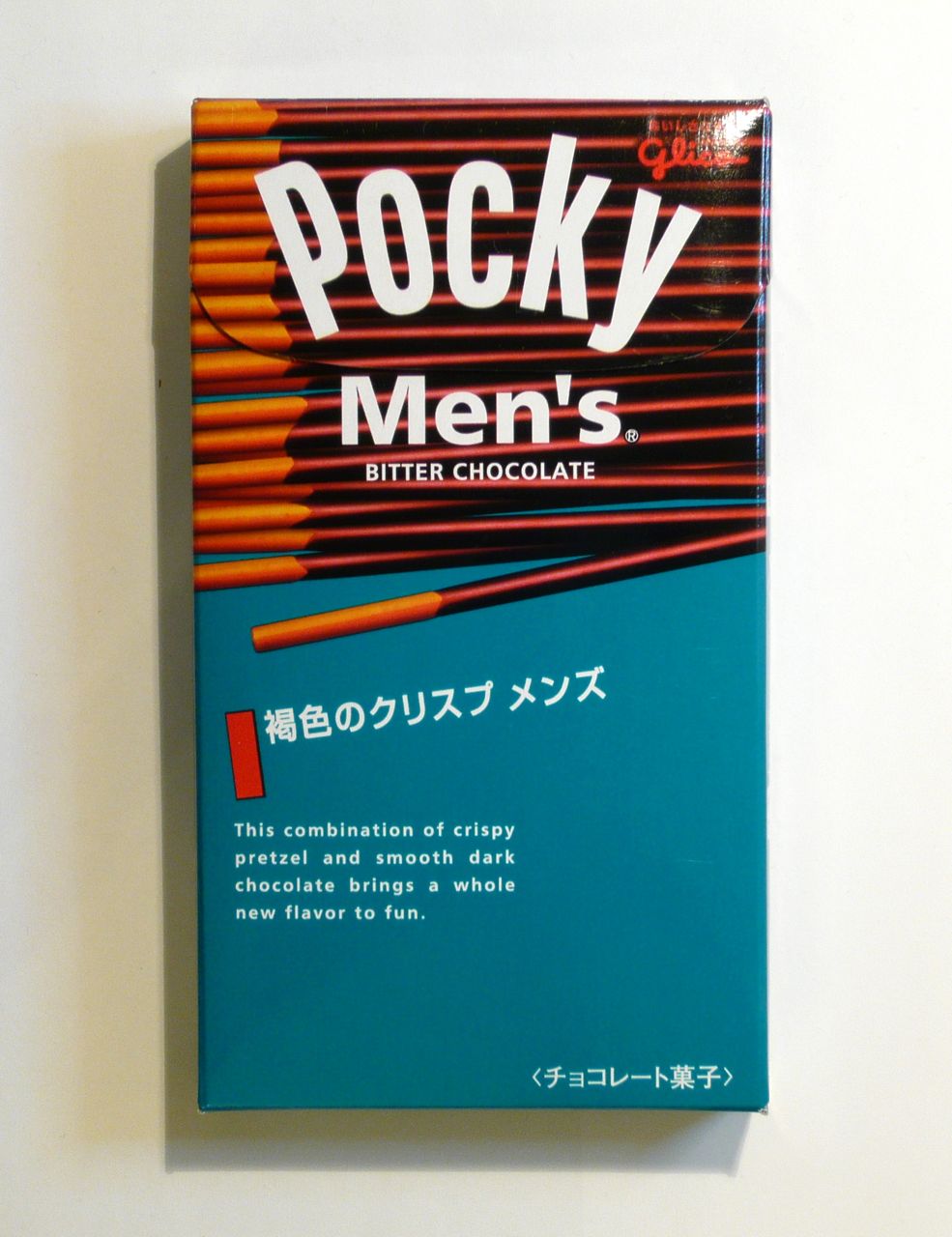
Like KitKat, it’s a crunchy, often chocolatey snack that comes in a mind-boggling array of flavours. I wanted to start myself off with something simple – and chocolatey – so I went for this “Men’s” bitter chocolate flavour.
Apparently it really is aimed at men. Perhaps women just can’t handle their dark chocolate in Japan. Or is it just that real men don’t eat pink strawberry flavoured Pocky? Either way, it seems a little weird to me.
The crunchy, biscuity part of pocky is a stick of pretzel about 10cm long. Most of the length of the pretzel is covered with a very thin layer of dark choclate. There’s no cocoa percentage given, but the ingredients are helpfully listed in English on a tiny sticker on the back of the box. “cacaomass”, “cocoa butter” and “cocoa powder” are all listed quite high up.
As far as flavour goes, it certainly lives up to its “Bitter Chocolate” name, because it is really quite bitter. There is a little bit of sweetness, but the taste is similar to dipping your finger in a jar of cocoa powder and licking it off. Frankly, it’s not really my cup of tea.
The pretzel stick doesn’t do much for me either, but then I’ve never been much of a pretzel fan. The combination of slight saltiness and the sweetness of the chocolate coating is quite nice, but not nice enough to make me want more.
So I’m not really a fan. It’s quite edible, but there was nothing about it that made me want more. The flavours weren’t amazing but my real problem with it is that at around 2 grams per stick, there’s no real substance to them and the end result just isn’t satisfying. I guess Pocky is one of those things that’s uniquely Japanese.
I picked up this particular KitKat in CyberCandy’s London store. I didn’t let the staff know who I was, so I actually had to pay for it (shocking!). I will say that it’s a nice little shop, clean and well presented with lots of interesting sweets from around the world. Well worth a visit.
Inside the box are two individually wrapped pairs of KitKat fingers (great for sharing & saving for later). I guess packaging chocolate like this is a little more expensive and a little less environmentally friendly, but it is nicer than just stuffing it into plastic wrapper. And I bet there’s a collectors market for the boxes too.
Open the wrapper and you’re greeted with the most amazing, lemony, fizzy scent. It reminds me strongly of something from my childhood. Something that I can’t put my finger on – but isn’t ginger ale. Whatever it was, I immediately fell in love with it and felt compelled to stuff it into my mouth as fast as possible.
Once again, this is a sweet white chocolate – though not as sweet as the maple KitKat. But the main flavour here is lemon, rather than ginger.
There is a hint of ginger ale going on – but it’s a ginger ale with lots of lemon and none of the spicy pepperiness that you might expect from a ginger bar. I was initially disappointed by that, but I loved the flavour anyway. It’s refreshing, yet creamy. Like lemon flavoured icing.
There’s a hint of fizzyness there too, as well as that touch of ginger. I’m not entirely sure how they managed to get all those flavours into a KitKat, but they did, and I liked this one. There’s obviously an artificial quality to the flavours and hardly a hint of chocolate, but it’s still another KitKat variety that I would buy again and again if it was available in the UK.
Koeda is Japanese for twigs, and as you can see from the box, these are little knobbly twigs of milk chocolate. Inside each box are twelve individual packets, each containing four ‘twigs’ in a variety of flavours.
In typical Japanese style, even the inside of the box is decorated, with the lid offering instructions to the consumer.
As you can see the ‘woodland’ theme extends into the box itself, although the individual packets are somewhat lacking in rural symbolism.
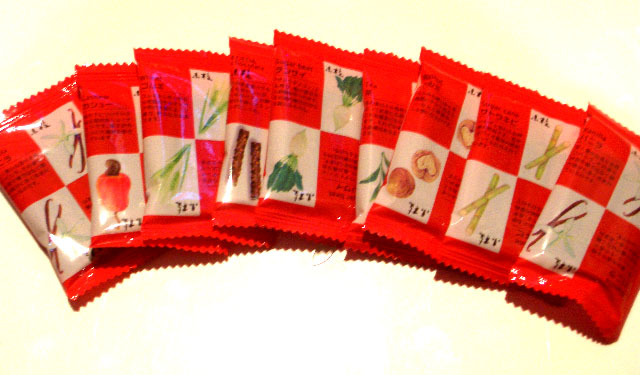
My Koeda came in eight different flavours – ‘original’ Koeda, Vanilla, Walnut, Cashew, Tea, Wheat, Sugar Beet and Sugar Cane. Each packet carries English and Japanese translations of the flavours (thank goodness) and is accompanied by a rather old fashioned looking illustration of the added ingredient. These little paintings wouldn’t look out of place in the sketchbook of a Victorian botanist, and seem somewhat at odds with my general perception of Japanese branding, but I suppose Morinaga decided to go all out with the ‘country’ feel. The designers certainly didn’t waste any space – there’s information and pictures all over every inch of this product, as seems to be the norm.
When it comes to the tasting part, I have to say that it took a bit of effort to distinguish the various flavours. A minimum of two of the four twigs was required to give me a hint of the ‘other’ ingredients, and they weren’t exactly bursting with flavour. Had I not seen that there were different flavours I night not have been able to discern any major differences between the various packets, but with eyes closed and the chocolate melting slowly in my mouth, I did manage to pick up the flavours of vanilla and nuts and the sweetness of the sugar cane and beet.
The chocolate itself isn’t anything special. It’s fairly bland, standard issue ‘factory’ milk chocolate – the sort of thing millions of confectionery companies use, and completely run-of-the-mill. A clear case of style over content which left me wondering how these would taste if they were a) bigger and b) made with better quality chocolate.
Information
- Contains milk chocolate.
- Filed under cashew, japan, koeda, milk chocolate, morinaga, sugar beet, sugar cane, tea, vanilla, walnut, wheat.