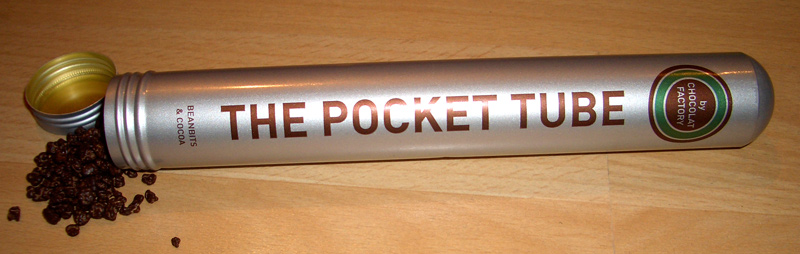
Here’s something a little unusual from Spain’s Chocolat Factory – a tube of ‘beanbits and cocoa’.
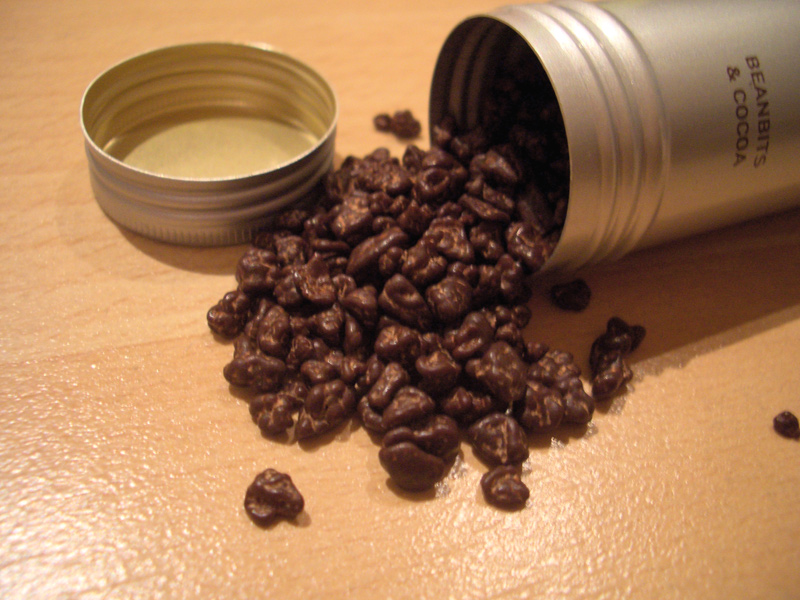
I believe I have mentioned Chocolat Factory’s award winning packaging in previous reviews, and this is certainly a great use for a cigar tube. Inside this large aluminium sausage you will find 70g of cocoa nib pieces with a shiny cocoa based coating (presumably to keep them fresh and stop them clumping together.
Pop a few of these in your mouth an the dark bittersweet coating starts to melt, teasing the palate with rich, tangy cocoa flavours. Bite down on the pieces and the slightly crunchy cocoa nibs start to release their softer, nuttier, more rounded flavours. The nibs are bursting with natural cocoa flavour and are quite frankly irresistible. Whether you leave them in your mouth to let the coating melt or just chew away at them, these little nibs are a delight for the palate.
A warning to you all – these are ridiculously moreish. This is one of those deceptive little products that has you reaching for the tube for ‘just a couple more’ again and again until you discover that you have to tilt the tube that little bit further and then it’s all over. I love cocoa nibs, and those devious Spaniards have managed to come up with a package that just lends itself perfectly to repetitive nibbling. Outrageously addictive and utterly delicious.
Unfortunately I’m pretty sure that Chocolat Factory doesn’t yet have UK distribution, but Summer is coming, and if any of you fly into Spain there’s a good chance you’ll come across a Chocolat Factory shop at the airport or one of the major cities. Check out the website for more product details and locations.
I have yet to sample a Chocolat Factory product which didn’t make me smile AND set my mouth watering. They’re creating some very interesting products and I’m sure it won’t be too long before they stop being a well kept secret and go global.
(I’m not sure which pocket I’d slip the tube into though. Might be a case of “Have you been to Chocolat Factory, or are you just pleased to see me?”)
“Oh my…
Has anyone reviewed this yet? its making me cheat on my diet, calling me
seductively from the drawer i’m keeping it in. Help!”
When Chocablog reader Kathy sent us that email, I sent both Kath and Ashleigh out to find it. Luckily, they both came up trumps, so it’s time for another one of our (almost) legendary two-for-one reviews!
Ashleigh’s take…
When this came in, I immediately decided on delegation to Kath – the unchallenged Queen of Oz Choc. I had to you see – after having all my management responsibility at work removed, I felt a burning desire to delegate, delegate! Trouble is, she reported back that Green & Blacks is a bit hard to find in Melbourne. So we soldiered on, found some, and arranged to send it to her. Cooperation does exist, in the lumpy bit at the bottom of the planet. Trouble is, she found her own in the meantime. What to do? Damn it – perhaps we’ll both have to review it.
I have to admit, when I found this was a milk chocolate, I was a bit underwhelmed. Surely butterscotch would work better with a dark. After all, EVERYTHING works better with dark chocolate.
When we open the pack here, we find a nicely presented chocolate, just like all the others we expect from Green & Blacks. The aroma is not especially strong – again much as I’d expect from a milk chocolate. Busting it apart, the little pieces of yellow cruchy stuff are apparent, though still giving no hint of what is to come.
On trying it…
Oh WOW! This really is something. It’s a crunching choccy. Don’t suck on it or let it melt – crunch it up. And when you do, you’ll go back for more. And more. Caramel, sugar, honey – yes, it has them all, and something else I can’t really define. Just WOW factor.
I feel a dose of the Austin Powers coming on. This is clearly something concocted in the evil labs of Dr Evil, designed to make me into that other famous character, Fat B$#tard. This is wicked stuff. I dare you to stop eating it when you start. I fully understand and sympathise with our reader who requested the review. Calling out it is… calling now. Think I need to go back and check to see if it’s got any worse. Bet it hasn’t.
Hands being draaaaggggeeedddddd away from keyboard……
Kath’s review…
I am a very bad person. Really bad. I bought this block at the supermarket, saying to Love Chunks and Sapphire, “Oooh this is new. I’ll get it and share it with you before writing the review.”
Sorry. I didn’t. I got it home, let it sit there by the bowl of oranges and waited for Sapphire to go to school and Love Chunks to cycle into the weather bureau before taking the required photographs of it.
Then, I unpeeled the wrapper, took another photo and tasted a couple of squares.
At first, I could barely detect any butterscotch. There was definitely some lovely crunchy bits in it, but they could have been nibs for all I could tell.
So I popped in another couple of squares, chewing this time with much more concentration and attention. Ah yes, a nice, burnt-sugar butterscotch taste but thankfully not as sickly as some. Maybe that’s because the milk chocolate has a fairly generous amount of cocoa – 34%?
I wasn’t entirely sure of the reason, so tried some more. Nope, they disappeared into my cavernous mouth far too quickly, I needed to taste a few more but much more s-l-o-w-l-y, to let the chocolate melt invitingly on my tongue, then smear itself all over my eager taste buds before allowing me to play with the shards of butterscotch teasingly lingering at the end.
Whoops, I must have zoned out a bit, because I found myself munching away far too avidly for any serious taste sensation meditation to be done. I reached for a few more squares, then another row, finally the last one and a few guilty licks of my finger to press onto the wrapper to collect any stray crumbs and… Oh dear, none left for my daughter or (hopefully very understanding and forgivingn) husband.
Too brilliantly delicious, too moreish, too naughty. A hundred grams, a schmundred grams – too easy to inhale for a Greedy Guts like myself.
Future Note to self – buy three blocks next time so we all get to try some.
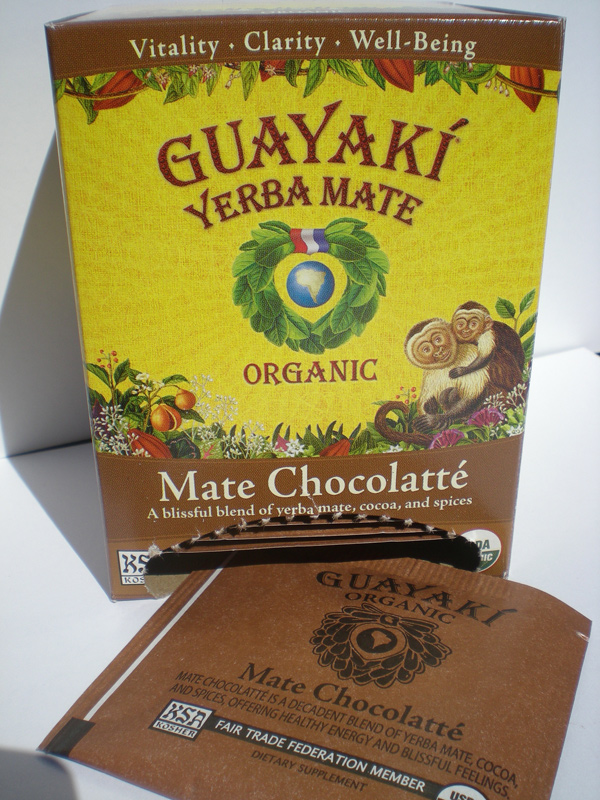
For those of you who aren’t familiar with it, yerba mate is a very wonderful tea that’s popular in South America and often pushed for its health benefits. Namely, focus, clarity, and energy. I found this one in the “health food” section of Fry’s (the grocery store, not electronics), so you may have to hunt for it a little depending on where you are.
The box says that mate has been held as “the drink of the gods.” That sounds familiar; maybe it makes perfect sense to pair it with chocolate. Now, there’s something about mate that lends itself to adding other flavors. I recently had some vanilla nut mate and discovered the twist of adding gentler flavors to its strength.

Another great thing about yerba mate in general is that it never gets bitter. So they recommend letting it brew for five to ten minutes. After leaving it for nine minutes, it was a beautiful caramel color. Right away, though, I could taste that dreaded leaf, stevia. Sure enough, it’s listed as part of the blend. Why, oh, why couldn’t they just let anyone who wants it add it in themselves? Ignoring the stevia, we also have nutmeg, cinnamon, and cloves giving it a nice warm, spiced aroma that carries into the taste, as well. The chocolate blends in with a rather tender flavor, in about the latter half of the taste. It’s still a different kind of tea, being so strong, but adding other ingredients helps suit it to more palates.
It’s also common to drink it with, as they put it, “your favorite milk and sweetener.” For me, that’s almond beverage and just a touch of cane sugar. The almond can influence flavor, but I don’t really notice its taste anymore, so no worries about that. Despite drinking tea plain all the time, I actually like this one better like this, partially because the stevia taste is all but gone. Besides that, it becomes more of a drink. It stays clear, while flavorful. This is where you can see what they mean by putting “latte” in the name.
Guayaki is also a company you can trust, being fair trade, organic, and kosher, and growing their mate under the rainforest trees. Overall, it’s a must have for tea/chocolate lovers.

Managing Director Rainer Sandmann and Public Relations Manager Oliver Dede, Premier Food and Beverages. They look happy in their work, don’t they?
If someone invites you to visit one of ‘the most comprehensive chocolate showrooms in Melbourne’ you’re not going to say ‘no thanks,’ are you?
And so one nice morning I met Oliver Dede and Rainer Sandmann of Premier Food and Beverages and learned a lot about obscure European brands not commonly available in Australia, the intricacies of shipping and what makes German-Aussies homesick.
PFB import 50% chocolate and 50% deli items. Their showroom is hidden in an enormous warehouse, but is a veritable treasure trove of chocolate, confectionery and foods such as sauerkraut, egg noodles, German biscuits, mustards, mayonnaise and even herbal teas endorsed by Steffi Graf.
Despite moving a huge number of Lindt blocks and Ritter sport bars to various confectioners and coffee shops in Australia, Rainer is keen to introduce Aussies to European brands that are not yet widely known and provide top quality chocolate and value for money.
His first move towards this goal was from the heart and not the wallet. Jovial Rainer is from the south-west corner of Germany, and his fondest memories are of riding on his grandmother’s bike across the river into Switzerland to buy blocks of his favourite chocolate, Torino. And this from a bloke who grew up smelling the Milka chocolate being made near his home!
He tells me, “I’m a businessman and shouldn’t be led by personal emotions, but I had to bring Torino out to Australia.” Made by Camille Bloch, it is a European classic consisting of sweet milk chocolate covering a soft and buttery hazelnut praline and named after an Italian city famous for hazelnut-filled chocolates. We cracked open a block and I was instantly converted. Milka who?
Then Oliver brought over another block, Ragusa. “This is a Swiss icon. Anyone who is Swiss was bought up on this and always pines for it when they’re away from home.” It is this block that “started it all” for Camille Bloch.
Ragusa was created in the 1930s at a time when cocoa was in short supply in Switzerland. They inserted whole hazelnuts into the praline centre to make the cocoa stretch further. What they got was not only a clever cocoa-conservation method, but also a chocolate that the people loved, with the recipe still the same to this day. (They have since released a dark chocolate version which I’ll review in a future article). For Jewish chocolate fans out there, Ragusa is made in a kosher version. In a fairly complicated delivery, it is made in Switzerland, shipped to the United States and then sent over to Australia but is apparently worth the effort to find.

Camille Bloch then moved on to liqueur filled chocolates, one of which, the Kirsch block, Ashleigh found during his European odyssey, brought back to Australia and reviewed for Chocablog. Rainer laughs, “Your Ashleigh could have found them here, but only in the international departure lounge at the airport!” Hopefully this availability will increase and stay tuned for a review on the Grappa (Italian spirit) and Williams (pear brandy) soon.
Australia is a hot country and importing chocolate can be difficult, Oliver and Rainer agree. Their shipping containers are refrigerated which naturally increase the costs of transport and reduces the size available inside. Once here, they are stored in their warehouse that has a specially-built ‘Chocolate Room’ refrigerated between 16-18C.
Rainer explains that every year he travels to Germany to attend the International Sweets Fair in Cologne. Sounds like a tough life I say jokingly, but he disagrees, “For most people, it’s work.” He describes seeing acres and acres of stalls over several floors, with new products, seasonal ranges and varieties on display. It was here that he found a new brand to import, Rausch.
Ironically, he didn’t see it at the fair, but in a German coffee shop. He loved the presentation of the product and its faithfulness towards specific countries, plantations and cocoa contents.
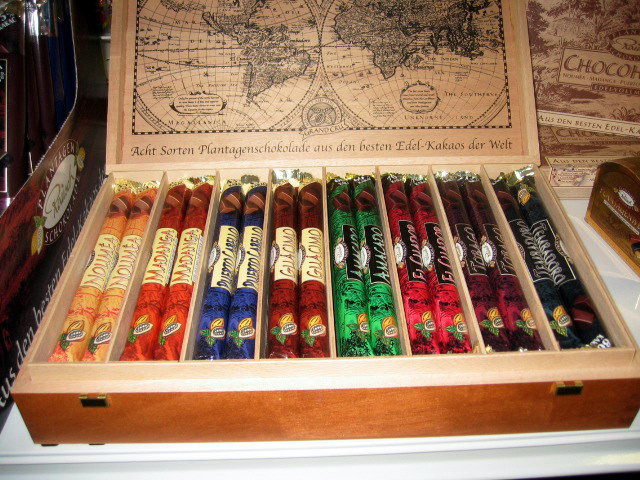
Presented in wooden cigar boxes or beautifully wrapped blocks, the eight varieties of chocolate each come from separate countries and plantations and range from 37% to 80% cocoa solids. Oliver chimes in, “We have individual wrapped squares of these in our showroom which is next to the coffee machine that we all use. It’s clear that the staff like the 43% the best, because the box empties so quickly.”
For sheer cuteness however, their imported Belfine chocolates – yes, from Belgium, are little works of art.
Everything from painted chocolate ducks to Santas, Easter Bunnies, flowers and chocolate lollipops and chocolate spoons to swirl into hot milk.
Less cute, but no less refined is Momami Creations hand scooped chocolate. This is very popular in Europe, but Rainer thinks that Aussies need to get over the fact that it may look like a cowpat, because the taste is significantly better.
Oliver cracked open the cranberry and milk chocolate creation and it was….. divine. The tartness of the berries cut a swathe through the sweetness of the chocolate and it went down a treat with our cups of freshly brewed espresso cappuccinos. And despite Rainer’s misgivings, I think they look beautiful. They won an award at the International Sweet Fair this year for their new La Choco La range which is a new style of hand-poured slab, some studded with toffee sesame seeds, ginger, seeds, cocoa nibs, almond slivers, and florentine pieces. I was heartily wishing them well in bringing all of those varieties over for us to enjoy.
What chocolate does Rainer eat when he’s at home, in his tracksuit pants in front of the TV?
“Still Torino, but also Rausch 43% or 47% or their nice dark 60% or 80% to cleanse my palate.”
And your wife and teenage children?
“My wife always loves blocks of good quality plain milk chocolate. Or she goes completely the other way and insists on Camille Bloch’s kirsch-filled blocks. My twelve year old son loves the Torino and my fourteen year old daughter prefers mostly dark chocolates, especially the dark Torino.”
As for you, Oliver, a chef with many years experience now immersed in chocolate, what do you like to eat in your down time?
“Oh, I eat the miniature Rausch chocolates because if I start on a block it’s gone before I know it!”
Rainer when you’re not actually in Europe for work, how do you keep track of chocolate varieties, prices and trends?
(Rainer smiles). “My mother might be 75, but she is often asked to be the ‘eyes and ears’ of what products are around, what everyone likes and what’s big in Germany.”
You’ve shown me a lot of German and Swiss varieties. Is there anything else up your sleeve?
“Yes, Spain! The company Simon Coll bought Amatller but I did think ‘Why on earth do I need Spanish chocolate?’” Rainer said. “Then I remembered that it was the Spaniards that introduced the cocoa bean to Europe and with Coll operating since the late 1770s they might know a thing or two.”
He could be right. The 70% block we tasted was very mild and creamy and had no hint of bitterness. Stay tuned for future reviews.