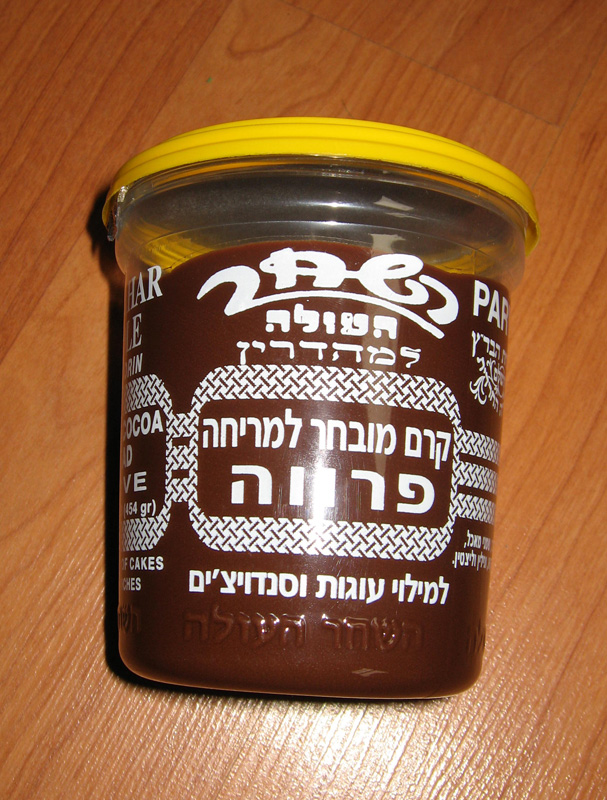
For generations, Israeli children have been split on the issue of the perfect chocolate spread. One of the main contenders has always been Hashachar Haole’s offering. Back when I was a child, no packed lunch was complete without a sandwich spread with the above. As teenagers, we took it along on our school trips and started each day with some coffee and a sandwich made out of digestive biscuits and a generous helping of this spread.
Even today, when the market is full of posher alternatives, Hashachar Haole is still the spread of choice for nostalgic Israeli parents who pass on the love to their children. It is, you can say, an institution.
But what does it taste like and how does it compare to other spreads on the market? I figured it’s time to revisit my childhood obsession and find out.
Sadly, having tried it, I must say that Hashachar Haole is rather disappointing in today’s standards. It’s neither refined nor indulgent in flavour but just very very sweet: I’d say 70% pure sweetness and 30% chocolate flavour. This is not surprising considering the fact that sugar seems to be the main ingredient in this spread.
Unfortunately, there is also a strange aftertaste involved that is rather sickly, so I found I couldn’t eat more than a tiny amount unless I spread a it quite thinly on something large enough to mitigate the effect.
Luckily, in spite of its thick consistency, Hashachar Haole spreads easily and effectively on sandwiches of both the bread and biscuit variety.
The Verdict
If you’re used to more upmarket spreads, you probably won’t like this one very much. It’s a basic product designed to satisfy children’s sweet tooth in the simplest and quickest way possible. It’s a relic from simpler times when all that was required from a chocolate spread was to be brown and sweet. As such, it does work to this day: my 10 year old brother would happily demolish a jar of the stuff as a snack if he were allowed to do so. Being kosher parev (or parve) Hashachar Haole is also suitable for vegans and those who are lactose intolerant, as it contains no dairy ingredients. That’s about as far as it goes, though. The rest is pure nostalgia.
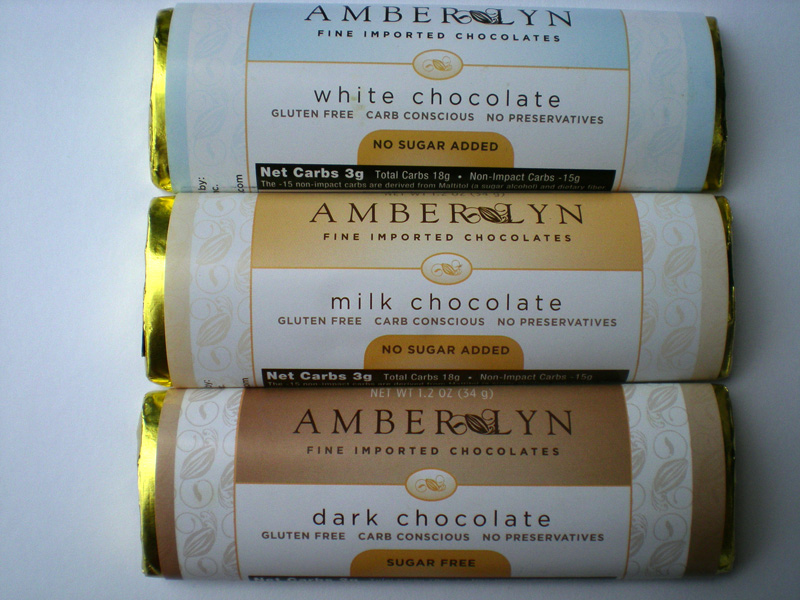
The formula for Amber Lyn’s sugar free chocolate comes from Belgium, discovered in 1999 by founder Lyman Peterson. His goal, and a sort of motto for the company today, was to find a “sugar free chocolate that didn’t taste sugar free.”
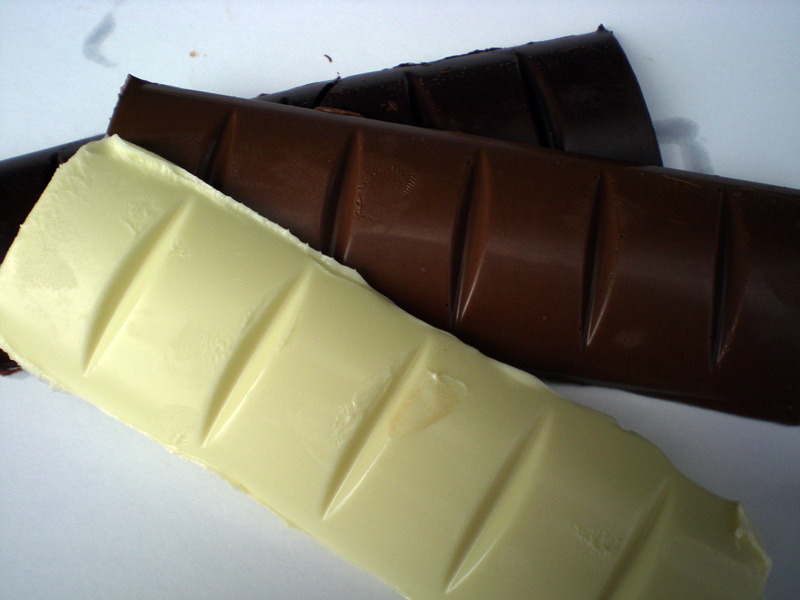
So I began testing the claim with their white chocolate bar. And they’re absolutely right on this one. Even without the sugar, the white chocolate is still its very creamy, sweet, and buttery self. Pleasant as far as whites go.
The milk chocolate (no cocoa percentages are listed on these three) tastes like… carob? Just a little, and I kind of like the dusty touch, though the carob-haters may not. It also has a rather delicious sweetness lingering on the edges. I quite like it. I think you can tell this one’s sugar free, though, but if it tastes good, what’s so bad about that?
The dark – well, it’s an alternative. He seems to be the child of Dove and carob, and he’s a little… odd, but if you give him a chance (aka. a second piece), he kind of starts to grow on you. At first, it doesn’t seem to have much depth, then a roundness comes out in the flavors that’s rather intriguing.
There were also four caramel truffles, two milk and two dark. The milk is, somewhat strangely, the one in the darker color. As I unwrapped it, I considered how most caramel is almost pure sugar and likewise probably tricky to get right without sugar. It’s the gooey, sticky kind of caramel they went for, and it ends up as simple as a Rolo. More like candy, yet still enjoyable. I think I’m even liking not having all the sugar. In the dark truffle, Mr. Carob-Dove and the softer-tasting caramel have a funny combo. There’s an almost salty taste. I think the milk worked better, but this one’s decent enough.
Sugar-less is what Amber Lyn set out to do, and it’s obvious that’s what they do best. Definitely worth looking into if you need (or want) to stay away from sugar. They’re also gluten free, “carb conscious,” and preservative-free. They have a wide range of flavors, too, so you’ll have plenty of new ones to try.
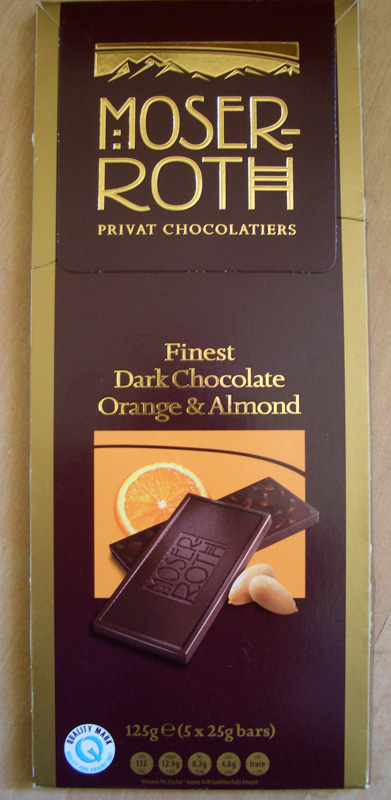
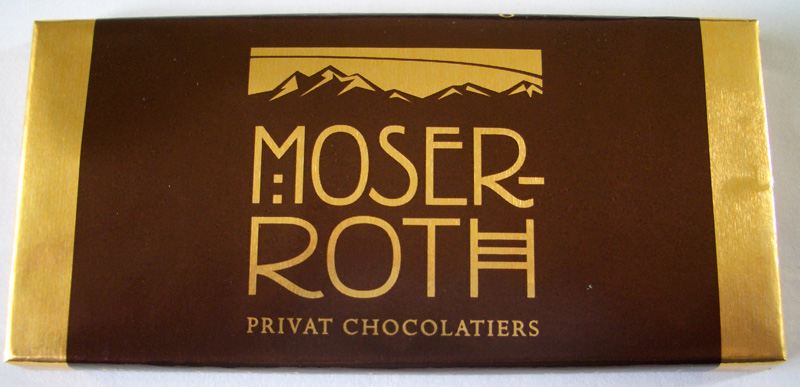
Here’s another (potentially) cheap and cheerful offering from one of the UK’s budget supermarket chains. Manufactured for the Aldi chain, the package contains five 25g bars and according to the blurb on the back it’s ‘a delicious treat for connoisseurs of sophisticated gourmet chocolate’.
Sounds like my kind of confectionery.
Further reading told me that the chocolate is made from ‘the finest cocoa to give a rich aroma… to create an unforgettable eating experience.’
Now I don’t know what you’re thinking at this point, dear reader, but it struck me that the contents of this packet were going to have to be quite something if they were going to live up to this kind of hype.
Now I have to say that you can’t really fault Moser-Roth for presentation. The chocolate mini-bars look the part alright. So far so good, but as we all know, the proof of the pudding lies in the eating, and that is preceded by the smell test, and this, I’m afraid to say, was where things started to go downhill.
As you might expect, there’s a good strong citrus tang but little in the way of a rich aroma. Popping a piece into my mouth had me reaching for the packet to check the ingredients.
Why?
Sugar.
Just under half of this chocolate is sugar – 45.5g of every hundred, in fact. A lot of sugar. What that does (for me at least) is to destroy any chance of appreciating the cocoa flavours, no matter how fine the cocoa may be.
Sorry, Aldi, but it’s not a winner. I do wonder whether this would be popular in the US, though…
Cadbury has been revamping the Old Gold range. For a long time the choices didn’t seem very extensive, and Old Gold was a bit of a yawn. Been round for ages. Yawn. Let’s try something else.
I’m pleased to say that the range has grown, and some of the new members are pretty good. And the plain Old Gold Dark 70% is something we just tend to have lying around the house to munch on – good chocolate, at a good price. Not too sweet, not to bitter, it’s pretty much the Baby Bear of dark chocolates: Juuuust Right. Though I have to admit to a bias as well – I regard the Lindt 70% dark as the “Gold Standard” to which others must compare – I do think it’s better, but also more of an acquired taste. The Old Gold 70% isn’t likely to offend anyone.
Cadbury have now also revamped the packaging, and the cheap looking plastic wrapping is gone – replaced by cardboard and foil (taking another leaf out of the Lindt book?). Even though it doesn’t contribute to the contents, just having the packaging look a bit less cheap does automatically make this feel like a more up-market product.
So, today, it’s time to try the Old Gold Dark Roast Almond. I was quite looking forward to this – after both Dom and I have taken forays into chocolate-with-nuts in the Wawel Gorzka Krakowska and Mr Goodbar
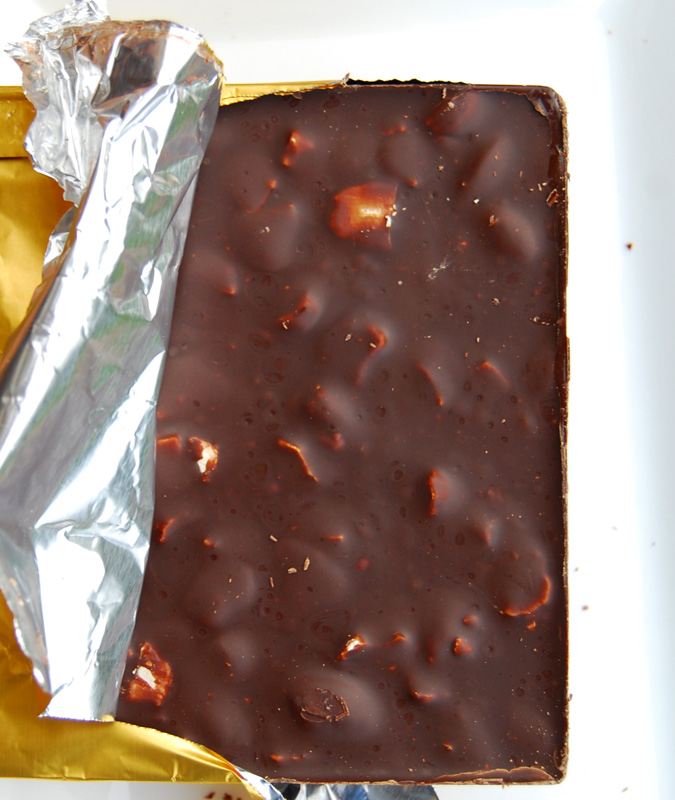
Oh dear, I’m a little disappointed. Firstly, opening the pack and checking the back reveals what seem like lots of nuts, and the pack does state Almonds at 16% of the total.
But it’s just not very nutty. It’s kind of sweet – and that’s borne out again from the ingredients list where the dark chocolate is only 40% cocoa. How is that dark? What happened to the 70%? The number 1 ingredient is sugar – and it shows. This is inoffensive – there’s nothing wrong with it, and the rest of the family think it’s not too bad. But they do agree that it’s sweet. We all agree that almonds don’t have a particularly strong flavour, so getting it to be really nutty might be difficult. But it should be better than it is.
After some of the others in the range have lifted the bar – this one is a bit of a disappointment. Unless you like sweet, then you’ll love it.
I have a use for the rest of this block… it’s perfect for this recipe.