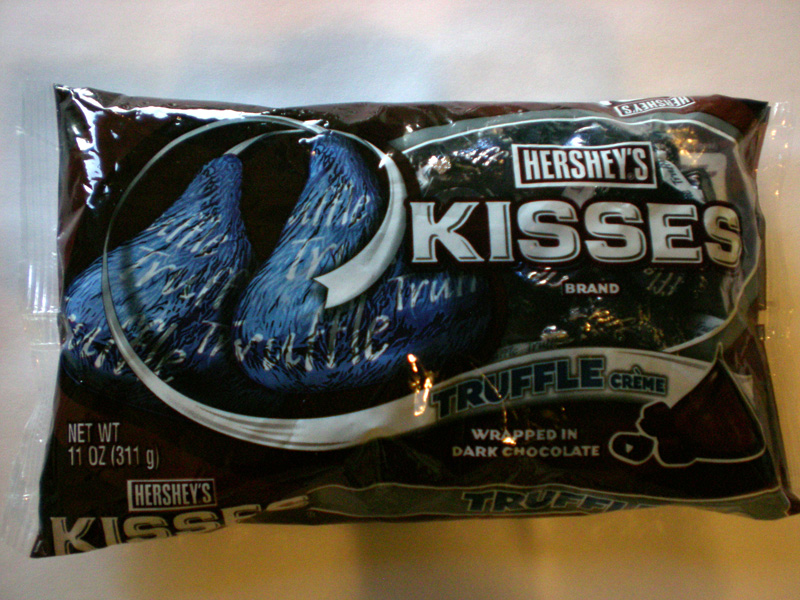
I didn’t buy this bag. I’ve had enough Hershey’s lately. But seeing as it was in the house, well, I couldn’t let it go without making a few comments. Let me just ignore the “truffle” part of the name, which there is no way I could agree with, even if it is just “filled with” instead of calling the entire chocolate a truffle. Anyway, they are in the Hershey’s Kiss format, which usually means a better taste to me.
My experience with these little things has been confusing. I had one at first and didn’t like it. At all. A couple days later, I thought they were rather good. So let me try and balance out these two opposite experiences.
These chocolates have very much of a warm, walnut brownie taste to them, especially with the inner filling. This means that there’s lots of chocolateyness and lots of sugar. So it follows naturally that the degree of liking will depend on the person and their mood. Sometimes you’re in the mood for simpler pleasures; sometimes you’re not. Then there are the people who don’t even like to “waste their time” with things like this. But for a small pleasure (like the brownies they remind me of), I’d say Hershey’s did a nice enough job.
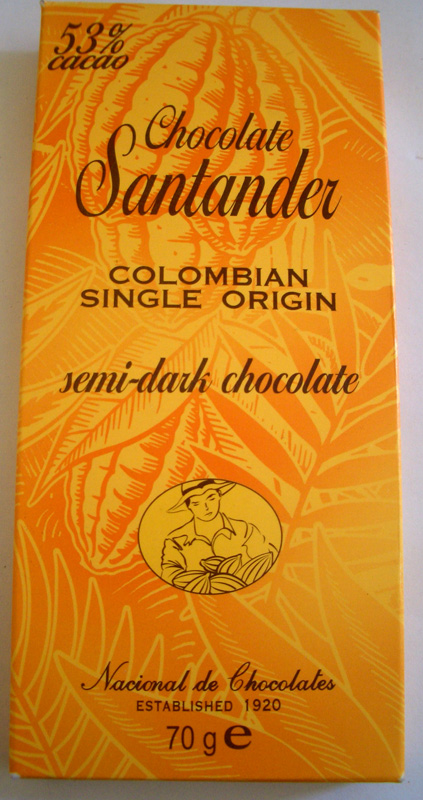
I suppose it makes sense for a country that produces coffee to also have a cocoa growing industry, but Colombian chocolate is a little thin on the ground in my usual UK haunts. This bar is a 53% cocoa semi-Dark chocolate, fairly traded by Nacional de Chocolates, who have been in business since 1920.
The concept of ‘semi-dark’ is intriguing, and I think it shows a difference in tastes worldwide. In the UK anything over 50% would usually be classed as dark chocolate, and I was intrigued as to how this might differ taste-wise from something I might call ‘dark’
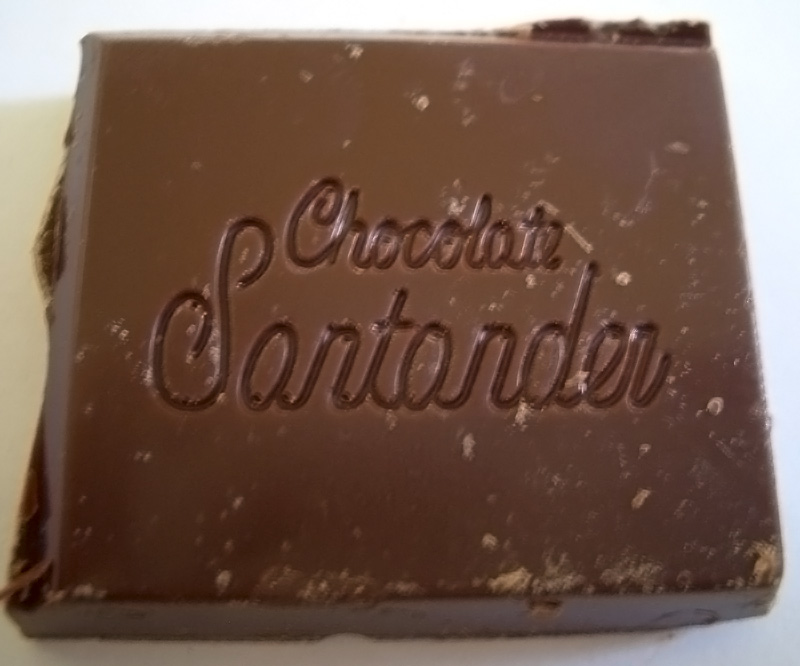
As you can see, it’s darker than milk chocolate but lighter than a really high cocoa content bar might be. The smell of it is very ‘toppy’ – all citrus and light wood aromas with a slightly sweet note in there. This is further amplified when tasting. The chocolate melts very quickly, flooding the mouth with sweet citrussy high notes. I had the distinct impression that there was quite a lot of sugar involved as well, but the packaging doesn’t give a breakdown of content by percentage. Texture and sweetness-wise it reminded me of the Seeds of Change dark chocolate I recently reviewed.
It’s certainly not as deep tasting as a high cocoa content dark bar, and the more complex cocoa flavours are somewhat obscured by the sweetness, but it was certainly popular with my randomly selected tasting friends. I personally found it a little too sweet on my palate and found myself wishing for less sweet and more cocoa. It was pleasant enough, but not outstanding enough for me to want to rave about it to all and sundry. Perhaps it would work well as a ‘bridge’ between milk and dark – a ‘gateway’ chocolate, to use someone else’s terminology.
There’s no official UK importer for this product (I picked it up in Belfast) but I have a feeling that other delis and health food stores might stock it. I would certainly be interested in trying a darker Colombian bar sometime to see if the cocoa flavours are any more intense when concentrated.
We’ve mentioned before how impressed we’ve been with the way Thorntons are moving forward – in fact, we discussed it in depth when we met their head chocolatier Keith Hurdman a few months ago.
If the experts are to believed, this particular chocolate may be one of the best so far as the box proudly displays its Academy of Chocolate Bronze Award. I had been quite keen to try it, and luckily it turned up in our goody bags at the awards ceremony. Yay!
The format of this block is the same as the other Thorntons square blocks, except this one has a gold wrapper emblazoned with the words “award winning”, rather than the usual clear plastic wrapper. It definitely looks more appetising wrapped in gold, so I guess Thorntons are just going to have to win a few more awards so they can repackage the rest of the range.
The chocolate here is a Dominican Republic 60% and it’s really rather delicious. It has a bright, fruity flavour that instantly reminded me of Amano’s 70% Madagascar bar. It’s not bitter at all and is the kind of thing I could happily eat all day.
The caramelised macadamias add an interesting flavour too. They have just a hint of sweetness and a touch of salt with a very slightly burnt flavour coming in at the end. They’re finely chopped, so there’s no large chunks to contend with and they add just the right amount of crispy, crunchy texture.
I can certainly see why this won an Academy of Chocolate award – it really is rather good – and the fact that it’s available somewhere as accessible as Thorntons means that anyone should be able to get their hands on it.
Having said that, I can’t see it in their online store and I’ve not checked out my local Thorntons lately. If you do find it, let us know. And also buy some – you won’t regret it.
Update: I’m told by Thorntons that this bar is being introduced over the next few weeks and should be in all Thorntons stores by the end of the month. So look out for it!
Loving Earth is a Melbourne-based company that makes chocolate from the highest quality organic ingredients they have literally found and brought back from their community development work and sojourns around the world. They buy their cacao from an indigenous community in Satipo, Peru who belong to the Fair Trade Federation.
If that’s not worthy enough, they’re also developing three other projects for communities that include harvesting Gubinge (no I don’t know what it is either) in Broome, Western Australia; finding and installing a cacao press for the Mayan network in Xoconusco, Mexico so that they can cold press cacao licor into powder and butter; and finding a similar press for the cacao growers in Peru to increase their capacity and include more growers in their collective.
So what is raw chocolate exactly? It is suitable for vegans because it does not contain any sugar or dairy and is uncooked, unprocessed chocolate that is only sweetened with agave syrup (a natural, low GI sweetener). By ‘uncooked’ it means that the cacao is never heated above 40-45C from the time it is picked to when it is eaten and tests have shown that it has up to four times the level of antioxidants as conventional chocolate.
We decided to try their raw organic ‘plain’ chocolate, albeit with lucuma and maca (no, I don’t know what they are either but they sound like two guys I went to high school with), as Christian had given us a taste of algave syrup and it was a pleasantly thin, dark, sweet treacly liquid that they use instead of processed sugar. Being Australian and USDA-certified organic also lent it extra greenie cred.
As you can see, the chocolate doesn’t have the standard glossiness of commercial varieties and instead has a slightly powdery coating.
Biting into it the differences were made even more obvious. The cocoa and other powders were evident, giving it a taste similar to a dense chocolate brownie or flourless mud cake. It wasn’t overly sweet, so the cocoa could feature clearly and be appreciated as a single ingredient. Overall, the taste was ‘cool’, like a tiny million little bubbles were being activated, causing a refreshing mouth-feel that felt like the tightly compressed ingredients were gradually coming loose as they relaxed, melted and separated in my mouth.
The ingredients are therefore not your predicted sugar, cocoa butter, milk, vanilla but ‘organic raw cacao butter, organic raw cacao powder, organic agave syrup, organic lucuma powder, organic maca powder and Himalayan crystal salt‘. The only thing I didn’t like reading was that it contains 50.5 grams of fat per hundred grams – eek! Still, at least it was giving me energy and that extra winter warmth (or coat?) I’m always looking for.
This is the best and most unique of the fair trade, ethically-driven chocolate I’ve tasted so far and provides a really inviting alternative to the big-wigs of the industry. I’m looking forward to trying their other flavours that include Goji berries, Peruvian purple corn, Camu Camu, activated almonds and cacao nibs.
Stay tuned!