As any blogger knows, July is the time when all the big brands roll out their Christmas ranges. This year, along with invitations to various supermarket Christmas ranges, was one that stood out. An invitation to visit The Shard to try twelve Christmas buches, each made with Valrhona chocolate.
Each bûche de Noël (that’s a fancy Yule log, if you’re wondering) was designed and made by a top pastry chefs from some of London’s most prestigious hotels and restaurants. You may not have heard of some of these chefs, but they are the unsung heroes that produce some of the most wonderful desserts in the country.
Lucky invitees were invited to The Shard to try each of the bûche and spend some time chatting to the pastry chefs who made them.

Without exception, every one of the bûches was beautiful. Many, many hours of hard work and planning had gone into their creation, and it was a real privilege to be able to spend time talking to their creators.
Given the quality and amount of work that went into these magnificent creations, I think it’s only fair that I name all the chefs involved. They were Loic Carbonnet (The Four Seasons), Luke Frost (Coworth Park), Lewis Wilson (The Ritz), Denis Drame – (Pennyhill Park), Joseph Wagenaar (The Andaz), Sarah Barber (ME London), John Grantham (Restaurant 61), Cherish Finden (The Langham), Eric Rousseau (Patisserie Belle Epoque), Regis Negrier (The Delauney), Mourad Khiat (The Berkeley), Ryan Thompson (The Shangi La) and Andrew Blas (Café Royal).

Now, I know what you’re going to ask: Which one was my favourite? That’s a tough one. With so many different interpretations of the theme and such an array of flavours, it’s very hard to choose. They really are all winners.
In terms of presentation, Cherish Finden’s “Magic By Moonlight” (above) was simply stunning. Consisting of four mini-buches arranged sideways against a moonlight scene, it was made with Valrhona Caramelia mousse and rolled inside a moist Valrhona Kalingo sponge with crunchy praline.

But if I had to pick just one winner, then it would probably be Sarah Barber’s Black Forest Bûche Noel (pictured above). Made with Valrhona’s Manjari Madagascan chocolate and all the flavours of a black forest gateaux, this particular creation was as beautiful and indulgent as it looks, and a wonderful alternative to a traditional cake.
If you fancy trying one of these creations for yourself, the good news is that every one of them is going to be on sale as limited editions in their respective hotels and restaurants this Christmas. So if you really want to impress someone this Christmas, now is the time to start planning! Which one would you choose?
Valrhona have descriptions and photos of all the bûches on their Facebook page.
Huge thanks to Valrhona and all the pastry chefs for letting us come and try your creations. And if you’re reading this… can we come and play in your kitchen now??
Photo Gallery

As I mentioned last week, there’s nothing I like better than discovering new bean-to-bar chocolate makers. From a few very large companies and just a handful of dedicated chocolate makers back in 2000, the chocolate market has developed to a point where handmade bean-to-bar chocolate is on the verge of becoming the norm, rather than the exception.
The United States dominates the list of quality chocolate makers, but slowly the rest of the world is waking up to it and wanting to get in on the game. And that brings us nicely to OmNom Chocolate. Iceland’s first – and so far only – bean to bar chocolate maker.
I first heard of OmNom via my friend Judith, who visited the small factory on a recent trip to Reykjavik. I was lucky enough to be given this bar by another friend, and first impressions are very good.
I love the name and branding, but I particularly like the box. The thin card wrapper with has a simple paper sleeve to keep it closed, and it feels like a quality product. Most importantly of all, the design means I can re-seal the pack after taking a chunk or two. With a quality chocolate bar, it’s really important to be able to wrap the bar up again, because it’s not something you tend to eat in one go. OmNom’s packaging means I can keep the bar with me and not have to worry about stray chunks and crumbs at the bottom of my bag. It’s the little things that make for a great chocolate experience.

On opening the foil inner wrapper, you’re immediately greeted by the unmistakeable aroma of Madagascan cacao. There’s a wonderfully vibrant, fruity aroma to it.
There’s a slightly soft texture to the chocolate, although I’m sure that’s in no small part down to the current hot weather in London at the time of writing. Consequently, the chocolate has a quick melt and releases it’s flavour rapidly.
The fruity, citrus notes are there in the flavour, but they’re much more subtle than I was expecting from the aroma. Instead, there’s a prominent liquorice flavour note and some rather interesting floral flavours. It doesn’t kick you in the face like some Madagascan chocolates, but instead takes you on a more gentle and interesting ride.
The friend who gave me this bar told me it was great, but perhaps not as refined as it could be. Personally though, I love it. I love that it’s not the same as every other Madagascan origin chocolate bar. I love the flavour and I love the way it’s presented.
You can buy OmNom Chocolate online and it’s also available in a few retail outlets in the US, Denmark and France. Hopefully we’ll be able to get it easily in the UK soon too, as it really is rather good.

A friend asked me the other day why I don’t ever write about any fun chocolate. Apparently all my recent articles have been rather serious. I was immediately a bit defensive, countering that all chocolate is fun but I suppose she did have a point. After all, most people just stop off at their local supermarket to pick up a bar of chocolate rather than searching out a locally made bean to bar creation. So here’s my attempt at a fun review.
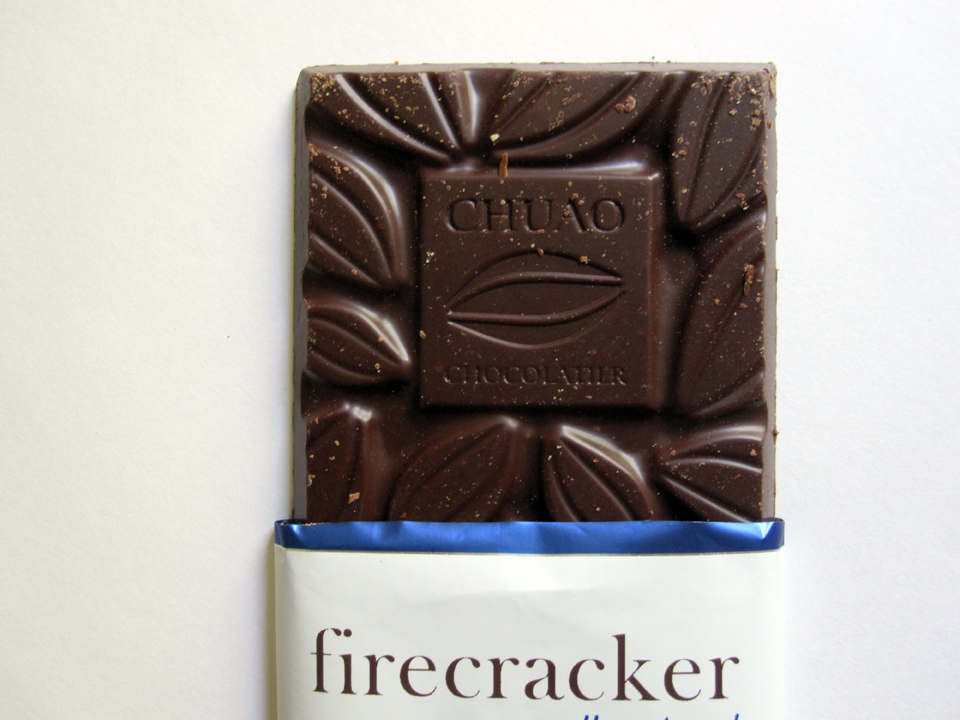
I’ve had some Chuao Chocolatier bars before, or at least a few nibbles from an accommodating friend (a different, less judgemental one…), so I was quite happy that the majority of their range has turned up in a local shop. And since I was looking for something fun, I selected their Firecracker bar because it has popping candy and what’s more fun than popping candy?

Chuao is headed by a pair of Venezuelan brothers, Michael and Richard Antonorsi, and their focus is on creating unique bars of chocolate with unexpected flavour combinations. That means that the focus is more on what is mixed into the chocolate rather than the chocolate itself, although it is a serviceable 60% cocoa solids which leaves more than enough space for spices and the like. In the case of the Firecracker bar, the main flavour comes via chipotle and pasilla chile peppers which add some smokiness and just the slightest touch of heat. And then there’s a touch of salt which helps to punctuate the whole experience, and also draws a bit more depth out of the chocolate. But really, it is all about the popping candy.
I’ve had chocolate with popping candy before, but there’s a crazy amount in here – breaking the bar reveals that it is positively studded with the stuff. As soon as the chocolate starts to melt, the popping takes over at an alarming rate and the bar really lives up to the latter half of its name. There were even a couple of occasions when I bit off a corner and the level of explosion I was greeted with made me jump just a little.

The bottom line is that this really is a fun bar of chocolate. What it lacks in fieriness, it makes up for with its all out attack on the interior of your mouth. And it is pretty tasty too. It also works as a great introduction for those trying to enter a more adventurous world of chocolate because it is very different but not in an intimidating way. Plus it is a lot of fun. So there.

I’m always intrigued by the way television covers the chocolate industry. It will usually take one of two angles; Either it will reminisce about the long lost British chocolate industry with archive footage of the Cadbury, Rowntree or Fry’s factories, or it will extol the virtues of some European country; usually either France, Belgium or Switzerland.
I had high hopes when I heard Michel Roux Jr was tackling the subject with his BBC programme Chocolate Perfection. If anyone can open up the exciting world of chocolate makers and chocolatiers, it’s him. He’s knowledgable, charming, and from what I hear, a very nice man.
As I sat down to watch with my cup of tea, my enthusiasm was brought to a crashing halt with the words “You won’t be surprised that in the search for my best, I won’t be touring the UK” spoken over archive ’70s footage of Cadbury’s Bournville factory.
Well actually, yes, I am surprised.
Roux chose to base the entire programme in France, which is fair enough, but the throw away statement as to why the UK – and the rest of the world – were being skipped entirely was both shocking and poorly judged.
Now you might think that I’m just miffed that us Brits were left out, and that French chocolate really is the home of Chocolate Perfection, but that’s really not the case. There does seem to be a perception amongst some in the food industry that French chocolate leads the world, but that’s an outdated point of view and frankly, one that is just plain wrong.
Don’t take my word for it though; The International Chocolate Awards represent the very pinnacle of achievement for chocolate makers and chocolatiers. Out of 59 medals given at last year’s World Final, only one went to a French company (a sliver medal for Bonnat’s – Juliana bar). Italy led the way with fifteen awards, followed the the US with ten and the UK with a respectable nine.
In my chocolate travels, I’ve been lucky enough to visit France on many occasions. Indeed, for the last three years, I’ve attended the world’s biggest chocolate show, Salon Du Chocolat in Paris. The show is awash with French chocolatiers from all over the country and most of them are pretty good. But when you dig a little deeper, you’ll find that many are using the same Valrhona chocolate. In many cases, chocolatiers will simply re-mould existing Valrhona bars and put their own labels on them – complete with the original Valrhona product name.

The baseline for quality chocolate in France is certainly higher than in the UK. A bar or simple praline made with Valrhona chocolate is clearly better than our mass produced KitKat or Dairy Milk. The French have a tradition of quality chocolate and simply don’t eat cheap confectionery bars in the quantities we do.
But with that tradition has come a level of complacency. For me, there has been little in the way of innovation to see in Paris over the last few years. And when it does appear, it’s usually from Japanese chocolatiers. The likes of Es Koyama who have started with a traditional French style and taken it in exciting new directions.
French tastes are so entwined with tradition that it’s very difficult for a chocolatier to try something truly innovative. Weird and wonderful flavour combinations don’t tend to sell, and as a consequence chocolatiers stick with what they know.
Here in the UK, we might seem a little more reserved than the French, but we have an adventurous streak! Chocolatiers like Paul A Young experiment with everything from Marmite to cigar leaves in their products in their quest to tantalise the tastebuds. Down in Dorset, Chococo use delicious local and fresh ingredients for their range of beautiful and brightly coloured chocolates. Shelly Preston’s Boutique Aromatique in Nottinghamshire produces a wonderful range inspired by fragrant florals and essential oils. And up in Edinburgh, The Chocolate Tree produce an entire range of bars, truffles and confections with chocolate they make from the bean themselves.
There’s still only a handful of companies in the UK producing chocolate from the bean, but it’s an industry that’s growing too. Only this week, York Cocoa House are embarking on their own journey, bringing back small batch chocolate making to the spiritual home of British chocolate.
There is so much excitement and innovation in the British chocolate industry at the moment and it was a real shame to see it dismissed in a single sentence at the start of Chocolate Perfection. And there was simply no mention at all of the explosion of small-batch bean-to-bar makers in the United States that are taking the world by storm. I enjoyed the programme for what it was, a interesting look at the French chocolate industry, but that’s all it was.
I only hope the BBC will consider commissioning a follow-up, looking at some of the inspirational and innovative chocolatiers and chocolate makers we have here in the UK.
For another viewpoint on the programme, take a look at Steven Pierce’s excellent post “Why Michel Roux Jr Is Wrong About Chocolate“.