Do you spend your days craving an upmarket an ethically sound Bounty bar? If so, Madecasse Toasted Coconut might just be for you!
Madecasse is probably one of the better known bean-to-bar chocolate brands, with its range of bars available readily online and in an increasing number of high end food stores. In fact, if you’re in the UK, you can most of the Madecasse range on special introductory offer at Waitrose for just £1.99 right now.
Made from tree-to-bar in Madagascar by local manufacturer Cinagra (who also make Menakao branded bars), Madecasse is actually an American company, founded by two Peace Corps volunteers working in Madagascar. They realised that making chocolate from local cocoa and exporting it around the world would keep significantly more money in the local economy than simply exporting the raw cocoa beans. And while I’ve heard mixed opinions about how effective Madecasse are at achieving those goals, there’s one thing you can be sure of; this bar will do both you and the planet a whole lot more good than a Bounty.

You might be wondering how they get coconut into a flat bar like this. There’s not much to see on the front of the chocolate; It’s a little scuffed (understandable, given the distance it has travelled to get into my greedy paws) and divided into four large chunks. But where’s the coconut!?
You have to turn the bar over to find it.

Now admittedly those eight little piles of beige flakes don’t look like much, but they do have plenty of flavour locked inside them. Of course, you’re not going to get that moist, chewy Bounty like experience from some toasted coconut flakes, but you do get a decent amount flavour.
If you’re anything like me, when you place a small piece on your tongue and you’ll immediately be transported back to childhood memories of stuffing a Bounty into your face and chewing forever.
But let it melt for a few seconds, something wonderful happens. Those coconut flavours are engulfed and overwhelmed by the wonderfully citrus, sweet and intense flavours naturally present in the Madagascan cocoa. It’s rare to find a chocolate that can hold its own against an added flavour, and even rarer to find one where the chocolate tastes this good.
Technically, the fruity acidity of the chocolate and creaminess of the coconut are probably not the best matched flavour combination in the world, but I personally love it. It evokes childhood memories and takes me on a flavour journey, reminding me why I love the complexity of single origin chocolate. And why I don’t eat Bounty any more.

Rabot 1745 is the name Hotel Chocolat gives to their bean-to-bar range that it produces in small batches at its Huntingdon factory and in some of its higher profile stores.
These stores, each with their own roaster, winnower, conch and tempering machine used to be known as ‘Roast+Conch’, but the company has rebranded its stores so often lately, I’m not sure they even have a name now. Suffice to say you can buy the Rabot 1745 bars online and in just about any Hotel Chocolat shop.
This particular bar was purchased in the Brighton store where I was offered a piece to taste. It was interesting enough that I ended up buying a whole bar to take home.

If you’re the kind of person who always wants to know more about their chocolate, then you won’t be disappointed with the wealth of information on this pack. The front tells me it’s made with 2013 harvest beans from the Mekong Delta & Dong Nai. It’s roasted for 25 minutes at 125C and conched for 40 hours by Senior Chocolatier Kiri Kalenko.
On the inside you can read the story of Hotel Chocolat’s Rabot Estate plantation in Saint Lucia, as well as a little history of Vietnamese cocoa.
There’s also a “Tastometer” chart that manages to plot the flavour profiles cocoa of different origins onto a single line. It seems to be an attempt to say “this bar is fruity, but not as fruity as some Madagascan origin bars”. As flavour profiles aren’t a one dimensional thing and I don’t think it’s particularly helpful here, but some may find it useful.

At 80% cocoa solids, this is a fairly hard hitting chocolate. It’s one that you need to allow to melt slowly to get the best from. I found an initial tannic bitterness developed into a punchy, fruity flavour if I let it melt slowly on the tongue.
The tasting notes on the front describe it as “A dragon with a taste for red fruit” and it turns out that’s a pretty good way to describe it. Initially it seems like it might bite your head off, but give it a moment and the wonderfully sweet cherry and raspberry notes come to the front, before the flavour finally transitions to something quite smooth and smoky. It’s really rather good.
This is certainly not the kind of chocolate you eat in one go. But a couple of pieces make a great afternoon pick-me-up.
Note that if you buy it online from the link below, the product description refers to a 2012 harvest version of this bar with slightly different tasting notes. You may or may not get this more recent version when you buy yours.

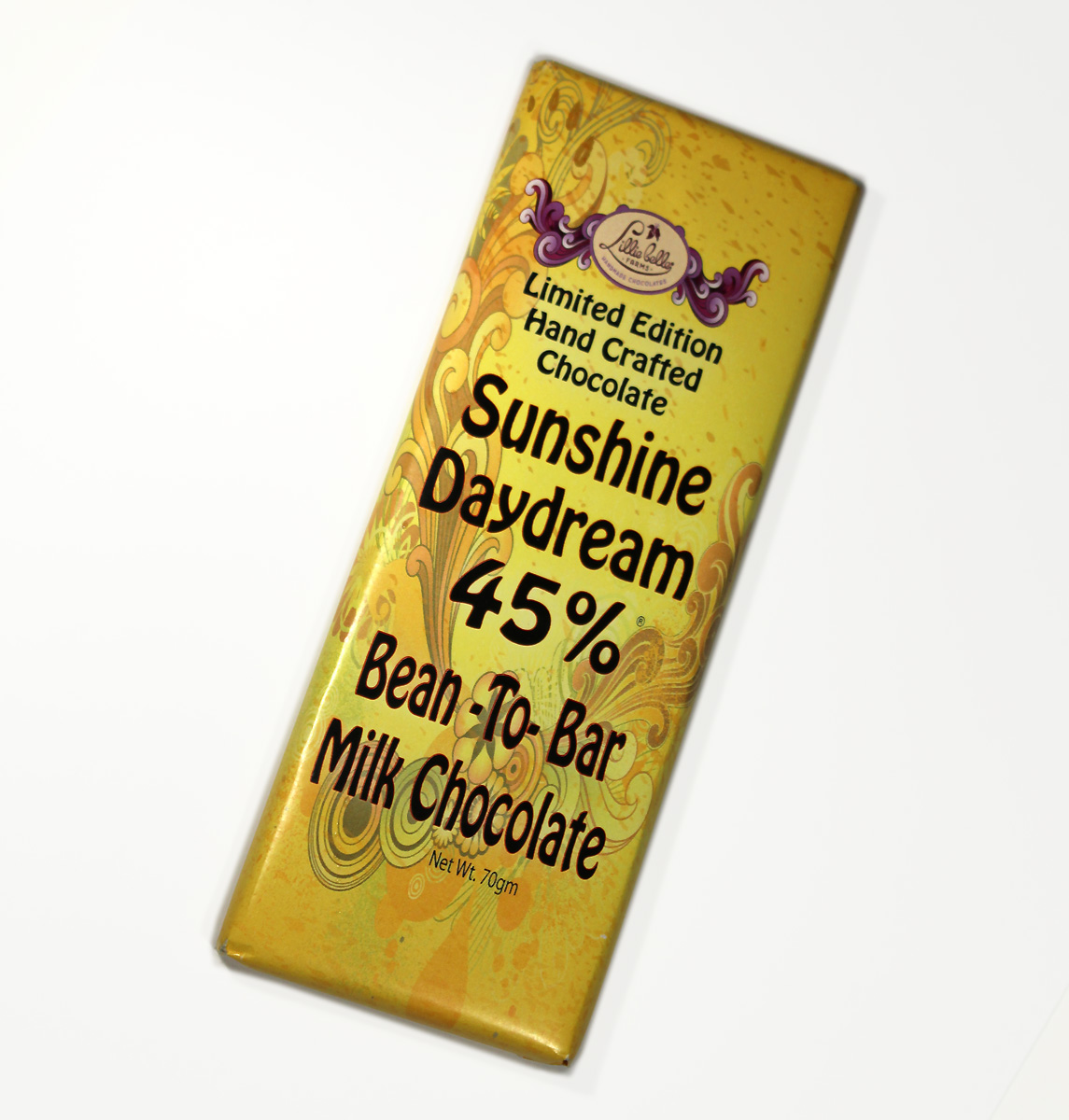
Last month I reviewed my first ever bar from Lillie Belle Farms, the Oregon based bean-to-bar chocolate maker. Although I wasn’t immediately drawn to the packaging, I discovered a unique and delicious chocolate underneath. Chocolate maker Jeff Shepherd was kind enough to leave his own feedback in the comments on that review and I do suggest you take a moment to check that out if you haven’t already.
Although at £9.99 a bar Lillie Belle Farms chocolate isn’t cheap, that first taste was enough to have me wanting more, and so on my most recent trip to Selfridges, I picked up this bar; a 45% milk chocolate with a twist.
The twist? This bar is made with buttermilk and (according to the ingredients list) blue cheese powder. Now I’m aware Lillie Belle also make a bar that puts blue cheese front and centre, so I’m assuming that this bar is a little lighter on the penicillin than its cheesier sibling.

As you can see it’s a beautiful looking bar. With its unique design and deep reddish brown colour, it’s almost a shame to break off a chunk. But when you do you are rewarded with a chocolate that tastes good as it looks.
The fruitiness of the Peruvian cocoa beans is evident and works exceptionally well with the milk / buttermilk combination. I can’t say I can taste any cheese which may or may not be a good thing, depending on your point of view!
It’s a rich and creamy flavour with a wonderful buttery, malty note. There’s a hint of smokiness suggesting a fairly high roast – something I’m not usually keen on, but it’s a flavour combination that I love in this chocolate.
If you’re into rich and creamy milk chocolates, then I recommend seeking this out. I can’t wait to try the rest of the Lillie Belle Farms range.

Keep reading to find out how you can win your own chocolate making equipment from Lékué. You can read our previous experiments with chocolate making here and here.
From time to time, I like to get my hands dirty in the kitchen and have a go at making my own filled chocolates. I’m no chocolatier and I’ve no desire to be one (it’s an awful lot of work and requires a great deal of skill!), but it’s fun to play around in the kitchen and it does help give me a small insight into the challenges small scale chocolatiers face.
Moulding is one of the big issues and decent chocolate moulds are quite expensive. There are options for the home chocolatier though, and when Lékué offered to send me some silicon moulds to play with I jumped at the chance.

They also sent me a few other items, including this collapsable silicon chocolate bowl for melting chocolate – either in a double boiler or in the microwave. So as part of my latest experiment, I thought I’d give them a go.
Around the same time I was sent the Lékué products, I happened to be visiting the warehouse of HB Ingredients in East Sussex when I saw something on the shelves that caught my eye. Callebaut’s Mycryo is a product I heard about a while ago that intrigued me. Mycryo is simply cocoa butter in powdered form and it bills itself as an alternative form of fat for frying – one that doesn’t impart flavour into the food like oil or butter does.

But what’s interesting about Mycryo for me is that the powder is actually pre-crystalised, or tempered. That means that you can use it to temper your chocolate, simply by stirring it in. This page has step by step instructions, but the process is incredibly simple. In my experiments, it proved to be by far the easiest way to temper small amounts of chocolate that I’ve come across.
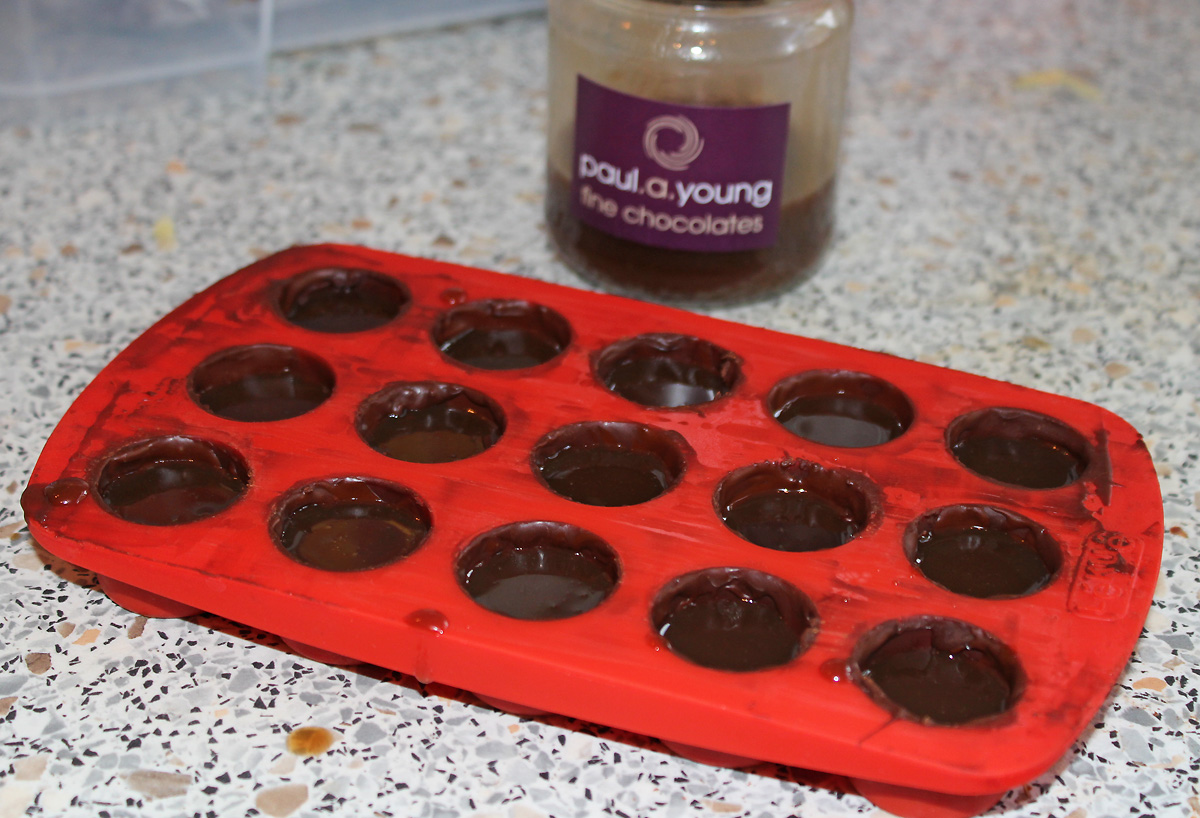
So with my chocolate melting bowl, moulds and Mycryo, I decided to get to work in the kitchen. Thanks to Paul A Young, I also happened to have a jar of Rum Caramel hanging around, so I decided to use that as the filling for my chocolates.
I used Cacaosuyo’s fruity Peruvian bean-to-bar chocolate for the shells. I melted & tempered around half the chocolate using the chocolate bowl in a bain marie, allowing it to cool to 34C before stirring in a spoonful of Mycryo. Being a fine powder, the Mycro melts quickly and leaves the chocolate smooth, glossy and easy to work with.

With the aid of a plastic spoon (metal conducts heat and can cool the chocolate too quickly), I filled the moulds, spreading the chocolate around the insides and tapping to get rid of any air bubbles. After filling each of the moulds, I went back and thickened up any areas where the red of the silicon was showing through. A chocolate maker with plenty of chocolate to work with would simply fill the moulds right up, then tip the excess chocolate out, but I found the spoon method to work well when you only have a small quantity.
After setting in the fridge for 20 minutes, I warmed the caramel in the microwave for 10 seconds to make it flow a little more easily, then spooned it into each chocolate mould. I left enough of a gap at the top to seal with chocolate later, then returned the chocolate to the fridge for the caramel to cool back down.
Finally, I melted and tempered the remaining half of the chocolate and spooned it on top of the caramel.. tapping the mould gently to encourage flat bottoms and to eliminate any air bubbles.
Once set, I simply pressed the chocolates out of the mould and voila! Delicious dark chocolate rum caramels with a lovely glossy finish.

Win A Set Of Lekue Chocolate Moulds
Inspired to make your own chocolates? Head on over to our Facebook Page for your chance to win a set of chocolate making moulds and a chocolate bowl from Lékué.
To enter, all you need do is Like Chocablog and leave a comment on this photo telling us what combination of flavours you would use in your own chocolates if you win.
This competition is open to UK residents only, one entry per household. Entries close at midday on Friday 5th September.