We’ve talked about Finland’s Fazer (pronounced Fat-ser) in the past, but back in November I had the chance to see a presentation by their Managing Director Pekka Rantala at a confectionery conference. Fazer are huge in Finland and are becoming much better known around the world. Recently, they’ve picked up a license to manufacture ‘Angry Birds’ confectionery, which according to Mr Rantala is flying off the shelves. Metaphorically speaking.
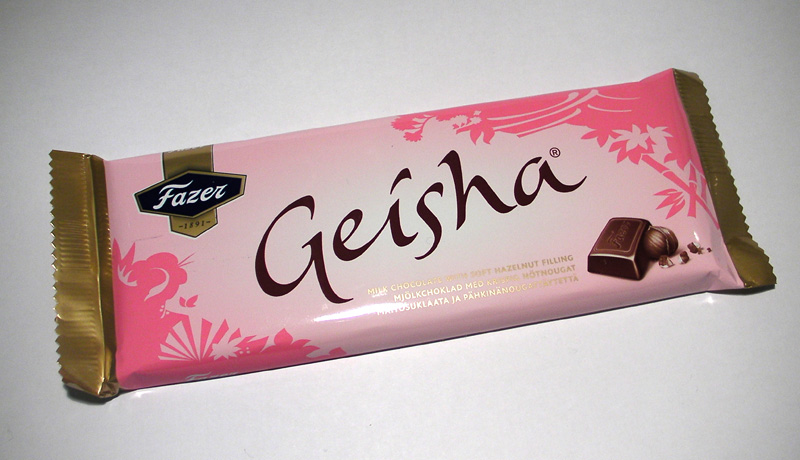
There are no birds (angry or otherwise) in Fazer Geisha though. Despite the bright pink packaging and slightly odd choice of name, this is a simple milk chocolate bar with a hazelnut filling.

The ingredients tell me that the filling makes up 40% of the weight, but there doesn’t seem to be a cocoa solids percentage listed unfortunately. What I can tell you is that is is pretty good quality for what is essentially a confectionery bar. It’s not particularly rich, but it’s creamy without being too sweet. I quite enjoyed it in fact.

The filling is essentially a praline, but being mass produced there are some vegetable fats in there. It has a nice texture, being smooth with a little bit of a crunch, but it is a touch too sweet for my tastes. Not so much that I didn’t enjoy a square or two at a time, but any more than that would have been quite hard going.

This is not designed to be a high end fine chocolate bar though, and ultimately I quite enjoyed it for what it is. At £2.50 for a 100g bar, it’s decent value and makes a nice change from your regular supermarket confectionery. I’m still not convinced by the packaging though!

Have you ever tried halva? I remember being given my first taste by my Polish aunt about thirty years ago and loving the sweet stickiness, but rapidly becoming bored with the underlying sesame taste. I also remember taking some to school one day and offering it around to friends who didn’t have a clue what on earth it was. I’m pretty sure most people have at least heard the word ‘halva‘ before, although it’s probably still a mystery item to many.
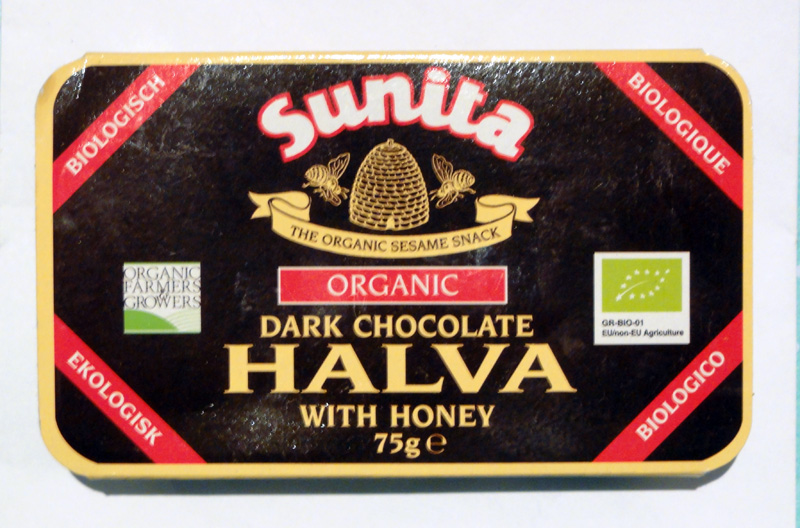
It’s been a good while since I had any halva (blame my declining interest in sweet tasting goods) but when I saw this little 75g box of organic dark chocolate Halva I decided it was a good chance for us to be reacquainted.
For those who don’t know, halva is made from sesame seeds and honey. It’s a Middle Eastern speciality, so it’s usually very sweet. This version also includes cocoa mass and cocoa powder, and all ingredients are certified organic. I have to say, when I slid the cardboard sleeve off the plastic tub and peeled back the seal, the contents of the tub looked a little less than appetizing, but the aroma of sweet honey and dark cocoa were some compensation.

If you’ve never eaten halva the texture may catch you by surprise at first. It tends to form into long shards, rather like ice crystals and when you first put it into your mouth it feels as though it’s going to melt away until you chew it, and then it gets pretty gooey. I had forgotten the way that halva clumps together and having sticky little lumps of it between my teeth transported me back to that first taste again, only this time instead of ‘pure’ Halva there was a strong undercurrent of dark cocoa added into the mix.
I found that the addition of cocoa powder and cocoa mass did quite a lot for the flavour. It took away a little of the usual sweetness and added a new dimension to the taste. Losing a little of the underlying sweetness made this much more enjoyable, but the cocoa didn’t take over completely so the overall flavour was a pleasant balance between honeyed sweetness and slightly bitter, dark chocolate.
I have to say that I was preparing myself for a sugar overload but was pleasantly surprised, so much so that I think if I ever had reason to buy Halva again, I’d be looking for this version and the reactions of friends who also tried it would seem to bear that out as it was almost universally acclaimed. If you’re a regular Halva eater, have a go at this. If you’ve never tried it, I would heartily recommend this chocolatey version.
We go inside Busto Arsizio Prison just outside Milan and discover an award winning chocolate factory.

Walking through the stark, concrete courtyard of a Milan prison on a freezing December morning might not be everyone’s idea of fun, but that’s where I found myself last week after having been invited to visit one of Italy’s most exciting chocolate companies.
Dolci Libertà (literally ‘Sweet Freedom’) is a chocolate company like no other. Started in October 2010 and part social project, part commercial venture, they produce a wide range of chocolates and baked goods that are sold across the region and all over Italy.
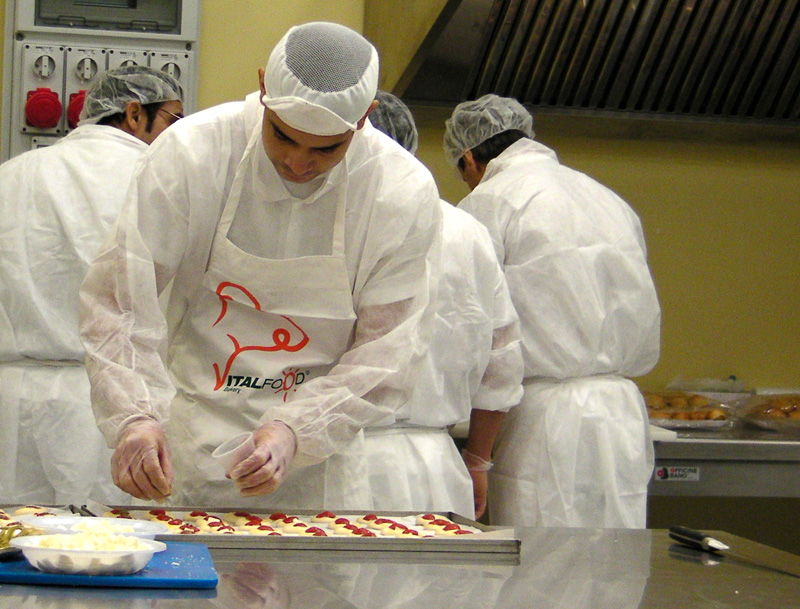
The factory is housed inside converted sports facilities inside the prison. There are no windows and despite the brightly painted exterior, there’s no escaping the fact that you’re in a prison. That is until you’re greeted by the wonderful smell of chocolate and freshly baked treats as you walk inside.

Entering the factory is like walking into another world. It’s bright, clean, modern and spacious. I’ve visited a few chocolate factories, and this was one of the cleanest and most impressive spaces I’ve seen. It houses about 1.5 million Euros worth of Selmi coating, tempering and enrobing equipment along with ovens, walk-in refrigerators and everything else you’d expect to find in a modern commercial kitchen. Unfortunately for me, most of the workers were busy making baked treats for the press during my visit, so I didn’t get to see the chocolate production in full swing.
Dolci People
Dolci Libertà employs 4 in-house staff and 25 prisoners who are paid €450 – €600 per month. But with only 25 places and 420 inmates in a prison designed for 200, these are highly sought after jobs. If a worker steps out of line, either inside or outside the factory, they immediately lose the privilege.
The prison director tells me that one of the key benefits of working in the factory is the effect it has on behaviour. If you’re given the chance to work in the ‘chocolate lab’, it’s not something you want to give up in a hurry, so you’re much more likely to try to stay out of trouble.

There’s also a significant saving in security costs for the workers. Where normally there would be a guard for every two prisoners, only four guards are needed for the whole factory.
Of course, as I sit here eating one of the truffles, back in my warm London flat, there is a disconnect between the luxurious, delicious chocolate and my thoughts of the prisoner who made it. What was his story? Where was he from? Would I want to accept chocolates from this person?

Back in the factory, one of the most surprising aspects was how much access we were given to the prisoners. We were allowed time to talk to them unsupervised, and the ones I spoke to were eager to share their story. Many were from South America, caught carrying drugs at the local Malpensa airport. Others were there for much more serious crimes. But I didn’t once feel threatened by them. It seemed they just wanted to be out. To be home and to rebuild their lives.
It’s easy to forget, but whatever their mistakes, these people are more than just prisoners. They are human beings with hopes and dreams like everyone else. For them, working with chocolate is something more than a job. More than learning a skill. It’s an opportunity to be something more.

But what of the chocolate?
Dolci Libertà is a fascinating social project, but it’s also a commercial venture. That means they have to make money to survive. To do this, the 800 square metre factory turns out about 1000kg of baked goods and chocolates every day. Products are sold into shops all over Italy and online via an online store.
The company uses chocolate couverture from Callebaut, Icam, Valrhona and Domori made from beans from Peru, Madagascar and Ecuador. From what I understand, the Callebaut is primarily used in baked goods, while the higher quality couvertures are used in the truffles. This enables them to maximise both quantity for things like biscuits and quality for the artisan truffles.

It seems to be working. Earlier this year, Dolci Libertà’s pralines and truffles won a gold and two silver awards in the Italian round of the International Chocolate Awards.
While at the prison, we got to sample many of the baked goods the company produces, and I took home a bag full of truffles. I’ll be reviewing some of those separately, but I do want to talk about them briefly here.
They are quite simply made; balls of ganache, enrobed in dark chocolate and rolled in cocoa powder. Some of the shapes are a little irregular, but the flavours are wonderful. Strong enough to come through the rich dark chocolate, but subtle enough that you can still taste everything. I’m certainly going to enjoy working my way through them over the festive period.
Back in the real world.
Back home in London and my short stay in prison is little more than a memory. But it’s a good memory. I discovered a remarkable project and a business that’s willing to invest in people. Dolci Libertà aren’t just making great chocolates, they’re giving people the opportunity to turn their lives around. Of course, it remains to be seen how many of them will use their new skills on the outside, but the workers I spoke to were enthusiastic about it.
It’s probably too early to say if the project will help reduce re-offending rates, but I do get the sense that the workers understand the value of the artisan skills they’re being taught. It’s such a wonderful idea that I’m longing to hear about the first ex-Dolci worker make it big in chocolate. Hopefully I won’t have to wait too long.
Dolci Libertà have a UK distributor lined up, so you should be able to buy their chocolates over here from early next year.
Photo Gallery

The first time I looked into the aptly named Hedonist Artisan Chocolates, my comments were generally favorable. This time they got in touch to send me some of their holiday offerings, Candy Cane Bark and Salted Caramels.

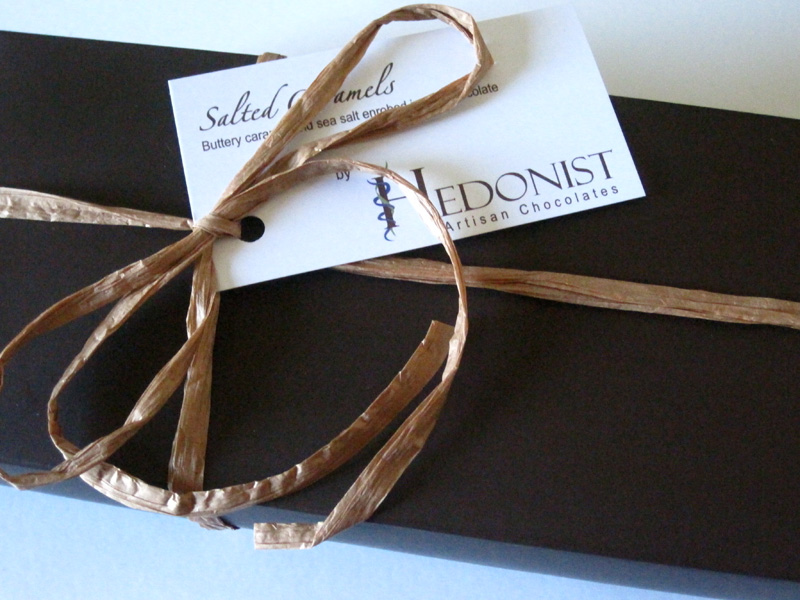
Let me first get out of the way what is essentially my only complaint. It’s the packaging. While the bark’s clear bag works as a basic, I’m not as happy with the caramels in another brown box. I have no problem with a plain box and no problem with brown; perhaps it is the not quite matte, not quite shiny finish of the material that I’m not liking.
And while raffia can be a handmade finish, I would like to see ribbon take its place at some point in the future to create more of a hedonist’s packaging, something more sumptuous. But these are the areas for improvement, like every company has.

A base of dark chocolate with generous swirls of white chocolate forms the Candy Cane Bark. Topping this base is a field of shredded candy cane–shredded quite effectively, too. The pieces are small and thin enough to crunch on along with the chocolate but not so small that the pop of their flavor and texture disappears.
While most of the bark has a generous coating of candy cane, a couple of the pieces (which seem to be from the edges of the bark) have been left too bare. But on the whole, this bark is sweet and lightly dark, casual and minty in flavor. It’s holiday bark – for sharing or gifting.

My box of Salted Caramels had five each of milk and dark chocolate varieties, happily rimmed in gleaming gold where they sat. Two things you’ll want to note from the ingredients here: pasteurized cream and natural vanilla. Good. Now, I’m not sure if I prefer the milk-coated caramel or the dark. They’re both very different.
The caramel itself is the chewy kind, but done effectively in an old-fashioned kind of style. It tastes like vanilla, not stiff goo. The sweeter milk chocolate blends right in with the caramel, whereas the dark chocolate enhances the caramel’s stiff side rather than its sweet side. It’s like a Riesen turned handmade. In both cases, the flaky sea salt adds just the right amount of interest to the pairing.

Both of these products are at comfortable levels right now, and you won’t be getting complaints if you choose to gift either one. Personally, I’m wondering if Hedonist is aiming more for the handmade side or the artisan side – or the level where the two intersect. But while I ponder the philosophy of chocolate branding, I’ll just finish off the second half of those caramels and another piece or two of Candy Cane Bark.