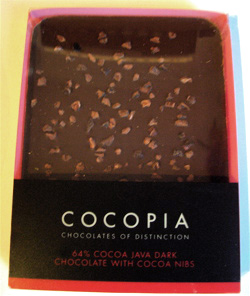
Another small slab from Tesco’s own private Swiss chocolate maker, Cocopia. This one is (as you can see) made with a 64% cocoa chocolate which uses Javan Criollo beans. It’s also dusted with cocoa nibs (a personal favourite – I just love crunching my way into them as the chocolate dissolves).
The chocolate itself has a great bittersweet flavour, and although it’s not as rich as some of the higher content bars I’ve tried recently it does have quite a good mix of citrus tanginess and that rich, almost burnt taste one tends to associate with the darker chocs. The beans used are Criollo beans, which have a stronger citrus element in their flavour makeup, with an additional mildly smoky note.
These beans tend to be used in milk chocolate, and so I’m assuming that the lower cocoa content is a way of keeping these flavours in check. I happen to be rather partial to a cup of Javan coffee, and the beans tend to be dark, strong and complex in flavour. Well, there are elements of that in this bar as well.
Because Cocopia have used a single bean variety, this bar offers an opportunity to taste how a single variety grown in one region can taste. The same beans from a different region will naturally taste somewhat different, so if you’re on a mission to discover the wide variety of flavours a single bean variety can produce in differing climates, then it’s worth trying to find more Criollo from other areas.
If, however, you’re just looking for something a bit different or a tasty little treat for yourself or a friend, then I’d recommend investing £1.50 in some of Cocopia’s little slabs.
I’m not sure if marzipan chocolate is a German “thing”, but this is the second German bar I’ve had a bar with marzipan in it. The first was the Ritter Sport Marzipan which I reviewed back in November.
On the surface, this bar looks quite similar to the Ritter Sport bar. At 100g, it’s the same weight (although a different shape), and even the packaging looks similar. The chocolate in this bar is slightly darker at 52% as opposed to the Ritter’s 44%.
Oh. And it’s also significantly shinier…
It’s not completely clear from the photo, but the finish on this bar is wonderful. It’s the glossiest looking chocolate I’ve seen in a long time. In fact, I could probably use it as a mirror if it wasn’t for the fact that I just feel guilty looking at myself in chocolate. Oh well…
Now I don’t know about you, but I hadn’t heard of Niedergeger before. Looking at their web site, it becomes a little clearer as to why – they’re not so much a chocolatier as a marizpanier. (Yeah, that’s a real word! What of it!?)
The texture of the marzipan in this bar is very similar to that of the Ritter Sport bar. It’s drier and crumblier than I’m used to. The taste is quite pleasant, but I’m not entirely convinced by the texture. It’s just a little too grainy and dry for my liking. I’d quite like to try a smoother more moist filling with the same flavour, but I guess this is the German “style” of marzipan.
The chocolate itself is rather nice and complements the marzipan flavour quite well. It’s not too bitter, with no nasty aftertaste, and feels as smooth and shiny on the tongue as it looks.
But once again, whether you like this bar or not is going to come down to whether or not you like marzipan. Not being a huge fan of it myself, I don’t think I’d buy this again. But if you’ve never had marzipan chocolate and just want to try one, I’d recommend this above the Ritter Sport version.
You can find it in your local Waitrose.
This was my fourth E. Guittard purchase. The company is based out of California in the United States, but its founder, Etienne Guittard, went to California from France in the 1850’s. I enjoyed the other three bars immensely, so I was expecting the same quality here. I wasn’t disappointed.
Each of their bars is wrapped in the same tasteful design with black trees behind the name and gold edging, only with different colors on the sides. Ambanja had a blue-purple color, reflecting the intensity of the bar.
Although there were a couple of air bubbles, the chocolate had a healthy, reddish sheen. Like the others, this bar is divided into twelve rectangles, each perfectly sized for tasting. I don’t consider 65% cacao very high, but Ambanja retains a darkness with deep, fruity flavors that become sweeter about halfway through, finishing in richness.
It also maintains E. Guittard’s exquisite texture. As the chocolate melts in your mouth, it ripples off much like a fondue fountain, only slower, of course.
Normally, 50 or 60% chocolates don’t go over very well with me because they have neither the sweetness of milk chocolate nor the range of flavors of dark, but this bar passed the test.
Although the flavor is much the same throughout, it is both sweet and rich. An ideal combination. I paid three dollars for this 56.7 gram bar (online, it’s closer to four dollars), but it was worth every bit.
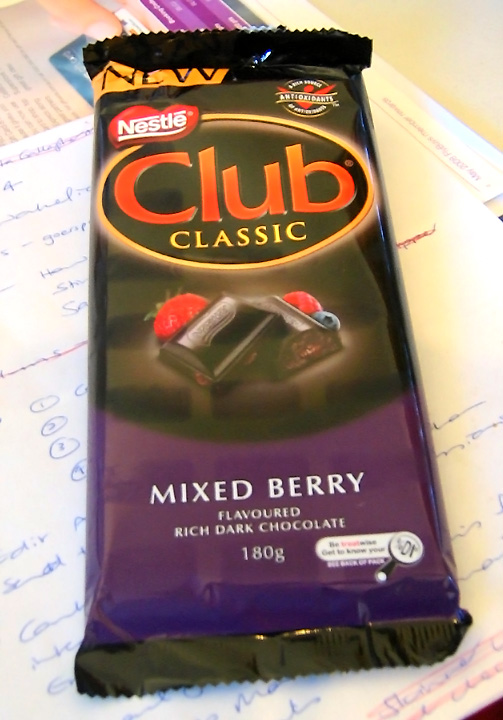
Not to be outdone by Cadbury’s revamp of their dark chocolate Old Gold range, Nestlé too are still proudly flogging their ‘Club Classic’ dark chocolate varieties, and have introduced a ‘Mixed Berry’ flavour to the supermarket shelves.
I really love Nestlé’s dark chocolate (especially their Club Cappuccino) but that doesn’t mean it escapes my attention that this block is a mere 180g compared to either their usual 200g or Cadbury’s 250g blocks that sell for about the same price. Either the ingredients are more expensive and are hidden by reducing the size or they want to increase the price but not so that it’s noticeable. Whatever the reason, it is sneaky and annoying and put me in a slightly negative frame of mind when it was time to try the stuff.
Luckily for Nestlé Club, the second the wrapper was ripped open my nostrils were assailed with a gorgeous berry smell and the sweet, rich scent of dark chocolate. Bad mood, what bad mood? What was I complaining about?
The chunks of berry pieces aren’t very distinguishable from the dark chocolate and could almost be mistaken for sultanas until you bite into a square or two. This was a truly delicious combination, with the chewy berry flavour complementing the slowly melting dark chocolate and lingering afterwards to a satisfyingly sweet finish.
The proportions looked good at first reading – 40% cocoa solids, with the bar comprising 85% dark chocolate and 15% ‘berry pieces’. The picture on the front of the wrapper shows a strawberry, raspberry and blueberry, but how were they incorporated? The answer, alas, wasn’t too comforting, and here in Australia the ingredients must be listed in order of volume first:
- Concentrated apple puree (no percentage listed)
- Strawberry puree 0.7%
- Plum puree (no percentage listed, but obviously 0.6% or lower)
- Elderberry juice concentrate (what the…? And no percentage)
- Blueberry puree 0.2%
- Raspberry juice concentrate coming in at a whopping 0.1%
Hmm. Now that the block was demolished, my bad mood was returning. If I dust off my high school calculator and work out that the ‘berry’ was only 15% of the block and the key ingredients of strawberry, blueberry and raspberry only comprise one percent of that, then Nestlé has a bit of cheek in putting them on the front wrapper when they only comprise 0.15% of the ingredients!
Ah well, it tastes good and I know I’ll be buying, eating and enjoying it again.