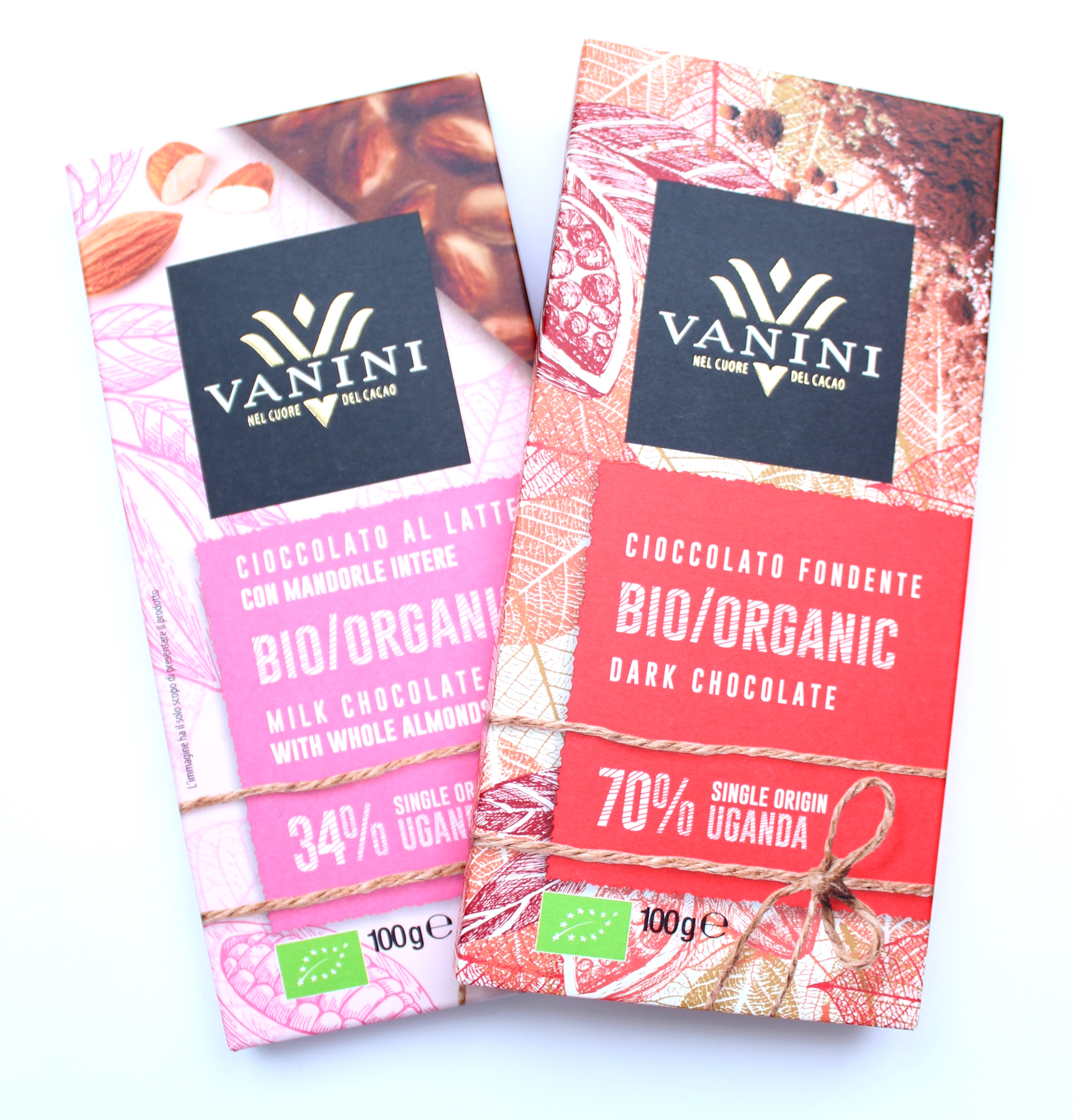
Nuts seem to be something of a theme around here at the moment. Hot on the heels of the Amedei Prendimé range bars I recently reviewed, ICAM sent this colourful looking range from their Vanini brand.
These bars are a little different from the Amedei range though.
The immediately noticeable difference is bean origin. Whereas Amedei make no mention of origin at all, the Uganda origin of the Vanini bars is celebrated. In fact, ICAM have been working in Uganda for a number of years, with over 5,000 smallholder farmers directly supplying the company with beans to the company’s local cocoa collection and processing facility.
I’m not in a position to judge the ethics or sustainability of one chocolate maker against another, particularly as I was sent both sets of bars without comment. What I will say is that as a chocolate consumer, I would much rather know where the beans have come from, so I can do my own research if I want to.

The bars I was sent are:
- Vanini Organic Uganda 34% Milk Chocolate
- Vanini Organic Uganda 34% Milk Chocolate With Whole Almonds
- Vanini Organic Uganda 70% Dark Chocolate
- Vanini Organic Uganda 56% Dark Chocolate With Hazelnuts And Caramel
- Vanini Organic Uganda 56% Dark Chocolate With Salted Pistachio Nuts
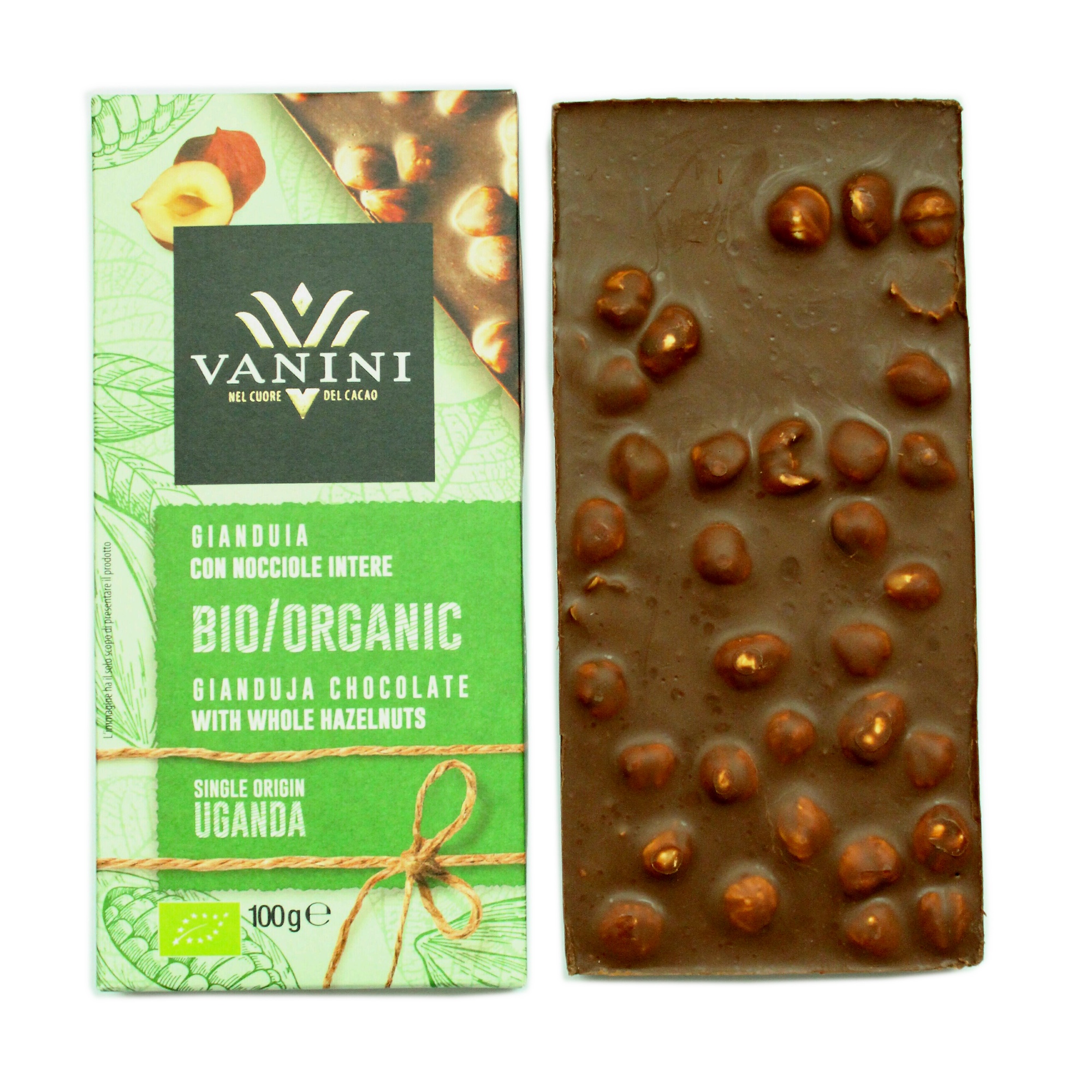
- Vanini Organic Uganda Gianduja Chocolate With Whole Hazelnuts
The packaging looks great for a high volume brand and the colourful boxes really stand out. The bars weigh in at solid 100g and have a satisfyingly chunky feel. Of course, flavour is important too and with that in mind, I wanted to try the 70% Dark Chocolate first.

The bar has a rich dark colour and an aroma to match. My first impression of the taste is that it’s very sweet for a 70% dark chocolate. That’s quickly followed by the usual strong chocolatey, cocoa powder flavour notes that I often associate with a mass produce chocolate.
But that quickly gives way to something more surprising. As the the chocolate melts, sweet fruity citrus notes make themselves known. It’s subtle and understated but really rather pleasant. The melt perhaps isn’t as clean and smooth as a higher end bar, but it’s perfectly acceptable and very easy to eat.
Similarly, my first impression of the 34% milk chocolate is that it’s very sweet. Some of those fruity notes are detectable, but it’s the caramel notes that make this a really pleasant milk chocolate. it’s not spectacular, but it’s a significant a step up from your average confectionery bar.
I love the added flavours of the two 56% bars. You really can’t go wrong with some good quality pistachios in chocolate, and this bar is no exception. It was the first of the range to be fully demolished. The hazelnut with caramel features whole nuts with small pieces of hard caramel, which again make a bar that’s a little too easy to eat. From the satisfying crunch, it’s clear that a lot of thought has been put into texture in this range.

For me though, the clear winner in the range is this Gianduja bar. While Amedei went for three layers to add interest to their bar, Vanini have simply dropped a shed load of whole hazelnuts into theirs, and I love it.
I’ve said before that I’m not the world’s biggest fan of nuts, but this one really worked for me. The sweetness, texture and crunch of this bar made it my favourite, and all too quickly I was mourning for its loss.

It’s a while since I’ve reviewed any bars from another chocolate maker, but when King’s Fine Food, UK distributors of Amedei, offered to send me their new high cocoa bars, I was curious enough to want to try them. The bars in question are Acero 95% with Maple Sugar and Toscano Black 90%.
The packaging for these bars looks very familiar, following the format that Amedei have used for years. Another familiar feature of Amedei bars is the lack of any reference to bean origin. Although Amedei do produce single origin bars, their blends have always been at the heart of their range. From a chocolate maker’s point of view, blending allows recipes to be tweaked to compensate for flavour differences in harvest and to produce a more consistent flavour. It gives more control over the final product when differences in weather and fermentation may produce noticeable differences in the flavour of the beans from harvest to harvest. So while I’m curious about the bean origin, blending is not necessarily a bad thing.
Acero 95% With Maple Sugar
This bar in particular piqued my curiosity. I’ve tried plenty of 90%+ bars and many made with alternative sugars, but I was curious as to whether I’d be able to taste the sugar in a bar with so little of it. The answer is yes, you can, but it’s quite subtle. In fact, I’d go so far as to say that the aroma stands out more than the flavour.
Of course, at 95% there is a strong cocoa note to this bar. It’s dark, leathery and a little spicy in nature, but it’s also surprisingly sweet. Not ‘sweet like Cadbury’ sweet, but just enough to make it very easy to eat, as long as you let it melt slowly. The packaging describes notes of liquorice, spice and wild citrus, but for me it was simply an enjoyable chocolate hit with a well balanced sweetness.
Toscano Black 90%
Obviously at 90% cocoa solids, this is another intense bar, but having tasted after the Acero, it came through as much sweeter, with a hint of fruit. The flavour is pleasant and the texture is smooth, but I didn’t pick up a great deal of complexity with this one. I guess that the kind of person who buys this will be looking for that intensity rather than subtle flavour notes anyway.
One thing I did notice with both these bars was a slight ‘papery’ note that I assume came from the packaging itself. Although the bars are sealed in foiled paper, it certainly felt like I was picking up something from the packaging itself, although it’s difficult to be sure.

Along with the high cocoa bars, I also received these three large (150g) nut based bars from Amedei’s Prendimé range.
First impression of this range is that it looks cheaper. The bars are wrapped in fairly thin white paper which doesn’t look as high end as the main Amedei range. I think there’s something also about a larger bar psychologically that makes me think it has been produced for ‘quantity over quality’.
That said, I was pleasantly surprised here, especially because I’m not a big fan of nuts.

Gianduja
The bar that got me was this rather tasty three layer gianduja bar. If you don’t know, gianduja is a blend of hazelnut paste and chocolate. It is sometimes the basis of chocolate & nut spreads and sometimes the filling for bonbons, but it can also be made firm enough to produce a bar on its own.
The packaging doesn’t specifically describe the three layers, although the ingredients do mention almonds as well as hazelnuts. The texture is smooth and melty with just the slightest hint of ground nuts as it melts. I can’t say that it’s the best gianduja I’ve ever had, but it’s certainly dangerously moreish. My bar did not last long at all.

Hazelnuts & Almonds
The other bars in the range are dark chocolate with almonds, dark chocolate with hazelnuts and milk chocolate with hazelnuts. Personally I much prefer the gianduja and find the large, chunky bars of solid chocolate a bit difficult to eat. As with the high cocoa bars, there’s no mention of bean origin, but the thing that sets them apart is the use of quality whole nuts.
If that’s your thing, you’re going to love these. For me, the gianduja bar and Acero 95% with maple sugar are the pick of this particular bunch.
Note: These bars were sent for review by Amedei’s UK distributor King’s Fine Food. They are available to buy online from King’s and other chocolate retailers.

Last week I was invited to the launch of Pierre Marcolini’s Christmas 2018 collection is London. Marcolini are unusual amongst Belgian chocolatiers in that they make all the chocolate they use from the bean in their Brussels factory. While most chocolatiers are happy to buy in cheap confectionery, Marcolini have been producing bean-to-bar chocolate for many years.
Back in 2012, I was lucky enough to be able to visit the factory and had a guided tour of the facility along with Marcolini’s Brussels boutiques. I’ve not been able to keep track of how the business has developed since then, however they have recently opened a London store to growing network of chocolate shops.

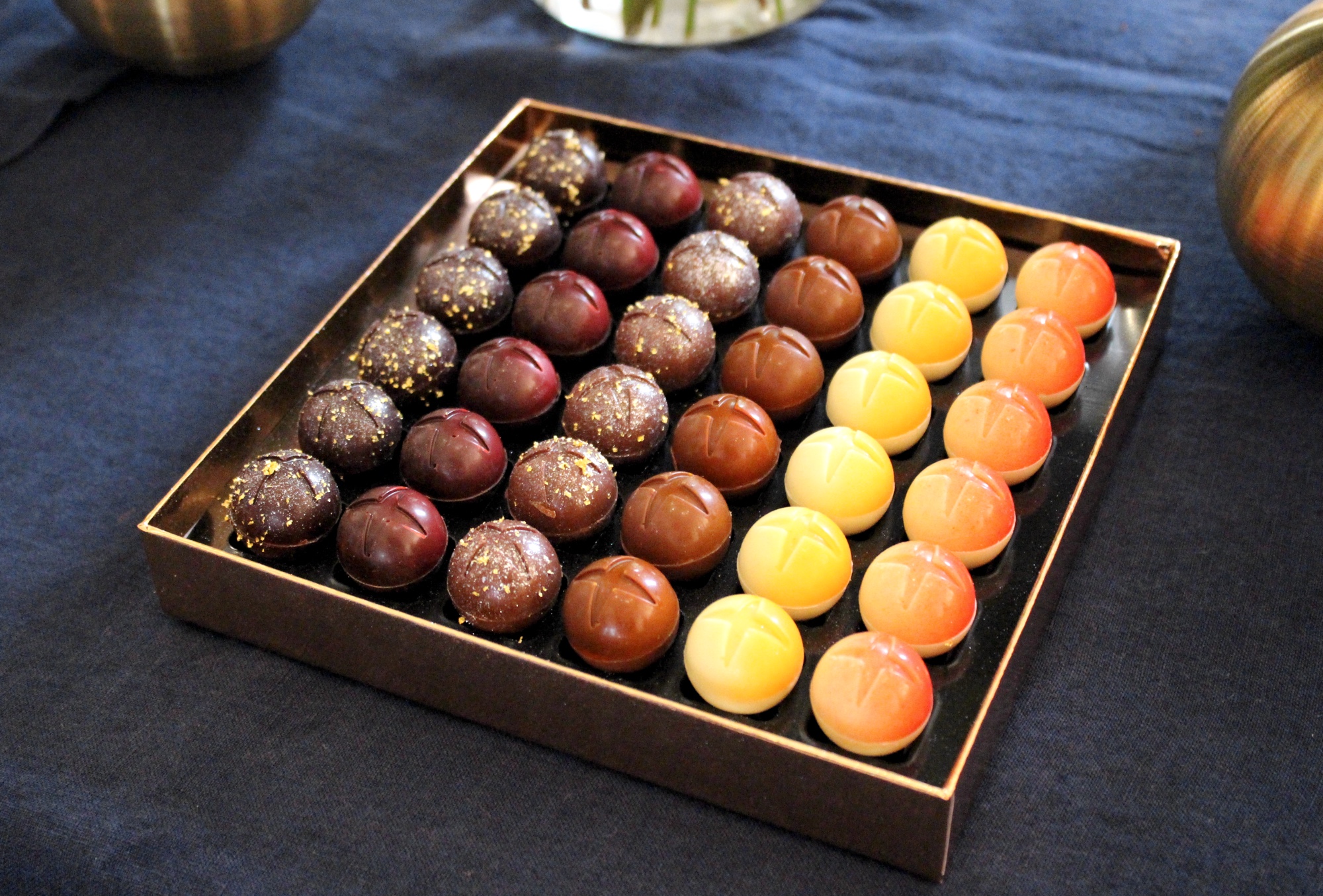
Although I hadn’t tasted the chocolates for a while, Marcolini’s style and attention to detail clearly haven’t changed over the last few years. Walking into the room, I was presented with a beautiful array of brightly coloured chocolates and desserts. The presentation is certainly eye catching. Show up with any of these at a Christmas gathering and you’re going to make a great first impression.

As you can see, simplified geometric shapes are the order of the day here. The Christmas bells are designed to look like spherical sleigh bells with a cross cut out. The Christmas trees are made up of a pyramid of spheres, and the Yule log is a plain brick decorated with those spherical bells. It’s very stylised and perhaps not immediately Christmassy, but I personally love the way it looks.

In terms of flavour, the overwhelming theme here is praline. That’s likely to suit Marcolini’s primary audience down to the ground, but I personally find pralines a little boring. I’m so used to adventurous British chocolatiers like Fifth Dimension and Paul A Young experimenting with weird and wonderful flavours, I’ve come to expect a little more innovation. To be fair to Marcolini, they have to produce what their customers want, and when it comes down to it the simple flavours aren’t out of place with the elegant visual aesthetic on display here.

Not available to try at the launch event, but something that caught my eye was a range of chocolates flavoured with rare rums and whiskeys called Fire In The Belly that sounds much more up my street. These limited edition ganaches come in six flavours:
- Aberlour whisky
- Oban whisky
- Nikka whisky
- Ardbeg whisky
- Chamarel rum
- Trois rivières rum
Hopefully I’ll get to try these soon!

Overall, this is a great looking collection with a modern design and traditional flavours. The Yule logs would be the highlight for me, particularly the white chocolate version with misérable almond cake, raspberry, cherry and meringue mousse flavoured with rose and passion fruit.

The Pierre Marcolini Christmas range is available to buy from November 9th.
When I first started Chocablog back in 2006, Dairy Milk was one of the first things I wrote about. Back then, I regarded it as a national institution and something not to be messed with. But times change and so have I.

In the last twelve years, my tastes have evolved and I’ve become a chocolate maker myself, so when I was asked to write about a new reduced sugar version of Dairy Milk for a national newspaper, I was a little reluctant. But I’m never one to turn down the chance to taste something new – or the prospect of paid work – and so I found myself headed to Mondelez with two Daily Mail reporters.
We were there to meet Glenn Caton, President of Mondelez’s Northern European division. He’s the man in charge of Cadbury, Green & Black’s and a whole host of other household brands. Although I can’t say I’m the biggest fan of every decision Mondelez has made, Glen came across as a good guy and our conversation was relaxed and informal.
We were there to try a new Dairy Milk ‘30% Less Sugar’ variety that the company has been working on. It’s something that has obviously been in development for a long time and seems like a reaction to the current “all sugar is evil” stance the UK government is taking. For me, the most interesting thing about this new product was that the sugar isn’t being replaced by another sweetener such as stevia or maltitol, but the chocolate has been reformulated to include ‘plant fibre’ to replicate the texture and structure of original Dairy Milk.
I use ‘plant fibre’ in quotes, because Mondelez weren’t willing to go into any details what this actually is. Having spoken to chocolate industry friends, some believe it may be inulin, which is often extracted from chicory. One thing’s for sure though; although this product will have less calories, it won’t be a significant reduction and that’s not how Cadbury are positioning it.
Technically, adding plant fibre to chocolate means it’s no longer actually chocolate. But given Cadbury have already crossed that line by adding palm oil to Dairy Milk, I decided to judge this particular bar purely on how it tasted compared to original Dairy Milk. I personally don’t regard Dairy Milk as real chocolate (which has a strict definition) and don’t think replacing sugar with fibre makes it any closer to real chocolate, but that’s an argument for another time.
I was surprised that Mondelez hasn’t really planned for journalists wanting to taste their new product and that we were seemingly the only ones to get to try it. In fact, there only seemed to be a single bar in the office and the Mondelez team clearly hadn’t been expecting three people to show up to try it.
Nevertheless, plates were found and few samples of ‘30% Less Sugar’ and original Dairy Milk were offered. Trying the reduced sugar version first, I was surprised at just how sweet it was. It’s been a while since I’ve had any Dairy Milk, but this tasted every bit as sweet. It also had that trademark milky flavour and slightly grainy, sticky texture. Tasting this alone, I would not have known it had 30% less sugar.
Trying original Dairy Milk immediately after, it was apparent that there was a difference, but it was very slight. My two reporter friends couldn’t taste a difference, but I noticed the original version was a little sweeter and did have a slightly different flavour note. The thing that surprised me was that the textures were very similar.
I’m sure that 90% of people tasting the ‘less sugar’ version in isolation will not notice a difference. But I’m also sure that the 10% who do (or claim to), will be quite vocal about their longing for the good old days before Cadbury was sold off to the Americans.
To me, that discussion is largely irrelevant, because this new version will not replace the current Dairy Milk, but will simply be sold alongside it as an alternative. Glen told me that Cadbury would not be overtly pushing this as a ‘diet’ alternative, but simply another option.
I can see both pros and cons to this product. On the plus side, it’s an alternative for people who like their confectionery chocolate but just want to cut down on sugar a little. On the downside, it’s another step away from real chocolate, and perhaps a missed opportunity to develop a new higher cocoa, lower sugar chocolate without vegetable fats.
Consumers are certainly more aware of what’s in their chocolate, and I’d like to think the public is ready for a simpler, healthier and more ethical confectionery product with fewer ingredients. As a craft chocolate maker, my dream is to see all chocolate produced to the standards artisan makers hold so highly.