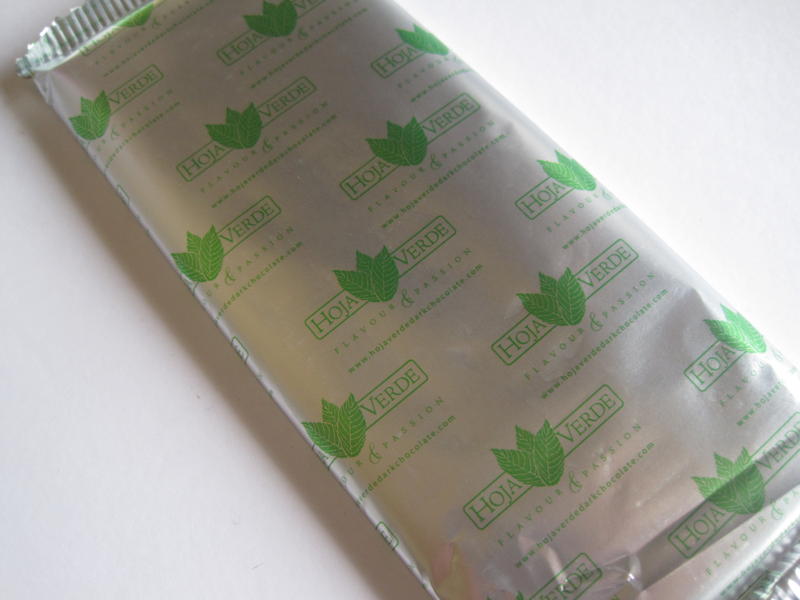
Hoja Verde, Spanish for “green leaf,” is so named to honor the rainforests shading their cacao plantations and the company’s background in roses. Their base is in Florida, and their single origin chocolate is made with Arriba beans from Ecuador. They have four of these bars at 58%, 72%, 80%, and 100%. I received the 72% to try out.
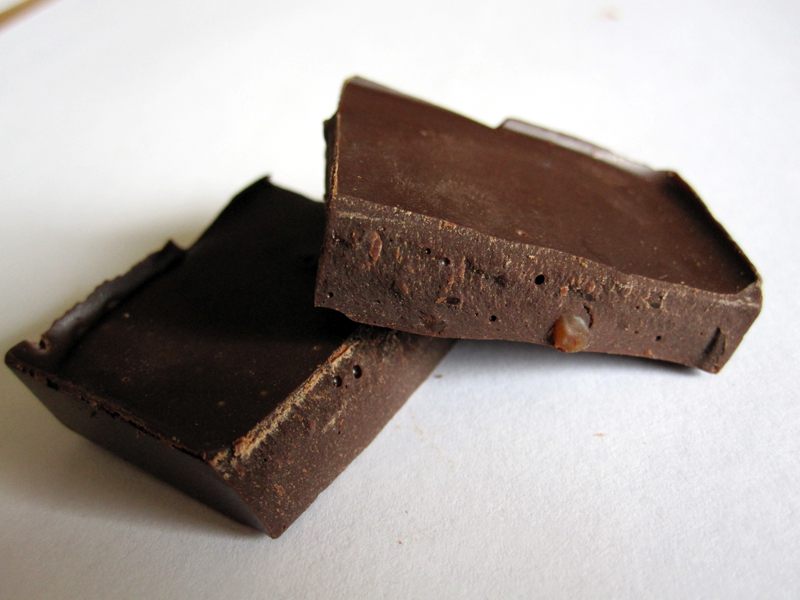
First impressions of the Hoja Verde site and phrasing: it leans a little on the gimmicky. Not that they don’t have anything to say, as they’re Fair Trade and Rainforest Alliance certified. But calling their range “a decadent odyssey in intense flavors,” well, isn’t it my job to get all poetic over chocolate? The packaging design works, though. I never thought black and orange could go together without Halloween; here they just speak of boldness. The bar itself is a little beat up, probably from the mail and because I, ahem, dropped it. The finish looks a little matte, but it’s hard to tell with the abuse.

It smells sweet, as a 70% does. The feel of it reminds me of Dove; it has a very soft break. Now, I don’t like Dove, but Hoja Verde is obviously higher quality. There is more depth to this flavor: red and rich notes, brownie and cake tastes. Almost like Ghirardelli, but thicker. It’s a nice bar. The flavors are warm and even the texture begins to grow on me. There’s an organic feel that gives it some personality, for all that it isn’t my personality.
It’s also sweeter than I like my dark chocolate to be. Hoja Verde says that they use Arriba beans because they need less sugar, allowing you to enjoy chocolate’s health benefits instead. Either they still added too much sugar, or the market for “healthy chocolate” (versus chocolate that’s healthy) isn’t ready to put health over palate yet (100% bars aren’t for all of us). At $6 for 80 grams, I find myself contemplating the word “gimmick” again. I know the simple facts of Fair Trade and Rainforest Alliance cost more, but they have to be worth it, and this bar just doesn’t click enough with me to pay gourmet prices. You have to like your chocolate sweet to go all the way with this one.
It’s been a while since I looked at anything from Ooh La La, so I decided to pick up a box with ‘one of everything’ from their Spring Collection when I saw them at the recent London Chocolate Festival.
There are 12 chocolates in the collection, although I’m not going to look at them individually, as we’ve seen some of them before (and because I don’t have a wide enough vocabulary to describe a dozen chocolates differently).
The chocolates are; Earl Grey Tea, Jasmine Tea, Maple & Almond Crunch, Honey, Strawberry & Poppy, Peach & Apricot, Raspberry, Passion Fruit, Lychee & Rose, Pink Grapefruit & Gin, Baileys, Clotted Cream & Vanilla.
That’s an interesting range of flavours for a Spring collection, and not limited to the simple fruit flavours you might expect. I was particularly curious about the tea chocolates, as that seems to be this years ‘in thing’.
It turns out, the entire collection is rather lovely. Although the chocolates all look different, there’s a common theme going on – light, creamy and subtle soft centres.
There’s nothing overly challenging going on with the flavour, but that’s a good thing in this case. The chocolate and the cream flavours are front and centre and the other flavourings simply enhance them. Your taste buds are never going to be overwhelmed with bizarre flavour combinations, so you can just sit back and scoff the whole box without worrying if you’re going to like the next one. They’re subtle, without being bland.
As for those tea chocolates, well the Earl Grey was one of my favourites in the box, while the Jasmine just didn’t do much for me. That’s primarily because I just don’t like jasmine in chocolate, and I did prefer it to the more expensive Matcha Chocolat version, which is an achievement.
Overall, a nice little selection of chocolates that’s worth checking out. They don’t perhaps have the same level of sophistication as some of the higher end artisan chocolatiers, but they more than make up for that with quality ingredients and well chosen flavour combinations.
After enjoying the eight little chocolates that Vancouver’s CocoaNymph sent, I was looking forward to trying one of their bars. In fact, I was actually looking forward to it even more than the chocolates which were gone far too quickly – a decent sized bar allows you to luxuriate in the flavour rather than be sad than it is all over. And so that brings me to their Sea Nymph bar, looking quite lovely in its pretty blue wrapper which describes it as “Dark chocolate with sea salt & English toffee” in both official languages of Canada.
The chocolate doesn’t look quite as dark as I’d expected since it is a perfectly acceptable 64%, but fares better in the mouth where it straddles the line between bitter and silky. But the chocolate isn’t the star of the show here, that would be the stuff in the chocolate. Namely the salt and toffee.
Using the slow dissolve method, the flavours don’t really mingle very well, but that isn’t actually a bad thing. Instead, they form an orderly queue which is dominated by the smooth dark chocolate, punctuated with visits from sea salt crystals or bits of toffee and that makes for an interesting bar of chocolate. The salt in particular provides a lovely balance to the chocolate and could easily stand here all by itself. Best of all, it all works really well, especially if you decides to go the munching route instead where things do blend together in a sweet, salty, chocolatey mixture.
My only complaint is that I would have liked the toffee pieces to be just a little bit bigger so they provided a bit more bite and chew to the chocolate rather than just being a source of sugar. Perhaps this has already been investigated and the current bar represents the optimal formula for the toffee to chocolate ratio but I still think larger pieces would make a good bar even better.
I picked this box up at the London Chocolate Festival, and although I quickly lost track of how much I was spending, Damian Allsop’s web site tells me they’re £13.50 for this box of 12 chocolates. Or roughly £1.13 per chocolate, for the hardcore maths addicts out there.
But before I get into the review proper, I want to talk to you about ganache. A ganache is simply a mixture of chocolate and cream, and forms the filling for most ‘truffle’ chocolates. It’s used because melted chocolate and cream mix easily and form a soft, chocolatey base to which other flavours and textures can easily be added.
Damian Allsop, however, likes to do things differently. He’s famous for using water instead of cream in his ganaches. He believes that cream can hide the true flavours of the chocolate, and that using water can produce a better, lighter texture.
Why doesn’t everyone do this? Well aside from the fact that cream ganaches can be really rather nice, the main problem is that chocolate and water just don’t like to mix. In order to form a ganache, you need to find a way to get the chocolate and water to emulsify.
So how does Damian make his chocolates and what else goes into the water ganache to make it a ganache? Unfortunately, that’s a bit of a mystery – and one compounded by the fact that there’s no ingredients list anywhere on this box, or on his web site.
As you might have guessed, I’m a little skeptical, but there’s only one way to find out what they’re really like…
First off, the packaging is rather nice. A modern looking long, thin box with two of each chocolate. Perfect for sharing – and getting a second opinion – so I went to see our friend Jennifer Earle and we tasted them together.
The flavours are listed on a handy insert – Raspberry, Olive Oil, Peanut Crunch, Salty Liquorice, Pear Aniseed, Basil Leaf. Hmmm!
Raspberry
The first thing I noticed about this is that the chocolate shell is quite thin, and it’s milk chocolate, so these clearly aren’t designed to be dairy free chocolates. The filling is, well, odd. It’s glossy and smooth, but nice and soft. A little like a raspberry jelly sweet. The raspberry and chocolate flavours come through nicely, but there is a slight hint of greasiness to the finish.
Olive Oil
A dark chocolate, with an equally thin shell and a filling of a similar texture. But… Olive oil! Olive oil!?!? This is quite simply horrible. Why would I want to eat an Olive Oil chocolate, Mr Allsop? Because it shows your awesome l33t water ganache skillz? No!
Although there’s a hint of sweetness to take the edge of the flavour, it can’t disguise the slightly disturbing, greasy, oily texture. Definitely not my thing.
Peanut Crunch
This one’s much more like it. The filling in this milk chocolate is in two layers – a thin ‘peanut butter’ layer on the bottom and a darker ganache layer on top. But it’s not particularly crunchy or particularly peanuty. The flavours that do come through are quite pleasant though, and the texture here isn’t is off-putting as the olive oil chocolate.
Salty Liquorice
A dark chocolate with a glossy finish, decorated with white speckles. Once again, we have the same soft, smooth, slightly greasy texture. The flavour takes me back the the liquorice sticks and the Bassetts Sherbet Fountains of my childhood. The salt is noticeable, but subtle. I like this one.
Pear Aniseed
A milk chocolate, and other one with the filling divided into two layers – a thin layer of ganache on the bottom and a thicker layer of pear jelly on top. I enjoyed this one – a nice, subtle, fruity flavour. Again, the texture is slightly weird though. In this case that’s mainly down the pear jelly, which retains that soft, grainy texture you get in pears.
I didn’t pick up much in the way of aniseed at all though – and that’s fine by me.
Basil Leaf
Another weird one. A dark chocolate with that oily dark ganache and flavoured with basil. Gah.
Clearly this is meant to complement the Olive Oil chocolate above, and it does in so much as they’re both quite horrible. If you’d like to recreate the experience of eating this chocolate at home, take a handful of basil, add a knob of butter and sprinkle on a teaspoon of cocoa powder, then stuff it into your mouth. It’s not pleasant.
Overall, a very mixed bag. There are a couple of nice combinations in there, and there’s no doubt that avoiding the use of cream can help some of the other flavours come through. It’s just unfortunate that a couple of those flavours appear to have been picked out of a hat at a drunken party.
But it’s the textures that I’m really not keen on. Rather than the light, fluffy fillings you can achieve with cream ganaches, you’re left with soft, glossy and slightly oily finishes. I’m not sure exactly how Damian Allsop achieves that, but it feels like there’s butter in there. The lack of any hint of ingredients means I’ll probably ever know.
An interesting curiosity, but not something I can see myself wanting to try again.